The structure determines the behaviour
Declaring teamwork does not create it. When individual velocity charts, peer-ranked reviews, and personal OKRs are in place, the goal structure is competitive regardless of values. Social Interdependence Theory explains why — and what to change.
The team that declared cooperation and built competition
The values say teamwork. The retrospectives talk about helping each other. The Scrum ceremonies put everyone in the same room around the same goal. And yet the engineers guard their own tickets, rarely explain what they're stuck on, and check the velocity chart to see where they rank before they raise a hand.
The cause is not personality. It is not culture in any diffuse sense. It is the structure of goals. Morton Deutsch's social interdependence theory, developed at MIT in the late 1940s and refined across hundreds of subsequent studies, offers the clearest account of why declared cooperation so often produces experienced competition: the structure of how goals are correlated determines team behaviour, regardless of what the values wall says.
The three interdependence structures
Social interdependence exists when the outcomes of individuals are affected by each other's actions. Deutsch identified three ways this can be structured:
Positive interdependence — my success requires yours. When goals are positively correlated, members perceive that they can achieve their goals only if the others also achieve theirs. This creates the conditions for genuine cooperation: substitutability (your work can substitute for mine because we share the goal), positive investment in others' success, and openness to influence.
Negative interdependence — my success requires your failure. When goals are negatively correlated, each person perceives that their achievement comes at others' expense. This produces competitive behaviour even among people who genuinely like each other and hold cooperative values. The structure overrides the intention.
No interdependence — my outcome is unaffected by yours. In individualistic goal structures, members work in parallel without coordination, neither helping nor hindering.

Where agile organisations accidentally install negative interdependence
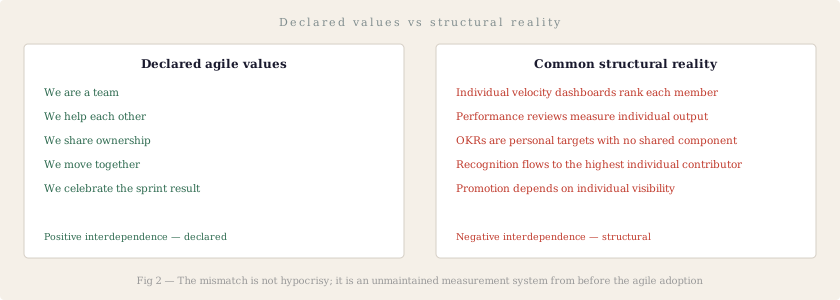
The declared values are cooperative. The structural reality is often competitive. The mismatch is not hypocrisy — it is the consequence of measurement and reward systems designed for individual performance in a context that claims collective ownership.
Declared
We are a team
Structural reality
Individual velocity dashboards rank each member separately
Declared
We help each other
Structural reality
Performance reviews measure individual output, not collaboration
Declared
We share ownership
Structural reality
OKRs are personal targets with no shared component
Declared
We move together
Structural reality
Recognition flows to the highest individual contributor
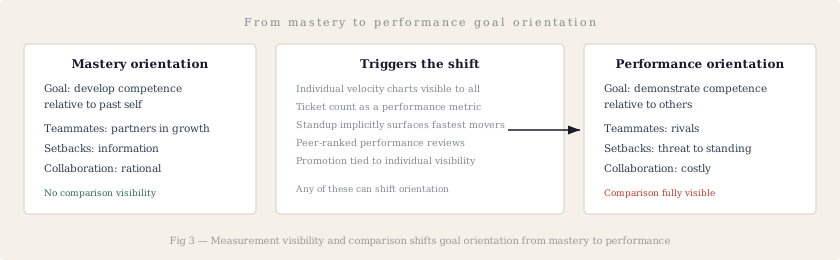
When measurement shifts orientation from mastery to performance
Alongside the goal structure sits a second mechanism. Dweck's goal orientation theory distinguishes mastery goals — developing competence relative to one's own past performance — from performance goals — demonstrating competence relative to others.
Members with mastery goals seek challenge and persist through difficulty because setbacks don't threaten their self-concept. Members with performance goals experience colleagues as rivals: every teammate's success is a relative reduction in their own standing.
Measurement systems trigger the shift. When individual velocity is visible and compared, when tickets closed per sprint is a metric, when the standup implicitly surfaces who moved most — the goal orientation of the room moves from mastery to performance. The values didn't change. The measurement structure changed what each person is actually trying to do.
Five diagnostic questions for coaches
Before coaching individuals on their collaborative behaviour, these questions probe the structural interdependence that shapes it.
If this person helps their neighbour close a blocker, does it help or hurt their own standing?
When the team misses a sprint target, who feels individually exposed and who feels collectively responsible?
What does a performance review measure — what this person achieved, or what the team achieved because of them?
Where does recognition flow — to the team result or to the individual who moved fastest?
Is there any measure in place that goes up when the whole team succeeds and down when any member is struggling?
What changing the structure looks like
Structural changes to interdependence do not require a transformation programme. They require precision about which measurement or reward mechanism is installing negative interdependence and what would replace it with a positively correlated alternative.
Shared sprint goals with collective accountability rather than individual ticket counts. Team-level retrospective metrics alongside individual ones. Recognition that names the contribution to others' success, not only the individual result. Paired code review that makes helping someone else move faster a visible and valued act.
The coach who addresses collaborative values without addressing the goal and reward structure is asking individuals to behave against their structural incentives. That is motivational coaching. Structural diagnosis comes first.
Continue Exploring
Go deeper into the work
The Book
The Art of Creating Self-Organizing Teams
The full framework behind this article — contracting, team dynamics, and practical coaching tools for every stage of the journey.
Companion Toolkit
Resistance Radar & Resilience Scorecard
Practical tools for mapping resistance patterns and measuring whether interventions increased capacity — not just compliance.
TA for Agile
Co-creative TA in Agile Contexts
Ego states, psychological contracts, group imago, and the relational concepts that underpin this article — applied to real teams.