What Agile Cannot Say: Vocabulary, Absence, and the Limits of Coaching Across Cultures
Agile coaching models are built on a specific vocabulary: autonomy, direct feedback, individual voice, productive disagreement. This vocabulary belongs to a cultural context. In communities where the Agile vocabulary is genuinely absent — not blocked but never formed — it cannot be unlocked by insight or permission. The article distinguishes absence from injunction as a diagnostic move.
The safety that didn't help
The coach had been flown in specifically because the organisation recognised a problem. Their Agile transformation in the Singapore office had been technically proficient — the ceremonies were running, the boards were visible, the metrics were tracked. What was not happening was the direct, candid, team-driven conversation that the transformation was meant to produce. Retrospectives were polite and inconclusive. Impediments were not raised. Feedback moved through indirect channels rather than across the team's own meetings.
The standard diagnostic pointed to psychological safety. The coach ran safety workshops. She worked with the team lead on creating conditions for direct feedback. She built trust over weeks of careful work. The team's safety scores improved. The conversations stayed indirect.
The problem was not safety. The problem was vocabulary. The kind of direct, individually attributed, verbally explicit feedback that Agile coaching models treat as the natural product of psychological safety was not absent from this team because it was feared. It was absent because it had never formed — because the social and cultural context this team had developed within did not build that kind of vocabulary, and safety cannot unlock what was never formed.
Vocabulary as a collective frame of reference
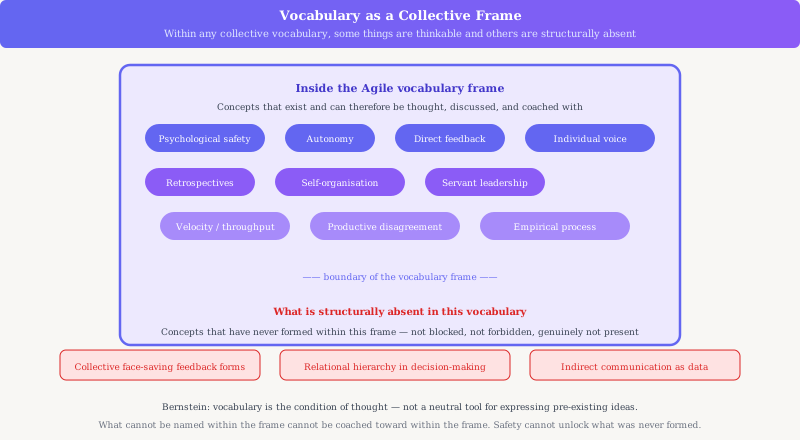
Sedgwick, drawing on Basil Bernstein's sociology of language, treats vocabularies as collective frames of reference — shared systems of categories, concepts, and ways of speaking that make certain things thinkable and others impossible to think within the frame. A vocabulary is not a neutral tool for expressing pre-existing thoughts. It is the condition of the thoughts themselves.
Every community, organisation, and cultural context develops vocabularies suited to the situations it regularly navigates. A community that regularly navigates explicit disagreement develops vocabulary for doing so — ways of naming conflict, frames for productive confrontation, norms about direct attribution of views to individuals. A community that navigates its collective life through consensus-maintenance and indirect communication develops a different vocabulary — equally functional for its own purposes, and without the terms that the first community takes for granted.
The Agile coaching model is built on the vocabulary of the first kind of community. It assumes that direct feedback, explicit individual voice, and productive verbal disagreement are available starting points that safety might need to unlock. In communities where these forms have not developed, they are not starting points. They are goals — and the route to them is not safety but vocabulary building.
The diagnostic move: absence versus injunction
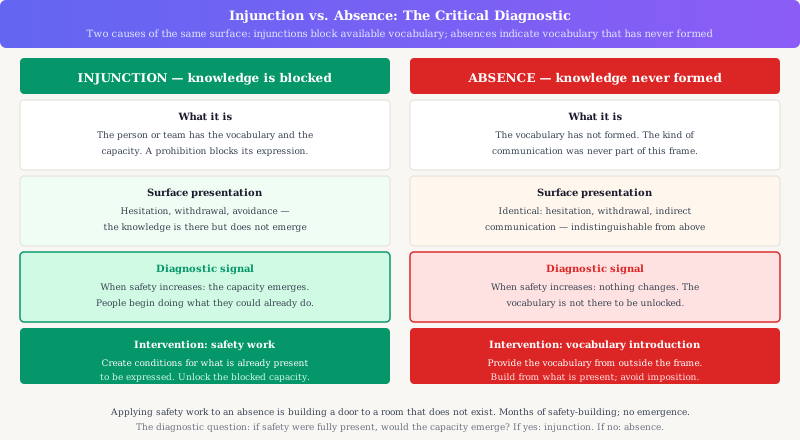
Sedgwick distinguishes between two fundamentally different conditions that produce the same surface presentation: a team that does not engage in direct feedback.
An injunction blocks knowledge that is actually available. The person or team has the vocabulary, has the capacity for the kind of communication the coaching model calls for, but a prohibition — psychological, cultural, or organisational — prevents its expression. The team that knows how to give direct feedback but has learned, through experience, that doing so is costly is operating under an injunction. Safety work, when accurately targeted, can lift injunctions. The knowledge is there; the barrier to its expression is what needs to change.
An absence is different in kind. The vocabulary has not formed. The kind of communication being sought was never part of the frame of reference this community developed. It is not blocked — it simply does not exist in the repertoire. Safety work cannot address absence, because there is nothing to unlock. The absence is structural: no amount of permission can make available what was never formed.
This distinction is diagnostically critical and often missed. Coaches who treat absence as injunction spend months building safety for a door that leads nowhere, because the room on the other side of it does not exist in this vocabulary. The team gets safer — and still does not produce the kind of communication the coaching model expected, because that kind of communication was never available.
What filling an absence requires
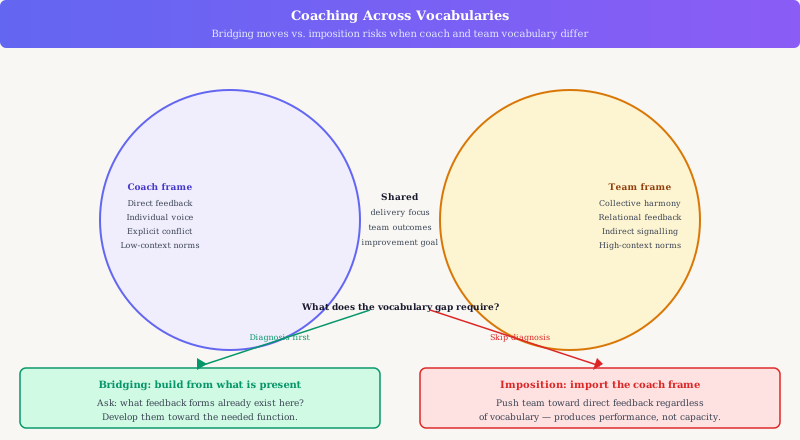
Filling an absence is a different kind of coaching work from lifting an injunction. It requires introducing vocabulary rather than unlocking it — providing, from outside the current frame, the conceptual and linguistic resources that make a new form of communication thinkable. This is not a neutral act. Introducing new vocabulary introduces new possibilities and forecloses others. It reshapes what can be said and therefore what can be thought.
The risk in filling an absence is imposition: providing vocabulary that serves the coach's framework rather than the team's actual situation. A coaching model built for high-individualism, low-power-distance contexts will provide vocabularies that fit those contexts well. Applied to contexts with different structural assumptions, the vocabulary may create new problems even as it addresses the one it was aimed at.
What effective vocabulary introduction looks like is contextually sensitive translation. Not "how do we get this team to give direct feedback the way our model specifies?" but "what forms of feedback this team already practices could be developed in ways that serve the same functions?" The latter question starts from the team's actual vocabulary — building on what is present rather than importing what is absent.
This is slower work than safety-building. It requires the coach to understand the team's existing vocabulary genuinely — to spend time learning how this particular community has developed its ways of navigating collective life — before introducing anything. The temptation, under time pressure and with a clear model of what the desired state looks like, is to skip this step. Skipping it produces the fastest path to a team that has learned to perform the required vocabulary without the underlying capacities that vocabulary is supposed to express.
What happens to sprint patterns when vocabulary is constrained
Sedgwick's account of horizontal games provides a related insight for cross-cultural coaching. Games — patterns that repeat without anyone choosing to repeat them — are generated and sustained by the vocabularies that circulate through a community. When a team is operating within a vocabulary that lacks the terms for a different kind of navigation, the game generated by the available vocabulary will persist even when everyone can see that it is not working.
A team operating within a vocabulary of consensus and indirect communication will generate the horizontal games appropriate to that vocabulary: decisions made by default rather than discussion, impediments resolved by accommodation rather than naming, feedback delivered through channels that protect relational harmony at the cost of clarity. These are not pathological. They are the games available in that vocabulary.
Coaching that treats these games as the products of individual psychology — as avoidance, as fear, as lack of safety — will apply vertical interventions to what is actually a vocabulary-structure problem. The horizontal game will persist because the vocabulary that generates it has not changed. The team can discuss it, agree it needs to change, commit to different behaviour — and return to the game, because the game is the most available navigation path in the vocabulary they share.
What changed for the team in Singapore
The intervention that eventually produced movement was not more safety. It was the identification of feedback forms that already existed in this team's vocabulary — indirect, contextually attributed, embedded in relationship rather than addressed to individuals across a table — and their development into forms that could serve the same function the Agile model specified.
The team's retrospectives shifted in format: less verbal roundtable, more structured written reflection followed by relational conversation. The feedback channels were widened rather than collapsed into a single direct mode. What emerged was not a team that gave feedback the way the model specified — it was a team that had developed its own adequate vocabulary for the functions the model was designed to serve, built from what was actually there.
Agile cannot say everything. Its vocabulary, like all vocabularies, has boundaries — concepts it cannot form within its own terms, questions it cannot ask from inside its own frame. Recognising those boundaries, and developing the diagnostic skill to distinguish absence from injunction, is among the most important capabilities a coach working across cultural contexts can develop. It is the difference between building safety for a door that leads somewhere and building safety for a wall.
Continue Exploring
Go deeper into the work
The Book
The Art of Creating Self-Organizing Teams
The full framework behind this article — contracting, team dynamics, and practical coaching tools for every stage of the journey.
Companion Toolkit
Resistance Radar & Resilience Scorecard
Practical tools for mapping resistance patterns and measuring whether interventions increased capacity — not just compliance.
TA for Agile
Co-creative TA in Agile Contexts
Ego states, psychological contracts, group imago, and the relational concepts that underpin this article — applied to real teams.