Architecture of Anxiety: How Your Sprint Review Became a Status Report
Isabel Menzies Lyth showed in 1960 that nursing procedures in hospitals were not designed to deliver care efficiently — they were designed, unconsciously and collectively, to protect nurses from the unbearable anxiety of caring for suffering patients. The same process produces the sprint review that became a presentation, the retrospective that became a satisfaction survey, and the standup that became a status meeting. These are not facilitation failures. They are architectural adaptations. The ceremony structure is the defence.
The sprint review that kept reverting
The coach had redesigned the sprint review three times. The first redesign replaced the slide deck with a live demo and open discussion. It lasted four sprints before the development lead started preparing a slide deck "just to organise the talking points." By sprint six, it was a slide deck with a live demo embedded in it. By sprint eight, the demo was a screen recording to "save time," and the open discussion had become a Q&A on the slides. It was, functionally, a presentation.
The second redesign introduced structured stakeholder feedback cards. The cards were used once, enthusiastically. They were used half-heartedly a second time. By the third sprint, someone had "forgotten to print them" and the team defaulted to a presentation. The third redesign required each team member to present one item. Within three sprints, the development lead was presenting on everyone's behalf "to keep things tight." The coach had redesigned the ceremony three times. The ceremony had redesigned the coach's interventions once.
Menzies Lyth and the nursing system
In 1960, Isabel Menzies Lyth published a study of a London teaching hospital that remains, more than sixty years later, one of the most penetrating analyses of how organisations manage anxiety. She had been brought in to investigate high staff turnover among student nurses. What she found was not a recruitment problem or a management problem. It was an architectural one.
The hospital had developed, over time, an elaborate set of task procedures: task lists, rotation schedules, and protocols that prevented individual nurses from forming sustained relationships with individual patients. A patient who needed wound care would be attended to by whichever nurse was responsible for wound care at that hour — not necessarily the nurse who had dressed that wound yesterday, or who would dress it tomorrow. The procedures were defended on grounds of efficiency and consistency. They were, Menzies Lyth argued, something else entirely.
Nursing involves sustained encounter with suffering, deterioration, and death. These encounters generate intense anxiety — anxiety that is structurally inherent to the work, not a product of individual weakness or insufficient training. The elaborate task-distribution procedures had been developed, collectively and unconsciously, to prevent nurses from becoming emotionally attached to individual patients and thus from experiencing the full force of that anxiety. The procedures were exquisitely calibrated to manage the anxiety. They were also, consequently, exquisitely calibrated to prevent the kind of sustained care that nursing is actually for.
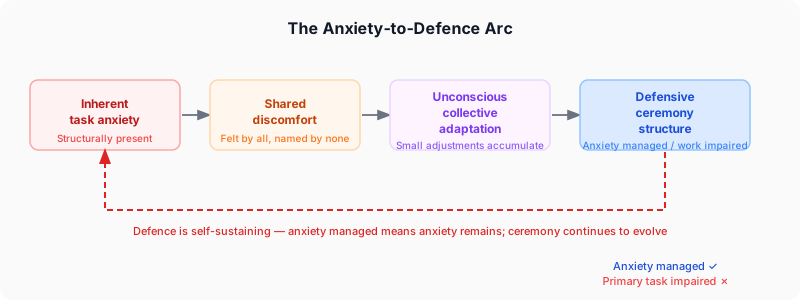
This is what Menzies Lyth called a social defence system: a collectively constructed and maintained set of institutional arrangements designed not to serve the primary task but to defend the individuals doing the primary task from the unbearable anxiety that the task generates.
The translation to Agile ceremonies
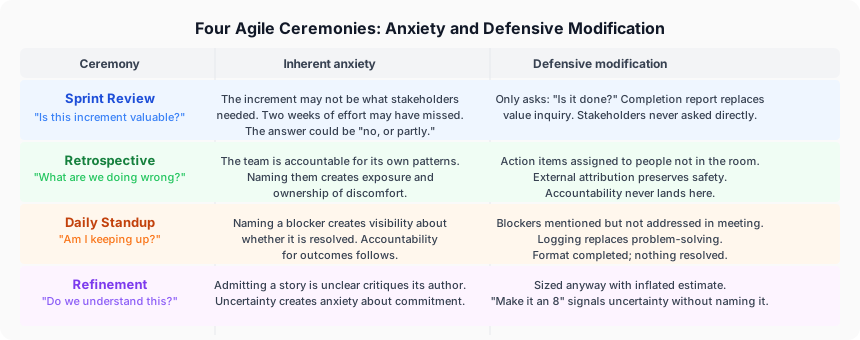
Every Agile ceremony carries an inherent anxiety. The sprint review asks: is this increment actually valuable? This is an anxiety-generating question for anyone who has spent two weeks building something — there is always the possibility that the answer is no, or partly, or "valuable but not what we wanted." The retrospective asks: what are we doing wrong? This surfaces the anxiety of inadequacy, of accountability, of exposing difficulties that naming them might make worse. The daily standup asks: am I keeping up, am I the bottleneck, do I have blockers I cannot admit to? The refinement meeting asks: do we understand this well enough to commit to it? Which is a polite way of asking whether anyone will admit they don't know.
These anxieties are inherent to the work. They cannot be designed away by good facilitation. They can, however, be managed — in exactly the sense Menzies Lyth identified. Ceremonies can be gradually modified, collectively and unconsciously, to approach the anxiety in a diluted enough form that it becomes manageable. The sprint review that never asks whether the increment is valuable — only whether it is complete — has been modified to remove its most anxiety-generating element. The retrospective where action items are always assigned to someone not in the room has been modified to ensure that accountability never lands in the room where the discomfort was generated. The standup where blockers are mentioned but never addressed in the meeting has been modified to make blocker-raising a formality rather than a genuine request for help.
Each of these modifications is rational from the anxiety-management perspective. Each of them damages the ceremony's capacity to serve its primary function.
Four patterns of ceremony as defence
The sprint review that only asks whether it is complete. The ceremony is designed to answer whether the increment is valuable. Asking this question requires opening the possibility that the answer is disappointing — to the team, to the stakeholders, or to the product owner who commissioned the work. Over time, the question shifts. "Is it done?" produces either yes or no, neither of which is anxiety-generating. The ceremony delivers a completion report. Everyone leaves on time.
The retrospective where action items belong to someone else. The retrospective's anxiety is that it surfaces the team's own responsibility for what is not working. Action items assigned to the team feel like admissions. Action items assigned to an external party — management, another team, the product owner — distribute responsibility outward and away from the discomfort. Within a few sprints, the pattern becomes established: we identify things outside our control, we ask others to change, and we reconvene next sprint to note that they haven't.
The standup where blockers are mentioned but not addressed. Naming a blocker in a standup creates an expectation of resolution. Resolution requires visible effort, which creates visibility about whether the effort is working, which creates accountability for outcomes. The defensive modification is to treat blocker-naming as a reporting function rather than a problem-solving function. The blocker is logged. The meeting ends. Everyone has technically done what the format requires.
The refinement where nobody says the story makes no sense. The anxiety of refinement is admitting that a story cannot be sized because it is not well-understood — which is an implicit critique of whoever wrote it. The defensive modification is to size it anyway, using a number large enough to signal uncertainty without naming the uncertainty explicitly. "Let's make it an eight" is a socially acceptable way of saying "we don't understand this" without saying it.
Why format redesign doesn't hold
The coach in the opening vignette was not doing anything wrong by redesigning the sprint review. The redesigns were sensible. The problem was that each redesign addressed the format without addressing the anxiety, and the ceremony's defensive function was not contingent on the format — it was contingent on the anxiety remaining unaddressed.
When a new format is introduced, it briefly engages the anxiety more directly. This is why new formats work for two or three sprints: the novelty itself creates enough engagement to approach the anxiety in a way the old format had stopped doing. But the anxiety is still present. The new format, which now asks real questions that the old format had safely avoided, begins to generate the same discomfort that the old format was modified to prevent. And so the new format is quietly, collectively modified in precisely the direction of the original defence.
This process does not require anyone to be cynical or deliberate. It operates exactly as Menzies Lyth described it operating in the hospital — through countless small adjustments, each of which makes individual sense, each of which contributes to a collective pattern that nobody would endorse if it were made explicit. Teams are extraordinarily creative in modifying formats. They will innovate indefinitely to restore the defensive structure, because the defensive structure is doing real work that the team legitimately needs.
The diagnostic question and three moves
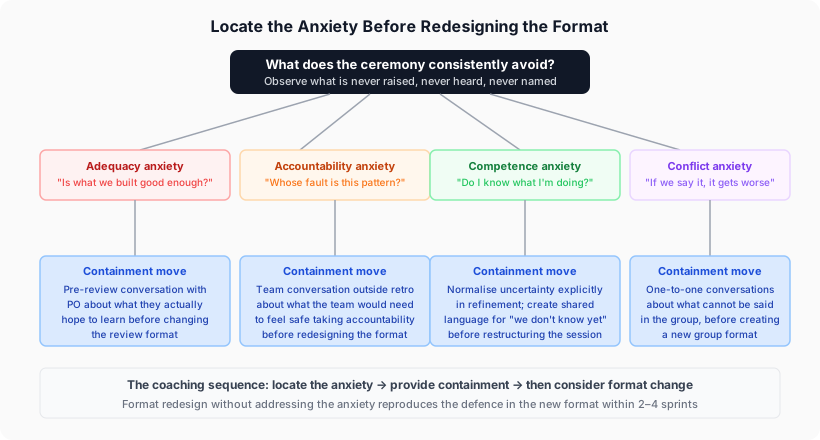
The question that changes the coaching agenda is not "what format would work better?" but "what anxiety is this ceremony protecting the team from approaching?" The answer to that question is what the coach actually needs to address. The sprint review that has become a status report is protecting the team from the anxiety of hearing that what they built was not what stakeholders needed. The retrospective that generates external action items is protecting the team from the anxiety of taking responsibility for their own dynamics. These are different anxieties with different intervention implications.
Locate the anxiety before redesigning the format. This requires a different kind of observation than format assessment. It requires the coach to watch not what the ceremony does but what it consistently does not do — what questions are never raised, what perspectives are never heard, what outcomes are never named. The consistent avoidance is the signature of the anxiety.
Make the defence visible without stripping it away. Defensive structures persist because they are doing something that the group needs. Removing them without providing an alternative is not a coaching intervention — it is an attack on the group's coping mechanism, which will generate exactly the resistance the coach is trying to avoid. Making the defence visible — naming it, tentatively and without shame, as a collective adaptation — begins the work without requiring the group to stop coping before they have another way to cope.
Provide an alternative container before inviting approach to the anxiety. If the sprint review has been modified to avoid the question of value, the coach needs to create a context in which the question of value can be approached — not just insert it into the existing format. This might mean a separate conversation with the product owner about what they are actually hoping to get from the review. It might mean a pre-session with the team about what they are afraid of hearing. The container must be established before the anxiety is approached, or the team will simply modify the format again to exclude whatever the coach has added.
What durable ceremonies actually share
The most durable team ceremonies are not the ones that have been most cleverly facilitated. They are the ones in which the team has developed, over time, a way of approaching the anxiety inherent to their work in doses small enough to be tolerable and sustained enough to be generative. These ceremonies often look unremarkable from the outside — they may not use sophisticated formats or advanced facilitation techniques. What they have is the quality of genuine encounter with the real material.
Building this capacity is slow work. It requires repeated return to the question the ceremony is avoiding, in a context safe enough for the team to gradually increase their tolerance for the anxiety rather than their skill at managing it. It requires the coach to have located the anxiety clearly enough to name it, and to have enough patience not to mistake the temporary success of a new format for the deeper change that has not yet happened.
The sprint review that reverts to a status report has not failed because of insufficient facilitation. It has reverted because the anxiety underneath the ceremony has not been approached. That is the actual coaching agenda.
Continue Exploring
Go deeper into the work
The Book
The Art of Creating Self-Organizing Teams
The full framework behind this article — contracting, team dynamics, and practical coaching tools for every stage of the journey.
Companion Toolkit
Resistance Radar & Resilience Scorecard
Practical tools for mapping resistance patterns and measuring whether interventions increased capacity — not just compliance.
TA for Agile
Co-creative TA in Agile Contexts
Ego states, psychological contracts, group imago, and the relational concepts that underpin this article — applied to real teams.