You Cannot Facilitate Your Way Out of a Double Bind: Argyris and Organisational Defence Routines
The retrospective surfaces the issue. Everyone agrees it is a problem. Action items are assigned. Three sprints later, the issue is back. This is not a facilitation failure. It is a defence routine operating exactly as designed. Chris Argyris spent half a century studying why smart people in organisations consistently prevent themselves from learning — and what it would take to stop.
The issue that keeps coming back
The retrospective surfaces the same issue it surfaced last month. The team agrees it is a problem. Action items are assigned. The coach facilitates well — good use of silence, balanced participation, genuinely useful reframes. People leave feeling heard. Three sprints later, the issue is back, stated in almost exactly the same form, with the same people making the same observations and arriving at the same conclusions.
The natural interpretation is that the team is not following through. Or that the facilitation needs to be better. Or that the action items need owners and deadlines. These interpretations share a common assumption: the problem is a surface-level failure of execution. Fix the execution and the pattern breaks.
This assumption is the problem. The issue is not coming back because the team is not trying. It is coming back because the system that produces it has not been touched. The retrospective action items are addressing outputs. The defence routine that generates those outputs is operating perfectly, untouched, beneath the surface. This is what Chris Argyris spent fifty years describing.
What Argyris spent fifty years studying
Chris Argyris, the organisational psychologist who worked at Harvard Business School until his death in 2013, built his career around a single observation: organisations consistently behave in ways that prevent learning, even when they sincerely say they want to learn. The more sophisticated the organisation, the more sophisticated its defences against the kind of learning that would actually change it.
His central conceptual tool was the distinction between espoused theory — what individuals and organisations say they do, the values they articulate, the principles they claim — and theory-in-use, the actual rules governing their behaviour, which can only be inferred from what they do rather than what they say. Most people, Argyris found, have limited access to their own theory-in-use. When their behaviour contradicts their espoused theory, they are typically unaware of the contradiction.
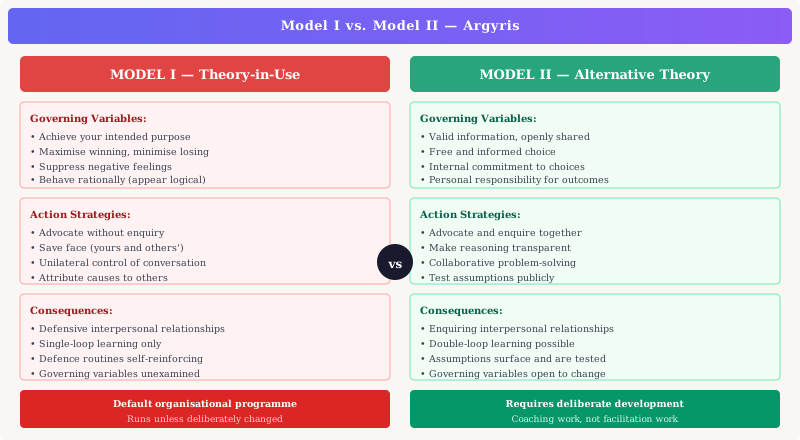
What makes this especially important for Agile coaches is that most organisations' theory-in-use turns out to be remarkably similar to each other. Argyris called it Model I, and he found it operating across industries, cultures, hierarchies, and organisational types. It is not a dysfunction specific to particular organisations. It is the default programme that organisations run unless they have done deliberate work to develop something different.
Model I: the governing theory of most organisations
Model I is defined by four governing variables — the values that the theory-in-use is trying to satisfy. Achieve your intended purpose. Maximise winning and minimise losing. Suppress negative feelings. Behave rationally. Each of these sounds reasonable in isolation. Together, they produce a system that cannot learn.
Achieving your intended purpose means staying committed to pre-formed conclusions. Maximising winning means treating challenge as threat. Suppressing negative feelings means keeping difficult truths below the surface. Behaving rationally means maintaining the appearance of logic even when the underlying reasoning is advocacy dressed as enquiry. The result is what Argyris called single-loop learning: the organisation adjusts its actions when outcomes are wrong, but never examines the governing assumptions that produced the actions.
The retrospective that produces action items without examining why those actions keep being needed is a perfect Model I artefact. The ceremony is there. The participation is there. The good intentions are there. What is not there is any examination of the governing variable — the assumption, policy, or structural condition that makes the problem recur. Action items address outputs. The governing variable produces the next set of outputs undisturbed.
The four rules of organisational defence
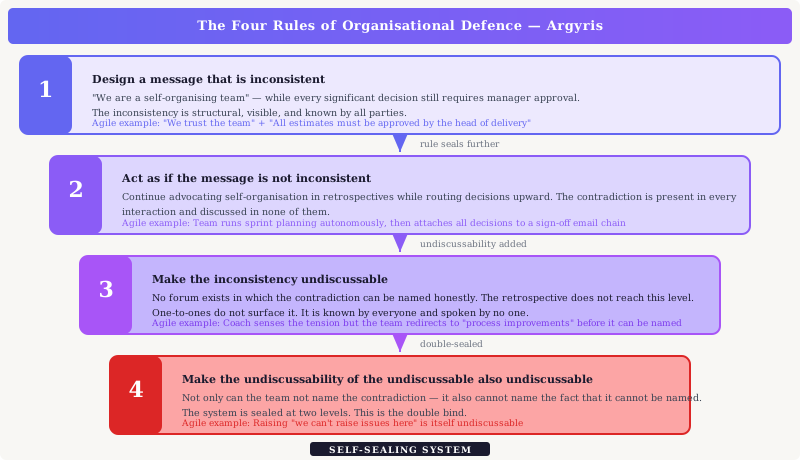
Argyris described how Model I produces organisational defence routines — habitual patterns that protect the organisation from examining its own contradictions. He identified four rules that together make these routines self-sealing.
The first rule: design a message that is inconsistent. An Agile organisation announces that it values self-organisation and then requires every significant decision to pass through a manager's sign-off. The inconsistency is structural and visible. But it is not named.
The second rule: act as if the message is not inconsistent. The team continues to behave as if self-organisation is real, advocating for it in retrospectives, referencing it in principles documents, while simultaneously routing every decision upward. The contradiction is present in every interaction and discussed in none of them.
The third rule: make the inconsistency undiscussable. No forum exists in which the team can honestly say "we claim to be self-organising but are not." The retrospective does not reach this level. One-to-ones do not surface it. It is known and unspoken.
The fourth rule: make the undiscussability of the undiscussable also undiscussable. Not only can the team not name the contradiction — it also cannot name the fact that the contradiction cannot be named. The system is sealed at two levels. This is the double bind: the team is held inside a structure it cannot examine and cannot admit it cannot examine.
Why facilitation alone cannot resolve this
This is a point worth dwelling on, because it directly challenges the implicit model behind most Agile coaching practice. Christine Thornton puts it plainly: facilitation alone cannot resolve undiscussability. A facilitator may help by highlighting inconsistencies. This is a short-term fix, and the group reverts to old habits as soon as the facilitator is gone.
The logic is simple. The facilitator is external to the system and disappears at the end of the session. The defence routine is internal and remains. A skilled facilitator can create a temporary opening — can surface a contradiction that was previously undiscussable, can model a quality of enquiry that is different from the group's habitual mode. But the group will return to its theory-in-use the moment the external container is removed.
This is precisely why the issue comes back in the retrospective three sprints later. The facilitation worked. The conversation was better than it would have been without it. But the governing variable — the actual belief, policy, or structural condition that makes the issue recur — was not touched. It remains in place, producing the same outputs, waiting to surface in the next retrospective.
Double-loop learning: what it actually requires
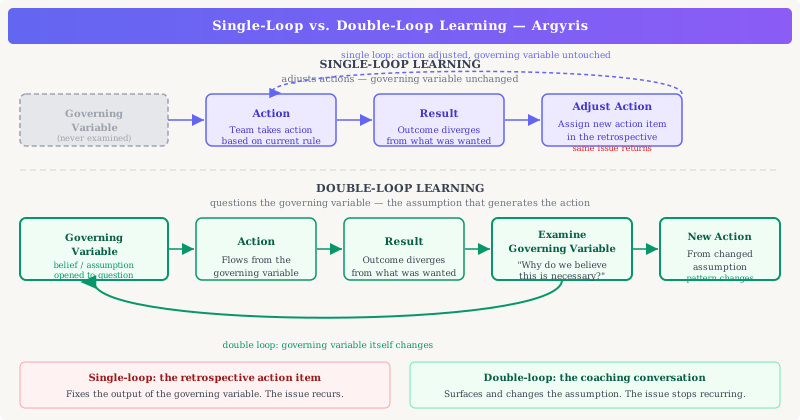
Double-loop learning is Argyris's term for the learning that changes the governing variable rather than just the action. Single-loop learning asks: given our current objectives and assumptions, what should we do differently? Double-loop learning asks: are these objectives and assumptions themselves the right ones?
The sequence double-loop learning requires is demanding. First, the team needs to surface its theory-in-use — which means naming the actual operating assumptions, not the espoused ones. This is the step the team will resist, because the theory-in-use is typically something the team has some awareness of and has chosen not to name. Surfacing it feels like accusation.
Second, the inconsistency between espoused theory and theory-in-use needs to be named directly. This is the step that will be resisted most strongly. The defences exist precisely to prevent this naming. The team may intellectualise, deflect, reframe, or turn the conversation toward practical next steps before the naming has actually occurred.
Third, the assumption behind the inconsistency needs to be questioned: not just "we say X but do Y" but "why do we believe that Y is necessary?" This question generates significant discomfort. If the answer were comfortable, the assumption would already have been examined. The discomfort needs to be sustained long enough for a new pattern to form. This is not facilitation work. It is coaching work, conducted over time, in relationship.
What team coaching can do that facilitation cannot
A facilitator enters and exits. A coach who works across multiple sessions with the same team has something the facilitator does not: a relationship with the defence routines over time. They have seen the pattern before. They know which undiscussable topic the team reliably approaches and then veers away from. They have a working hypothesis about what the governing variable might be. And they have a relationship with the team members that makes it possible — eventually — to name what the team keeps circling.
The coaching relationship can function as a container for the anxiety that undiscussability is managing. Defence routines exist because something feels too dangerous to examine. What makes it feel dangerous is almost always some version of the same fear: that if this is named, the consequences will be unmanageable. The coach's sustained presence over time provides evidence that naming does not destroy the group. This is not achieved in a single session.
This requires medium-to-long-term engagement. A coach commissioned for a series of retrospectives has limited access to these dynamics. A coach working with a team over six months, across different types of sessions, who has the trust that comes from sustained presence — that coach can begin to do the work that reaches the governing variable.
The coach's own risk
Argyris noted something that coaches are often reluctant to hear: inexpert or unreflective attempts to modify theory-in-use can actually reinforce it. A coach who challenges a defence routine without sufficient understanding of what it is protecting can produce a more rigid defence. A coach who believes they are modelling Model II while actually operating from Model I — winning arguments about double-loop learning, suppressing their own uncertainty, achieving their intended purpose of getting the team to change — will teach the team nothing new.
This is not a peripheral risk. It is the central one. The coach who presses hard in a retrospective on "why does this keep happening?" while privately feeling contempt for the team's defensiveness is operating from Model I while facilitating a conversation about it. The team will sense this, and the defence routine will incorporate the coach into its logic.
The practical implication is that coaches working with defence routines need supervision and reflective practice. Not as professional hygiene, but as functional necessity. The coach needs an outside relationship in which their own theory-in-use in this work can be examined — because it is operating, and if it is not examined, it will be managed at the expense of the work. The coach who cannot name their own inconsistencies is not well positioned to help the team name its.
The issue isn't the issue
The issue that keeps appearing in retrospectives is not the problem. It is the symptom of a governing variable that has not been touched. The defence routine surrounding that variable has been refined over years to be robust, self-sealing, and largely invisible to the people inside it. Better facilitation will produce better action items. The action items will not change the governing variable. The issue will return.
Facilitation reaches the surface. Coaching can go deeper — but only if the engagement is long enough to build a working relationship with the defences, sustained enough to hold the discomfort when the governing variable is finally approached, and honest enough for the coach to examine their own theory-in-use alongside the team's.
You cannot facilitate your way out of a double bind. You can only coach your way out — and only if you are willing to stay in the discomfort long enough.
Continue Exploring
Go deeper into the work
The Book
The Art of Creating Self-Organizing Teams
The full framework behind this article — contracting, team dynamics, and practical coaching tools for every stage of the journey.
Companion Toolkit
Resistance Radar & Resilience Scorecard
Practical tools for mapping resistance patterns and measuring whether interventions increased capacity — not just compliance.
TA for Agile
Co-creative TA in Agile Contexts
Ego states, psychological contracts, group imago, and the relational concepts that underpin this article — applied to real teams.