The Meeting Belongs to the Group: Beginnings, Endings, and What Sprint Ceremonies Don't Hold
The first five minutes of a team meeting set the ceiling on what is possible for the next fifty. The last five determine whether anything learned will transfer beyond the room. Sprint planning and retrospectives are beginnings and endings — but most Agile frameworks treat them as content containers, not relational thresholds.
The meeting starts before it has begun
A coach joins a sprint planning session. People are already on their laptops. Someone shares their screen without any acknowledgement of the group that has assembled. No one checks in. The facilitator names the first backlog item before half the attendees have found the meeting link. The meeting begins at its content before it has begun as a meeting.
Three hours later, nothing has been committed to. The team has talked around the tickets without landing anywhere. People are visibly disengaged by the second hour. There are side conversations in chat. The session ends without closure — someone has a hard stop and drops off, others follow, and whatever remained unresolved evaporates into Slack.
The problem that produced this outcome began in the first two minutes. The meeting that doesn't know it has started cannot know when it is over. And the team that never arrived together cannot work together. This is not a facilitation problem or a prioritisation problem. It is a boundary problem — and understanding it requires understanding what group boundaries actually do.
What beginnings actually establish
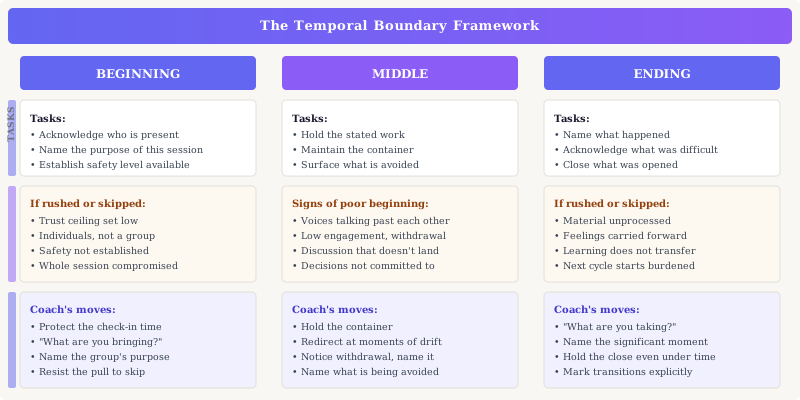
The opening moments of a group session are not ceremonial. They establish three things that determine the quality of everything that follows: who is present and acknowledged; what the group is here to do; and the level of psychological safety available for the work.
Gregory Bateson observed that a system needs to know it exists before it can act as a system. This is precisely what a proper beginning accomplishes. When a meeting opens with a check-in — even a brief one — it sends a signal: we are a group, and we are here. It activates the group as a social entity rather than a collection of individuals who happen to share a calendar event. The acknowledgement of presence is not a nicety. It is the condition for joint work.
What a rushed beginning actually communicates — however unintentionally — is that the content is more important than the people producing it. That the work of arriving is not worth time. That whatever is happening in the room around feelings, distractions, or readiness is not the group's business. People receive this message and behave accordingly: they stay at the surface, they don't raise uncomfortable questions, they don't surface the uncertainty they are carrying.
The trust ceiling is set in the beginning. If the beginning is rushed or skipped, the ceiling is set low, and it stays there for the duration of the session — regardless of the facilitator's skill in the middle.
What middles require
The middle of a session is where the stated work happens. But the middle inherits everything from the beginning. A group that has arrived well — acknowledged, oriented, given enough safety — can move into difficulty, disagree productively, and carry multiple perspectives at once. A group that has not arrived is working from behind from the moment the first agenda item appears.
The signs of a poor beginning visible in the middle are consistent: people talk past each other, repeating themselves without being heard. Engagement is low. One or two voices dominate while others have effectively withdrawn. Discussions fail to move anywhere — the team circles the same point without reaching resolution. Decisions are nominally made but not actually committed to. Someone says "OK so we agree?" and several people say "mm" and the call ends.
None of this is mysterious once you understand the beginning's function. The group did not become a group. It went straight to the task while remaining a collection of individuals. Individual voices compete. There is no shared container to hold a real disagreement. There is no trust available to say the uncomfortable thing. The middle reflects exactly what the beginning permitted.
What endings actually do
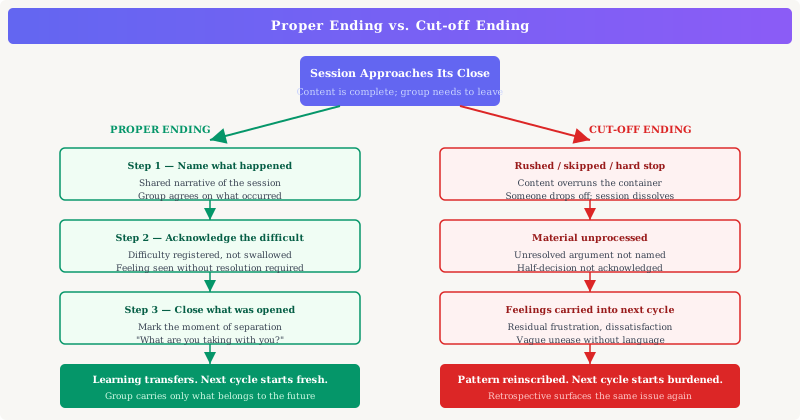
If beginnings establish whether the group can work together, endings determine whether anything transfers from the work. A proper ending does three things: it names what happened (so the group has a shared narrative of the session), it acknowledges what was difficult (so the difficulty is registered rather than swallowed), and it closes what was opened (so the group can actually leave rather than carry unfinished material out the door).
An improper ending — cut off by a hard stop, rushed because the content overran, or simply skipped — leaves material unprocessed. Members leave carrying feelings that have nowhere to go: the frustration of the unresolved argument, the dissatisfaction of the half-decision, the vague unease of something that was raised but not responded to. These feelings do not disappear. They are carried into the next meeting, the next sprint, the next conversation with a colleague in the corridor.
The group reconvenes next sprint carrying last sprint's unfinished emotional business. The retrospective that opens with residue from the previous one is working with a double agenda: the stated one and the accumulated one. This is partly why some teams find that retrospectives repeatedly surface the same issues. The content hasn't changed because the previous ending didn't process it.
Sprint ceremonies as beginnings and endings
The Agile ceremonies are not merely process checkpoints. They are, in group-analytic terms, the formal boundaries of the team's work cycle. Understanding them as boundaries — not just as meetings — changes what the coach attends to.
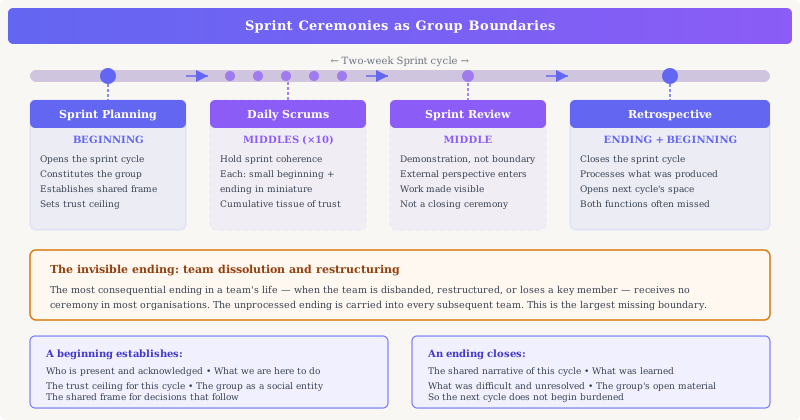
Sprint planning is a beginning. It opens two weeks of collaborative work. It is where the team constitutes itself as a unit, agrees what it is trying to accomplish together, and establishes the shared frame within which decisions over the coming fortnight will be made. When sprint planning is conducted purely as a scheduling exercise — who picks up which ticket — this constitutive function is lost.
The retrospective is an ending. Its primary function is to close the sprint — not by writing action items, but by processing what the cycle produced: what was learned, what was lost, what was difficult. The retrospective is also a beginning: it opens the space from which the next cycle will grow. When it is reduced to a facilitated activity with coloured stickies and a list of fixes, both functions are missed.
The daily scrum is a middle — or rather, a series of middles, each one small enough to be skipped without consequence, each one cumulatively important as the tissue that holds the sprint together. The sprint review is a middle too: a demonstration of the work produced, not a boundary event. The most consequential ending in a team's life — dissolution, restructuring, the departure of a key member — typically receives no ceremony at all.
The psychological dimensions of endings
Endings are psychologically complex in ways that have nothing to do with process. Every ending activates a cluster of experiences: loss (even small losses, like the end of a sprint, echo larger ones), dependency (will the group reconvene as the same entity?), and a question about the reality of what happened (did this work matter, were these relationships real?). These experiences are normal, and they are largely unconscious. They are also the reason endings get rushed.
Rushing an ending is an avoidance of these feelings. If the meeting ends before it ends — before the group acknowledges what happened — no one has to sit with the loss, the dependency, or the question. The protection is real and understandable. But the feelings don't disappear; they accumulate. And accumulated unfelt endings complicate future beginnings.
This is partly why newly formed teams so reliably recreate patterns from their previous teams. They carry the unprocessed endings of whatever came before. The team that "doesn't trust each other yet" may not be describing this team's relationships so much as importing the residue of the last team's insufficient endings. The patterns that seem to arrive fully formed in a new team's first month are the endings that were never made.
What coaches can do at boundaries
The practical work at beginnings is explicit arrival. A check-in does not need to be long — two minutes of "what are you bringing into the room today?" is enough to accomplish the constitutive function. What it requires is the coach's willingness to protect that time when the pull is to skip it. The pull is always there. Time is tight. The content is urgent. The check-in feels soft. The coach's job is to hold the line — not as a ritual, but because they understand what is being established.
The practical work at endings is deliberate closure. "What are you taking with you?" is the ending equivalent of the beginning's check-in. It externalises the transfer question — it makes the group name what it is carrying forward — and it marks the moment of separation. If something significant happened in the session (a real disagreement, a difficult decision, an emotional moment), the ending needs to name it. Not to resolve it, necessarily, but to acknowledge that it occurred.
At significant transitions — a team member leaving, the end of a coaching engagement, a restructuring that changes the team's composition — the coach should insist on ceremony even when the organisation resists it. These are large endings. The team will carry them regardless of whether they are marked. Marking them gives the group a chance to process them rather than simply absorb them.
There is a specific coach move at the moment when time pressure threatens to cut off the ending: name what is happening. "We have three minutes — let's use them to close properly rather than drift off." This is a boundary intervention in real time. It signals that the coach holds the boundary even when the content has consumed the container.
The meeting belongs to the group, not to the agenda. The agenda is the content. The group needs to arrive before it can work with the content, and it needs to leave before it can carry what it has learned. The coach's job at boundaries is not to add ceremony for its own sake. It is to help the group arrive, work, and leave — in that order, with each transition held deliberately. Without the beginning, there is no real middle. Without the ending, the work has nowhere to go.
Continue Exploring
Go deeper into the work
The Book
The Art of Creating Self-Organizing Teams
The full framework behind this article — contracting, team dynamics, and practical coaching tools for every stage of the journey.
Companion Toolkit
Resistance Radar & Resilience Scorecard
Practical tools for mapping resistance patterns and measuring whether interventions increased capacity — not just compliance.
TA for Agile
Co-creative TA in Agile Contexts
Ego states, psychological contracts, group imago, and the relational concepts that underpin this article — applied to real teams.