The Coach's Frame of Reference Has Gaps Too
Psychodynamic and TA traditions address the coach's involvement through countertransference — personal history activated in the present. Sedgwick adds a different dimension: cognitive vulnerability is irreducible for everyone, including the coach. The coach's frame of reference has absences shaped by their own social context, vocabulary, and cultural history.
The pattern neither of them could see
The coach had been working with the team for nearly a year. She was skilled. Her supervision practice was regular. She had developed real clarity about the team's dynamics — the shadow election that had placed one member in the carrier role, the avoidance pattern that made certain topics unspeakable, the dependency dynamic in the team's relationship to its product owner.
What she had not seen — what supervision over many months had not surfaced — was a structural pattern in how the team's authority over its own process was progressively ceded. It happened gradually, in small decisions that felt reasonable at the time. It happened in a way that aligned with a framework both the coach and the team shared — a framework in which process authority naturally resided at the product ownership layer. The pattern was invisible because it was invisible to both of them equally. It was in both their shared blind spot.
A new coach joining the system saw it almost immediately. Not because she was more skilled. Because she came from a different background, with a different frame of reference, and the pattern was therefore visible in the gap between her vocabulary and the team's shared one.
What countertransference does not capture
The psychodynamic and TA traditions have developed sophisticated accounts of how coaches become implicated in what they are working with. Countertransference — the coach's own psychological material activated in response to the client system — is the central concept: the coach's history, their unresolved patterns, their personal vulnerabilities, all of which shape their perception and response to the team.
This is a genuine and important phenomenon. Coaches who work with their own countertransference — who can distinguish their reaction to a team from the team's projection, who can use their emotional response as diagnostic data about what is happening in the system — are more effective and less likely to enact dynamics they have not examined. Supervision, at its best, is the space where countertransference is worked with.
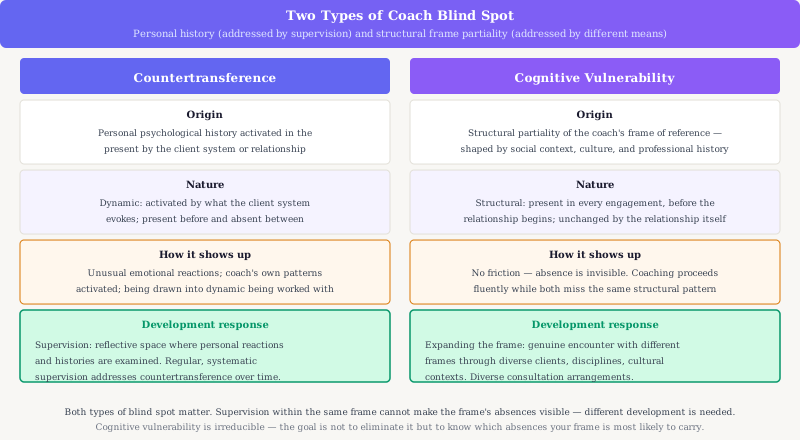
Sedgwick adds a different dimension that countertransference does not capture. The coach's frame of reference has absences shaped not by their personal history but by their social context, cultural background, and the vocabularies they have inhabited. These absences are not activated by the client system — they are structural features of the coach's particular view of the world, present before the coaching relationship begins and unchanged by the relationship's development. They are not personal. They are contextual.
Cognitive vulnerability as irreducible
Sedgwick's term for this structural partiality is cognitive vulnerability. Every person, including every coach, inhabits the world from within a particular frame of reference — a particular vocabulary, cultural context, and set of organising assumptions — that makes some things visible and leaves others in darkness. Cognitive vulnerability is not a deficiency to be corrected. It is a structural feature of being a situated, particular human being rather than a view from nowhere.
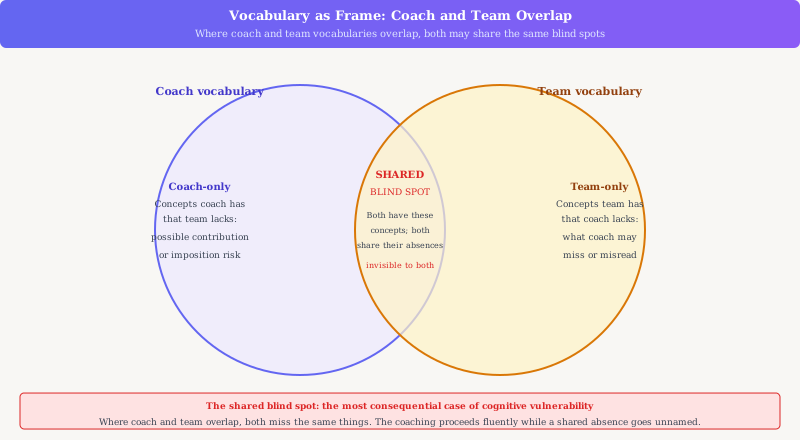
The coach reads the team through their frame. Where the coach's vocabulary aligns with the team's vocabulary, both will share the same absences — the things neither can see because neither has the conceptual resources to make them visible. Where the coach's vocabulary differs from the team's, there is the possibility of genuine contribution: the coach can name what the team cannot name because they bring a different frame. But there is also the possibility of imposing a frame that does not fit — of reading the team through a lens calibrated to a different kind of situation.
This is why coaching across cultural, social, or professional contexts requires something that neither skill development nor personal growth fully provides. A highly skilled coach who shares the team's cultural background will have rich sensitivity to the dynamics within that shared frame — and the same blind spots the team has, at precisely the points where those blind spots matter most. A coach from a different cultural background will see differently — sometimes generatively, sometimes through a distorting lens. The difference is not about competence. It is about the structure of situated knowledge.
The shared blind spot: the most consequential case
The most consequential case of cognitive vulnerability is the shared blind spot: when the coach's frame of reference overlaps sufficiently with the team's that both miss the same things. This is not uncomfortable. It is invisible. There is no friction to signal that something is being missed. The coaching proceeds fluently, the relationship feels productive, and the shared absence goes unnamed because neither party has the vocabulary to name it.
The coach in the opening example shared with the team a particular understanding of process authority in Agile contexts — an understanding shaped by the frameworks and communities of practice both had inhabited. Within that shared frame, the progressive ceding of team autonomy was invisible because it conformed to assumptions both held. Neither the coach's countertransference work nor the team's retrospective practice surfaced it, because the category — team authority over process as a thing that can be progressively lost — was not available in either vocabulary.
Supervision addressed countertransference — the coach's personal reactions — but could not address what was absent from the frame she and her supervisor shared. The frame itself was the problem, and supervision within the same frame cannot make the frame's absences visible.
What development addresses cognitive vulnerability
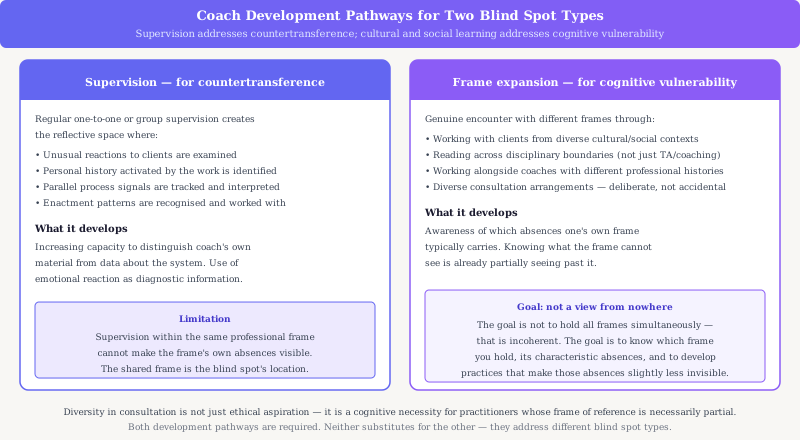
If countertransference is addressed through supervision — the reflective space where a coach's personal reactions and histories are examined — cognitive vulnerability requires a different kind of development response. The goal is not to become a view from nowhere (that is impossible) but to expand the frame enough that its absences become partially visible.
This happens, most reliably, through genuine encounter with different frames. Working with clients from different cultural, professional, or social contexts than one's own. Reading across disciplinary boundaries — not just the coaching and TA literature but philosophy, sociology, and organisational theory from traditions different from the mainstream practitioner culture. Working alongside coaches with substantially different professional histories, whose vocabulary includes things one's own does not.
Each genuine encounter with a different frame creates the possibility — not the certainty — of seeing something that was previously invisible. The coach who has worked in hierarchical organisations knows things about that culture that the coach who has only worked in start-ups does not, and vice versa. The coach trained in a psychodynamic tradition sees things in group dynamics that the coach trained purely in Agile frameworks does not, and vice versa.
The development implication is not to try to hold all frames simultaneously — that is incoherent as an aspiration. It is to know which frames you hold, to have some sense of their characteristic absences, and to develop practices that make those absences slightly less invisible. Diversity in consultation arrangements is not just an ethical aspiration. It is a cognitive necessity for practitioners whose frame of reference is necessarily partial.
A more honest account of the coaching relationship
Sedgwick describes the therapist — and by extension the coach — as a co-pilot rather than a map-holder: someone navigating the same uncertain territory as the client, with a different frame but not a privileged one. This is a more honest account than the implicit positioning of the coach as the person with the clearer view who helps the team see what it cannot.
The coach has a different view. That different view enables genuine contribution — things visible from the coach's frame that are not visible from within the team's. But the different view also means that the coach has different absences. Working honestly with cognitive vulnerability means holding both: the genuine contribution that a different frame enables and the genuine limitation that every frame imposes.
The first coach in the opening example was not less skilled than the second. She was embedded in a shared frame with the team, which gave her deep insight into some of what was happening and left her blind to the structural pattern that the shared frame made invisible. That is not failure. It is the irreducible structure of situated knowledge. Understanding it is the beginning of the kind of practice that is honest about what coaching can and cannot see.
Continue Exploring
Go deeper into the work
The Book
The Art of Creating Self-Organizing Teams
The full framework behind this article — contracting, team dynamics, and practical coaching tools for every stage of the journey.
Companion Toolkit
Resistance Radar & Resilience Scorecard
Practical tools for mapping resistance patterns and measuring whether interventions increased capacity — not just compliance.
TA for Agile
Co-creative TA in Agile Contexts
Ego states, psychological contracts, group imago, and the relational concepts that underpin this article — applied to real teams.