Communitas Is Not Team Building: Why Offsites Leave Everything Unchanged
Organisations invest heavily in team events and offsites under the assumption that shared experience creates cohesion. More often, the team has a pleasant time and returns to exactly the same dynamics on Monday. Victor Turner's communitas — the quality of genuine equality and shared humanity that forms only in liminal space — is not the same thing as team building. The difference is not the activity. It is whether anyone actually crossed a threshold.
The half-life of three days
The escape room was a success by every available measure. Everyone participated. There was genuine laughter and some genuine problem-solving. The debrief surfaced something real about how the team communicates under pressure. On the way back, on the bus, people talked differently than they usually do — with less positioning, more directness, a quality of actual interest in each other.
By Thursday, in the sprint planning, it was as if it had never happened.
The team lead reports this to the coach with a familiar frustration. They had hoped the event would shift something durable — that the different quality of connection on the bus would transfer into the meetings that mattered. It didn't. The coach, internally, knows exactly what happened: the event was well designed and genuinely enjoyable, and it was not the right kind of thing to produce the kind of change the team lead had in mind.
Victor Turner, the anthropologist who spent his career studying ritual transformation in human societies, would have recognised this immediately. He had a specific term for the difference between experiences that produce genuine transformation and experiences that feel like they might but don't. The first he called liminal. The second he called limonoid. Most team building is limonoid. This is not a failure. It is a category error.
What communitas actually is
Turner introduced the concept of communitas to describe a specific quality of relationship that emerges within genuine liminal space — the kind of space created by real rites of passage, by the crossing of genuine thresholds, by the deliberate and structured suspension of social identity.
Communitas is not team cohesion. It is not warmth. It is not rapport. It is the quality of connection that forms when people are stripped of the social structures that usually mediate their relationship — when they are relating to each other not as Scrum Master, Product Owner, senior engineer, new hire, or stakeholder representative, but as what Turner calls "human totals": human beings without their social packaging. It has the quality of what the sociologist Robert Hall called "a basic oneness with humanity" — a felt sense of shared humanness that goes beyond the relationships of everyday organisational life.
This is the quality that teams occasionally touch in moments of genuine crisis — when everything is at stake and the usual social hierarchies are temporarily irrelevant and people discover an unexpected closeness. It is also what teams sometimes find in the genuine retrospective that breaks through the usual format and gets to something real. It is rarely what they find in the escape room.
The crucial characteristic of communitas is that it cannot be manufactured. Turner is explicit about this. Communitas can only emerge under conditions that are created for it — and its arrival is not guaranteed. Attempts to produce it directly, through structured exercises designed to generate warmth and openness, tend to produce the performance of communitas: a declared connection that satisfies the social requirement without the actual experience of it.
The persona problem: why role doesn't disappear at the paintball range
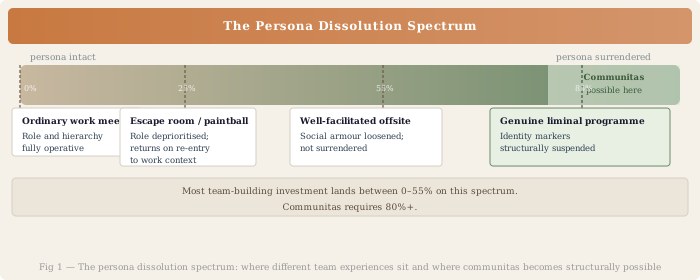
The obstacle to communitas in most team-building activities is the persona: the social role and the identity structures attached to it. When teams go to an escape room or a paintball range or a cooking class, they go as themselves in the full sense — they bring their organisational identities with them. The hierarchy is still present. The person who holds the most positional power still holds it, even if they are pretending to look for clues in a puzzle room. The junior team member is still junior. The person who is slightly on the margins of the group is still on the margins.
The activity creates a temporary context in which the role is somewhat less salient than usual. This produces the quality on the bus: a loosening of the usual social armour, a slightly more direct quality of conversation. But the persona has not been surrendered. It has been temporarily deprioritised. The moment the team returns to the work context, the persona reasserts itself completely, because it was never genuinely set aside.
Turner's description of genuine liminal space makes clear what would be required for the persona to actually be set aside: a structured separation from the ordinary social context, explicit ritual markers that signal that the usual rules of status and identity are suspended, and a container strong enough to hold what emerges when people relate to each other without those protections. None of these are present in a team offsite designed around enjoyable activities and good food.
What limonoid means and why it explains so much
Turner coined the term limonoid to describe experiences that have the feel and energy of liminality without its structural conditions. They are exciting, sometimes intensely so. They produce a sense of departure from the ordinary. They may generate ideas, restore energy, and create temporary closeness. But because they lack the genuine container and the genuine threshold, they cannot produce the lasting transformation that liminal experiences produce.
Limonoid experiences are not worthless. A team that is depleted and needs restoration may genuinely benefit from a well-designed offsite that is explicitly positioned as restoration rather than transformation. A team that needs to generate ideas in a different environment benefits from a change of context. A team that has never done anything together outside of work may genuinely benefit from a shared experience that creates some relational warmth.
The problem is when limonoid experiences are funded and expected to produce transformation. This mismatch — between what the experience is structurally capable of producing and what the organisation hopes it will produce — generates the familiar cycle of investment and disappointment. The escape room is followed by two days of improved dynamics and then a return to baseline, and the team lead concludes that team building doesn't work. Team building works. It does what limonoid experiences do: it stimulates, connects, and energises temporarily. It does not create communitas. It was never going to.
Conditions that allow communitas to form
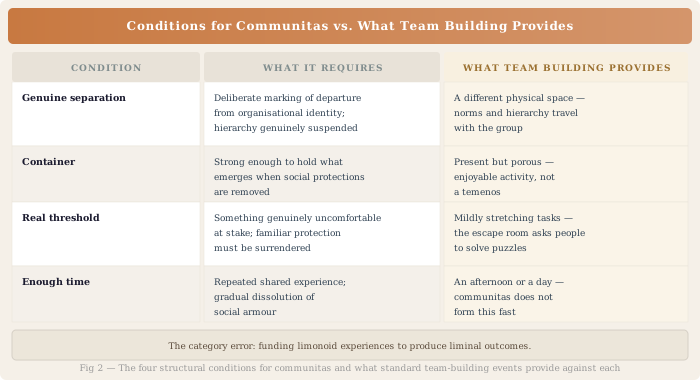
These conditions are structural, not programmatic. They cannot be produced by designing a better activity.
A genuine separation from the work context. Not just a different physical space, but a deliberate marking of departure from organisational identity. Participants need to understand that something different is being asked of them here — that the usual rules of hierarchy and role are genuinely suspended for the duration.
A container that can hold what emerges. When social protections are set aside, things surface that were being contained by those protections. The container needs to be strong enough to hold that material — which means the group needs some experience of working together in difficulty before it can be trusted with the more vulnerable territory that communitas requires.
A threshold that is real. Something must be at stake in the crossing. The team must be asked to genuinely set aside something — a familiar protection, a habitual stance, a social role — in order to participate. This requires the event to ask something genuinely uncomfortable of people, not something mildly stretching. The escape room asks people to solve puzzles. Communitas asks people to be seen.
Enough time. Communitas does not form in an afternoon. It requires repeated shared experience in the liminal space, a rhythm that allows the container to consolidate, and the gradual dissolution of the social armour that people maintain even when they are trying to be open.
What this means for how you design team events
The practical implication is a clearer conversation with team leads and sponsors about what they are actually hoping to achieve. If the goal is restoration and energy — a team that has been grinding for six months and needs to reconnect with its own enjoyment — then a well-designed limonoid experience is exactly the right investment, and should be positioned and funded accordingly.
If the goal is genuine relational transformation — a team that has been working with structural dysfunction, in which people are relating through their roles rather than to each other, in which the interpersonal substrate has become thin and defended — then a different kind of investment is required. One that takes the structural conditions for communitas seriously: extended time, a real container, a genuine threshold, and a willingness to work with what surfaces when the social armour is set aside.
This is more expensive, more uncomfortable, and less reliably enjoyable than the escape room. It is also more likely to produce the thing the team lead was hoping the escape room would produce: a different quality of working relationship that persists beyond Thursday.
The quality on the bus was real. It was a glimpse of what genuine communitas feels like. It disappeared because the conditions that produced it were temporary and uncontained. The path to something lasting is not to replicate the activity. It is to create the conditions in which what appeared briefly on the bus can be held long enough to become the foundation of how the team works.
Continue Exploring
Go deeper into the work
The Book
The Art of Creating Self-Organizing Teams
The full framework behind this article — contracting, team dynamics, and practical coaching tools for every stage of the journey.
Companion Toolkit
Resistance Radar & Resilience Scorecard
Practical tools for mapping resistance patterns and measuring whether interventions increased capacity — not just compliance.
TA for Agile
Co-creative TA in Agile Contexts
Ego states, psychological contracts, group imago, and the relational concepts that underpin this article — applied to real teams.