Complex Responsive Processes: Why Change Is Never Installed and Always Emerges
Ralph Stacey proposed that organisational change does not result from someone designing an intervention and then managing its implementation. It emerges — unpredictably and non-linearly — from the local responsive interactions between people in the present moment. Values, strategies, and cultural norms have no reality except as they are enacted in those local interactions. The implication for coaching is significant: the retrospective, the working agreement, and the coaching plan are not vehicles for delivering change. They are structured occasions for local interaction from which change may or may not emerge. Coaches who measure themselves against a planned outcome will systematically misread what is happening.
The coaching plan that the team outgrew
The coach arrived at week six with a plan that had been carefully designed before the engagement began. Twelve weeks, four phases, specific interventions at specific points. By week six, the plan was already wrong — not because the coach had misjudged the team, but because the team had changed in ways the plan had not anticipated. Something unexpected had emerged: a productive conflict between two engineers that had been simmering invisibly for months, now available for examination in a way it had not been before the coaching began.
The plan had no space for this. The coach had three options: follow the plan and miss the live material, abandon the plan and lose the structure, or treat the plan as a hypothesis and the emerging conflict as evidence that the hypothesis needed revision. The third option requires a different understanding of what coaching plans are for — and a different theory of how change actually happens in organisations.
Stacey's departure from systems thinking
Ralph Stacey's complex responsive processes framework begins with a challenge to the dominant metaphor in organisational thinking: the organisation as system. Systems thinking gives us a useful vocabulary — feedback loops, homeostasis, emergence, interconnection. But Stacey argues that it still imports a problematic assumption: that the organisation exists as a thing with boundaries and properties that can be observed from outside and managed toward a desired state.
Stacey's alternative: organisations are not systems. They are patterns — patterns of interaction between people in the present moment. There is no system to be managed from outside. There is only participation in the local interactions that produce the pattern. The organisation does not have dynamics that a practitioner can observe and adjust. The dynamics are constituted by the practitioner's own participation in the interactions, along with everyone else's.
This is not a semantic distinction. It changes what coaching is for. If the organisation is a system, then the coach is a change agent who designs interventions to move the system from its current state to a desired state. If the organisation is a pattern of local interactions, then the coach is a participant whose participation changes the pattern — unpredictably, non-linearly, and without the possibility of full control over the outcome.
What this means for change
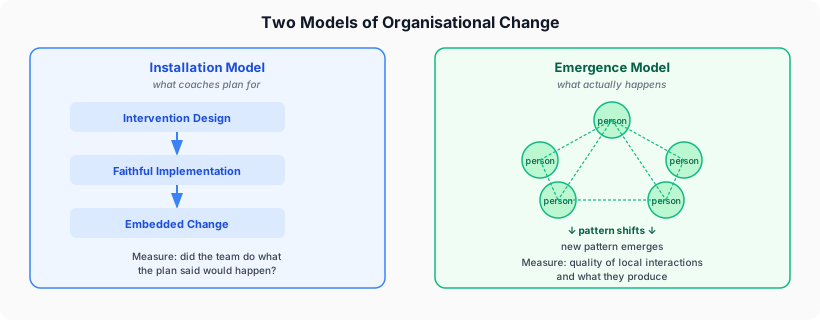
In the installation model of change — which is the implicit model of most coaching programmes — change happens because an intervention is designed, implemented faithfully, and embedded. The coach's job is to design a good intervention, implement it with skill, and ensure the team adopts it before the engagement ends. Success is measured against the plan: did the team do what the plan said would happen?
Stacey's alternative is emergence: change happens because local interactions shift, and as they shift, different patterns emerge across the whole. Nobody designs the outcome. The outcome is constituted by thousands of small interactions between people — in standups, in code reviews, in corridors, in the coach's conversations with individual team members. The coach cannot cause the change they have planned. They can only participate in the local interactions in ways that create the conditions for different patterns to emerge.
Values, strategies, and cultural norms have no reality in this framework except as they are enacted in those local interactions. A working agreement that is signed but not enacted has no effect on the pattern. A retrospective format that produces conversations the team was not having before is changing the pattern, whether or not the planned outcome is being achieved. The question shifts from "is the plan being implemented?" to "what are the local interactions producing?"
Why the Agile sprint is particularly suited to emergent change
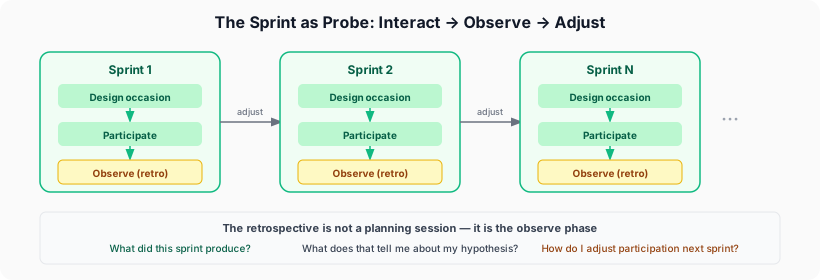
Agile's iterative structure creates something that most organisational change programmes lack: natural occasions for local interaction at regular, bounded intervals. A sprint is not a plan delivery unit — it is, from a complex responsive processes perspective, a probe. The team interacts through the sprint, a pattern emerges, and the retrospective makes that pattern briefly visible before the next sprint begins.
The coach who understands this does not use sprints as implementation vehicles for a pre-designed coaching plan. They use each sprint as evidence about what the previous sprint's interactions produced — and they adjust their participation in the next sprint accordingly. This is not abandoning structure. It is using structure differently: as a rhythm of probing and observing rather than a sequence of planned deliverables.
The retrospective, in this frame, is not a planning session. It is an observe phase. The team is looking at what the previous sprint's local interactions produced, and — if the coaching is working — developing the capacity to see the pattern in the interactions, not just the items on the retrospective board. This is a more demanding use of the retrospective than the default, and it requires the coach to be attending to the quality of the interaction in the room rather than managing the output of the ceremony.
Three common coach errors in a complex responsive frame
Measuring the wrong thing. The coach who measures the outcomes of planned interventions — did the team adopt the working agreement? did velocity improve? — is measuring whether the installation model is working. In an emergent frame, the more useful measure is the quality of local interactions: are the conversations in planning more honest than they were last sprint? Are the retrospectives producing different observations? Is the silence in standup shorter? These are not formal metrics. They are the texture of the pattern changing.
Over-interpreting early results. Complex responsive processes unfold over time and across many interactions. The sprint where the team suddenly has a productive conflict, or the retrospective where something previously unspeakable is said for the first time, is not the outcome — it is a leading indicator that the pattern may be shifting. Coaches who treat early positive indicators as evidence of success and reduce their engagement, or treat early negative indicators as evidence of failure and escalate their intervention, are responding to the noise, not the signal.
Premature closure. Calling an engagement complete when a pattern has merely stabilised temporarily mistakes a local equilibrium for a durable change. Patterns stabilise and then shift again. The team that appears to have arrived at a new way of working may be in a temporary stable state that will dissolve under the next significant environmental input — leadership change, restructure, a difficult release. The coach who understands emergence does not close the engagement when things look good. They ask: what is the environmental perturbation that would destabilise this pattern, and has the team developed enough adaptive capacity to orient when that happens?
Stacey's practical guidance: reflexive use of tools
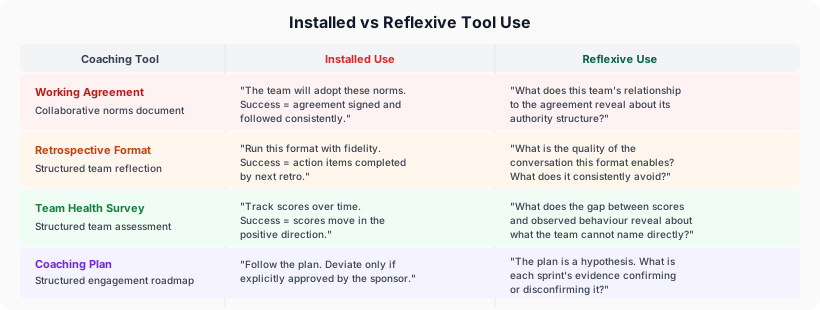
Stacey is not arguing that coaches should stop using tools and techniques. He is arguing for a specific relationship to them: reflexive rather than prescriptive. A reflexive practitioner uses a tool and simultaneously observes what the use of the tool produces in this specific context, with this specific group of people, in this specific moment. The tool is a probe, not a solution. The fact that working agreements have worked in the practitioner's previous engagements does not mean working agreements will work here, and the fact that they are failing here does not mean they are ineffective tools. It means they are producing something different in this context than they did in others.
Reflexive tool use requires the coach to hold two attentions simultaneously: implementing the tool (participating in the interaction) and observing what the tool's use is producing in the local interactions of this specific group. This is different from both mechanical implementation (doing the tool without attending to its effects) and abandoning tools entirely in favour of spontaneous response.
Three moves
Shift from planning to attending. A coaching plan is a hypothesis about what interventions will produce what patterns in this team over this timeframe. Treat it as that, and attend to whether the hypothesis is being confirmed or disconfirmed by what the local interactions are actually producing. When the evidence contradicts the hypothesis, update the hypothesis rather than defending the plan.
Design for interaction quality rather than outcome delivery. The question before any ceremony, any coaching session, any planned intervention is not "what outcome do I want this to produce?" but "what quality of local interaction do I want to make possible?" These are related but not identical. The outcome question is about the endpoint. The interaction question is about the quality of the process — the honesty, the attention to what is actually happening, the willingness to stay with difficulty. In an emergent system, the quality of the interactions is the most reliable leading indicator of what the emerging pattern will be.
Hold the plan as a hypothesis and the retrospective as evidence. Every retrospective is an opportunity to check the coaching hypothesis against what the previous sprint's interactions produced. Not: "did the team deliver the planned items?" but: "what did this sprint's interactions produce that was not produced by the sprint before it, and what does that tell me about the hypothesis I was operating from?"
Change is not something that gets installed
Change does not result from a practitioner designing an intervention and managing its implementation. It emerges from thousands of local interactions over time — most of which the coach is not present for, and none of which the coach fully controls. The retrospective, the working agreement, and the twelve-week coaching plan are not vehicles for delivering change. They are structured occasions for local interaction from which change may or may not emerge.
The coach's most useful question is not "how do I produce this change?" It is: "what is the quality of the local interactions in this team right now, and what does that quality make possible?" The coach who can stay with that question — across a twelve-week engagement, across the moments where the plan is not working, across the unexpected emergence of things the plan had no room for — is working with the grain of how organisations actually change, rather than against it.
Continue Exploring
Go deeper into the work
The Book
The Art of Creating Self-Organizing Teams
The full framework behind this article — contracting, team dynamics, and practical coaching tools for every stage of the journey.
Companion Toolkit
Resistance Radar & Resilience Scorecard
Practical tools for mapping resistance patterns and measuring whether interventions increased capacity — not just compliance.
TA for Agile
Co-creative TA in Agile Contexts
Ego states, psychological contracts, group imago, and the relational concepts that underpin this article — applied to real teams.