Why agile decisions converge too fast
Concurrence seeking is not a safety problem — it is a structural one. When no process requires dissent, evaluation apprehension fills the gap and the room closes around the first confident voice. Constructive controversy is the structural fix.
The decision that was unanimous and wrong
Sprint planning took forty minutes. Everyone agreed on the goal. The estimates were smooth. There were no awkward silences. Two weeks later, the sprint missed because the API dependency the team had implicitly assumed would be available was not — a concern two engineers had privately noted before planning and had not voiced.
This is not primarily a safety problem. The engineers did not stay silent because they feared punishment. They stayed silent because nothing in the structure of that planning session required them to speak. There was no moment designed for dissent, no role assigned to challenge, no process that made their concern a required input rather than an optional one.
Concurrence seeking: what it is and how it closes decisions
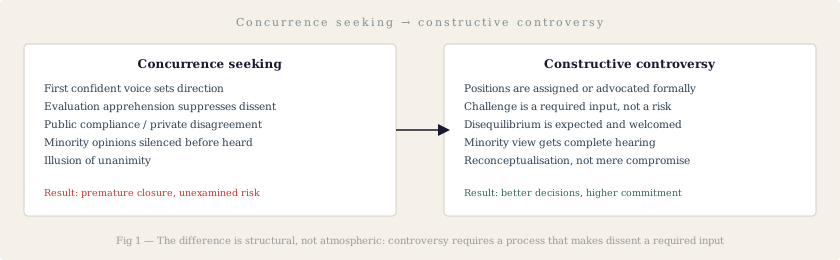
Concurrence seeking is the dominant pattern in most agile decision-making. It is not a failure of safety or culture — it is the natural default of groups under time pressure with implicit social approval structures. It operates through evaluation apprehension (members suppress concerns to avoid being seen as obstructive), the illusion of unanimity (visible agreement is mistaken for genuine consensus), and the public-compliance/private- disagreement split (members agree in the room and retain their doubts outside it).
The Challenger shuttle disaster is the archetype. The engineers at Morton Thiokol had the analysis. The concern about the O-ring seals at low temperature was documented. The engineers presented it. And the decision-making process — which had no structural requirement to hear the minority view until it was resolved — closed around the launch recommendation. Twenty-five experimental studies on constructive controversy, with a mean effect size of 0.70 over concurrence-seeking conditions, show the same pattern at smaller scale in ordinary groups: when dissent has no structural home, it doesn't survive the room.
How constructive controversy works
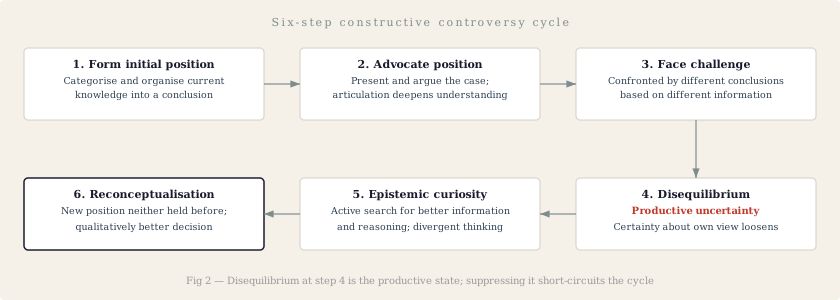
The six-step controversy cycle, developed by Johnson and Johnson across decades of research, describes what happens when disagreement is structurally protected rather than structurally suppressed.
Members form an initial position from their current knowledge. They advocate for it — which deepens their own understanding through articulation. They face a challenge from someone with a different position. This creates conceptual conflict and disequilibrium — not a failure, but a productive state. That disequilibrium motivates epistemic curiosity: an active search for better information and reasoning. The result is reconceptualisation: a position that neither member held before the controversy began.
Two wrong positions, when genuinely argued, can produce a correct conclusion. The value is not in the correctness of the dissenting view — it is in the cognitive processing that genuine challenge produces.
What concurrence seeking looks like in agile ceremonies
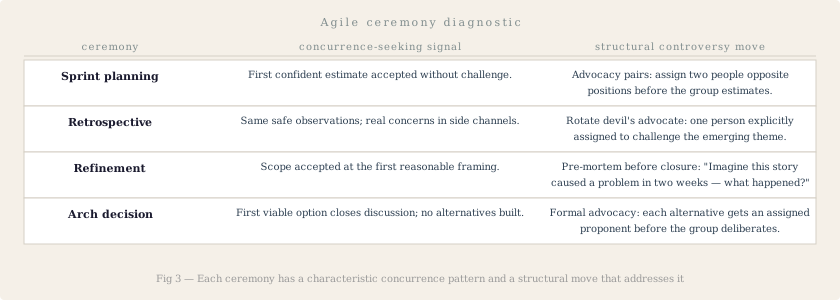
Sprint planning closes at the first estimate a senior engineer offers without challenge.
Retrospective action items are variations of last sprint's — nobody names the same elephant twice.
Architectural decisions are proposed, briefly discussed, and accepted within the same session.
Dissent surfaces in side channels — Slack DMs, hallway conversations, post-meeting — never in the room.
The person who speaks last in planning is almost always the person whose view prevails.
Three structural moves that install controversy
Advocacy pairs
Before a key decision, assign two people to opposite positions and give them ten minutes to build the best case they can for their assigned side. Only after both have advocated do the group discuss.
Forces elaboration of alternatives that would otherwise close at the first viable option.
Rotating devil's advocate
One person in each decision meeting is explicitly assigned to challenge the emerging consensus. The role rotates so no individual becomes the institutional contrarian.
Institutionalises dissent without making it personal, and removes the social cost of being the person who disagrees.
Pre-mortem before commitment
Before a sprint goal or architectural decision is finalised, run a five-minute pre-mortem: 'Imagine it's three weeks from now and this has failed — what happened?' List the answers before closing.
Creates a mandatory controversy checkpoint. Surfaces concerns that evaluation apprehension suppresses in forward-looking discussion.
The coach's role
The coach who names concurrence seeking explicitly — "I'm noticing we're closing toward agreement quite fast; has anyone got a concern they haven't yet voiced?" — is making a direct intervention. It works once. The team learns to expect it and may start producing performative dissent.
The structural moves are more durable because they don't depend on the coach being in the room. They build controversy into the process itself, making dissent a required input rather than a courageous exception.
The distinction this article is making is not the same as the argument that psychological safety is declared but not experienced — though that argument matters and is explored elsewhere. This is a different problem: the process structure closes decisions before dissent has a place to land. Safety may be present and still not be sufficient, because no process requires anyone to use it.
Continue Exploring
Go deeper into the work
The Book
The Art of Creating Self-Organizing Teams
The full framework behind this article — contracting, team dynamics, and practical coaching tools for every stage of the journey.
Companion Toolkit
Resistance Radar & Resilience Scorecard
Practical tools for mapping resistance patterns and measuring whether interventions increased capacity — not just compliance.
TA for Agile
Co-creative TA in Agile Contexts
Ego states, psychological contracts, group imago, and the relational concepts that underpin this article — applied to real teams.