The Route to Autonomy Goes Through Dependency: A Paradox Every Coach Must Hold
Coaches are trained to avoid creating dependency. The irony is that this training produces coaches who withdraw too early — and teams that never develop the autonomy the coach was trying to build. Winnicott showed that the route to independence is not around dependency but through it. The coach who cannot tolerate being needed cannot be used.
The coach who successfully prevented dependency
The coach was proud of running clean engagements. Time-bounded, clearly contracted, no blurring of roles. They never let teams lean too heavily. They stepped back early, pointed to the team's own capability, and consistently declined to be the person the team brought its problems to. Six months in, the team was polite, cooperative, and completely unchanged.
The coach had successfully prevented dependency. They had also prevented learning.
This is one of the less examined failure modes in coaching: the engagement that goes technically well — good contract, clear boundaries, appropriate professional distance — and produces almost nothing. The team is not worse. It is exactly the same. The coach maintained enough distance that nothing was ever genuinely held, which meant nothing was ever genuinely changed.
What Winnicott showed about development
D.W. Winnicott, the British paediatrician and psychoanalyst, observed something counterintuitive about how the self develops. The infant does not become a separate, autonomous self by being left to manage its own experience. It becomes a self through being held — by a carer who is consistent, present, and responsive enough that the infant can begin to experience itself as real. The holding provides the container within which the true self gradually emerges.
This requires temporary dependence. The infant who is not allowed to depend — whose carer is inconsistently available, or who withdraws prematurely in the name of encouraging independence — cannot individuate properly. Instead, a false selfdevelops: compliant, adaptive, presenting a workable surface while the real self remains hidden and undeveloped. The holding is not an obstacle to autonomy. It is its precondition.
Winnicott's concept of the good enough mother — good enough, not perfect — is also important here. The carer does not need to be omnipresent or infallible. They need to be consistent enough that the infant can trust the relationship, explore away from the secure base, and return when anxiety rises. The exploration is made possible by the security, not by the absence of the carer.
Autonomy, in Winnicott's account, is not the absence of dependence. It is what emerges on the other side of dependence, after the dependence has been properly held.
The coaching corollary
The developmental logic applies directly to coaching. Clients — individuals and teams — need enough dependency to feel held before they can take risks. The coach who maintains clinical distance in the name of preventing dependency creates a relationship too unsafe for genuine learning. The team that cannot rely on the coach as a consistent, present figure has no secure base from which to attempt the uncomfortable things that change requires.
The temporary dependency that often develops early in a coaching relationship is not a regression to be corrected. It is the mechanism through which the holding works. The team that starts routing its conflicts through the coach, that looks to the coach to name what is happening, that leans on the coach's presence to have conversations it could not otherwise sustain — this team is using the coaching relationship correctly.
The coach who pulls back from this, concerned about fostering dependency, is withdrawing the container at the moment the container is needed. What they protect is not the team's autonomy. It is their own discomfort with being needed.
What temporary dependency looks like in team coaching
In Bion's terms, the team in a dependency basic assumption state is looking to the leader — or in this case, the coach — to provide answers, resolve ambiguity, and take responsibility for outcomes. The team asks the coach what to do. Decisions that could be made by the team are deferred until the coach is present. Conflicts that the team cannot hold are routed through the coach as an intermediary.
For a coach trained to spot and interrupt dependency states, this can feel like a problem to be solved immediately. But there is a distinction between the basic assumption of dependency — the flight from autonomy into passive waiting — and the appropriate early use of a coaching relationship as a secure base for difficult work.
The team routing its conflicts through the coach because they cannot yet hold them directly is not failing. It is using a resource. The coach becomes the relationship anchor that allows difficult conversations to happen at all. Over time, as the team develops its own capacity to hold its conflicts, the need for that anchor diminishes naturally. This is the coaching relationship working. It is not a failure of the coaching relationship.
When dependency becomes stuck dependency
The distinction that matters is between temporary dependency — a developmental stage — and stuck dependency, in which the team has not moved through the holding phase toward exchange and risk-taking. Temporary dependency should have a trajectory: the team's need for the coach as intermediary should gradually decrease over the course of an engagement, not remain constant or increase.
Stuck dependency has recognisable signs. The team cannot function in the coach's absence: progress halts between sessions rather than continuing. The escalation rate — the frequency with which the team brings problems to the coach rather than resolving them internally — does not decrease over time. Most diagnostically: the team seeks the coach's approval rather than their challenge. They want the coach to confirm that they are doing well, not to introduce the discomfort that growth requires.
When these signs appear, the dependency has become a defence rather than a stage. The coach's task shifts: not to withdraw, but to introduce more challenge within the holding, to begin the gradual movement toward exchange. The holding does not end. Its quality changes.
Premature independence: the coach's more common error
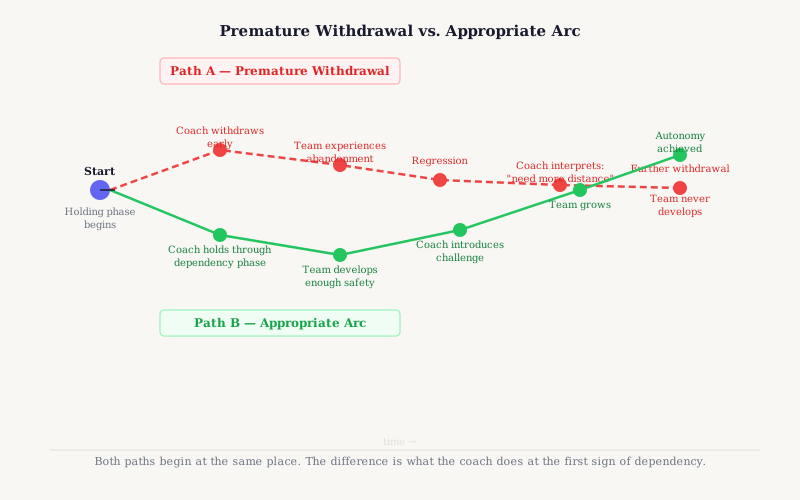
Coaches are trained to worry about dependency and withdraw early to prevent it. The training is well-intentioned: genuine stuck dependency is real, and coaches who never reduce their presence fail their clients. But the worry tends to produce a characteristic timing error: the coach withdraws just as the team is beginning to consolidate the holding — at the moment when the secure base is becoming stable enough for genuine exploration.
The team experiences the withdrawal as abandonment. This is not dramatic projection. The coach was the container for things the team was only beginning to be able to hold. When the container is removed before those things are fully held by the team itself, the team regresses — returns to earlier, safer patterns, closes down the work that was beginning to open.
The coach, seeing the regression, typically interprets it as evidence that they need to be even more boundaried. The team is dependent again — which confirms the original worry. The coach increases their distance further. The team regresses further. The opposite of what was needed has been done, and the intervention has confirmed itself as correct.
The well-managed dependency arc
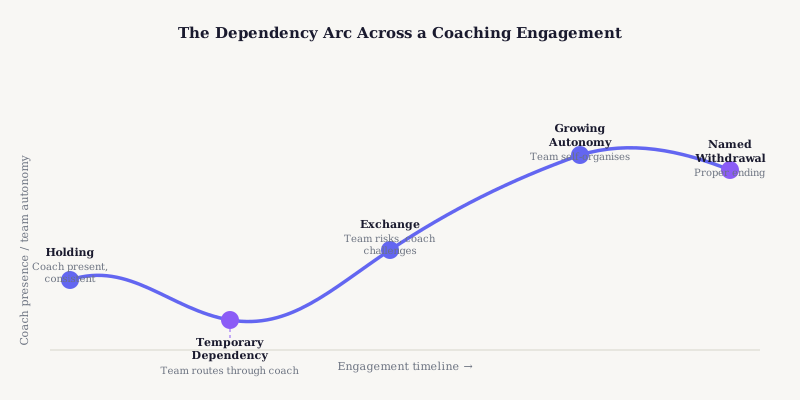
What healthy dependency management looks like across a coaching engagement has a recognisable shape. Early in the engagement, the coach is explicitly present, available, and consistent. The holding is not apologised for. The coach names it: "My role at this stage is to be a reliable presence while the team develops its capacity to work with what's difficult." This is not passivity. It is deliberate holding.
As safety grows, the coach introduces challenge. Not as a separate phase that replaces holding, but as an addition to it. The holding and the challenge alternate: the coach offers a difficult observation, then holds the team's response to it. The team begins to risk more because the container is stable enough to risk within.
The reduction in coach presence is deliberate, named, and gradual. Not "I'm stepping back now to let you lead this" as a surprise. But a conversation: "I've noticed the team is holding its own conflicts more directly. I'm going to start being less available between sessions. What would you need to have in place to use that well?" The reduction is a coaching move, not a withdrawal.
The ending acknowledges what the relationship held. A proper ending is not administratively clean and relational nothing. It is a named recognition of what the team has held with the coach's help, what the team can now hold without it, and what was changed in the holding.
The structural contradiction
There is a contradiction built into the coaching engagement model that Christine Thornton names plainly and that coaches are usually reluctant to look at directly. The structure of coaching — billable hours, ongoing contracts, commercial relationships — incentivises continued engagement. The coach who successfully builds a team's autonomy is also building their own redundancy. Their best work makes them unnecessary.
This is not a reason to be cynical about coaching relationships, nor a claim that coaches consciously manufacture dependency to protect their income. Most coaches do not. But the structural incentive is real, and it operates below conscious intention. Coaches who have not examined it may find themselves, in entirely good faith, making decisions about pacing and withdrawal that are subtly shaped by the contradiction they have not named.
The honest response is not to resolve the contradiction but to hold it consciously. The coach who knows they have a commercial interest in continued engagement, and who nonetheless works to make themselves unnecessary, is navigating the contradiction with integrity. The coach who has not examined it is at risk of resolving it dishonestly without knowing they have done so.
Both are required
The route to autonomy goes through dependency. This is not a platitude. It is a developmental claim with clinical grounding, observable consequences, and direct implications for how coaches manage the arc of an engagement.
The coach who cannot tolerate being needed cannot be used. They maintain enough distance that nothing real is ever held, and the team they work with remains politely, cooperatively unchanged. The coach who cannot tolerate no longer being needed cannot finish. They extend the holding past the point it serves the team, and autonomy is perpetually deferred.
Both capacities are required. The willingness to be genuinely present and to allow the team to lean on that presence when it is needed. And the willingness to make oneself unnecessary, named and gradually, once the team can carry what it previously needed the coach to hold. Neither is harder than the other. Both require the coach to examine something about themselves.
Continue Exploring
Go deeper into the work
The Book
The Art of Creating Self-Organizing Teams
The full framework behind this article — contracting, team dynamics, and practical coaching tools for every stage of the journey.
Companion Toolkit
Resistance Radar & Resilience Scorecard
Practical tools for mapping resistance patterns and measuring whether interventions increased capacity — not just compliance.
TA for Agile
Co-creative TA in Agile Contexts
Ego states, psychological contracts, group imago, and the relational concepts that underpin this article — applied to real teams.