Disorders of Opportunity: When Too Much Freedom Produces Stuck Teams
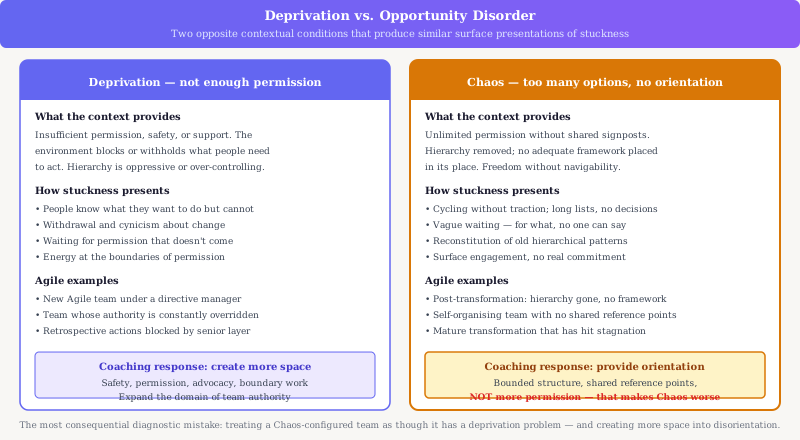
Agile coaching treats stuck teams as though they lack permission. Sedgwick's Chaos configuration inverts this: in many post-transformation teams, permission is not what is lacking. The problem is unconstrained proliferation of options without shared signposts. These teams don't need more permission — they need orientation, structure, and a bounded enough field to move within.
More freedom, still stuck
The transformation had been comprehensive. Hierarchies were flattened. Teams were declared self-organising. Managers were reframed as servant leaders and asked to step back from directing the work. The ceremonies were in place. The retrospectives ran. The team had the authority — formally and explicitly — to decide how to work.
Eighteen months later, the team was stuck in a way that no one could quite name. Not resistant — they were not pushing back against anything. Not avoidant — they showed up, engaged, and went through all the motions of self-organisation. But they were cycling. The same planning conversations happened every sprint with minor variations. The retrospective generated the same action items and the same follow-up experience of those action items not quite landing. People seemed to be waiting for something, though no one could say what.
The coaching assessment, repeatedly, came back to the same conclusion: the team needed more safety, more permission, more openness to experiment. The coach kept creating space. The team kept not moving into it. The problem, in Sedgwick's terms, was that the diagnosis was exactly backwards. This team did not have a permission deficit. It had a permission surplus.
Disorders of opportunity, not deprivation
Sedgwick distinguishes between two types of contextual dysfunction. The more familiar type — the one that most coaching frameworks are built to address — arises from deprivation: the context has withheld permission, resources, or support. The stuck team lacks the freedom to act, and the coaching task is to create the safety or authority it needs.
But there is a second type, less often named, that arises from the opposite condition. Sedgwick calls these disorders of opportunity: dysfunctions that arise not from the absence of permission but from its unconstrained proliferation. The team has been given everything — full autonomy, explicit authority, maximum freedom — without the structural conditions that make freedom navigable.
This is Sedgwick's Chaos configuration, and it is more common in mature Agile transformations than in new ones. It is the condition that appears after the initial work of removing hierarchy has been done and the organisation discovers that removing hierarchy alone does not produce direction. The Parent has become all permission and no prohibition. The space that has been created is not a space of possibility but a space of disorientation.
The phenomenology of Chaos: why freedom can feel like ground that doesn't hold
The Chaos configuration is phenomenologically distinctive. Teams in it do not feel oppressed or constrained — they feel, if they can articulate it at all, vaguely disoriented. The usual reference points are gone. The familiar structures that told people where they stood — the management hierarchy, the clear escalation paths, the defined authority levels — have been removed. What has replaced them is a set of principles that require interpretation, a set of values that require application, and an expectation of autonomy that requires knowing what to do with it.
Without shared signposts, navigation becomes individual. Each team member is making their own sense of the space. Some are more comfortable with ambiguity and move confidently. Others are less comfortable and freeze. The team's collectively available options — theoretically vast — are in practice a source of paralysis rather than creativity, because creativity requires a bounded enough space to orient within. Infinite options are not experienced as opportunity. They are experienced as the absence of ground.
The retrospective generates long lists of possibilities and no clear traction because the team has no shared framework for evaluating options against each other. Everything is equally possible, which means nothing is clearly better. The conversation circles because there is no shared orientation that would make some directions more coherent than others.
Why familiar patterns return: horizontal games in Chaos conditions
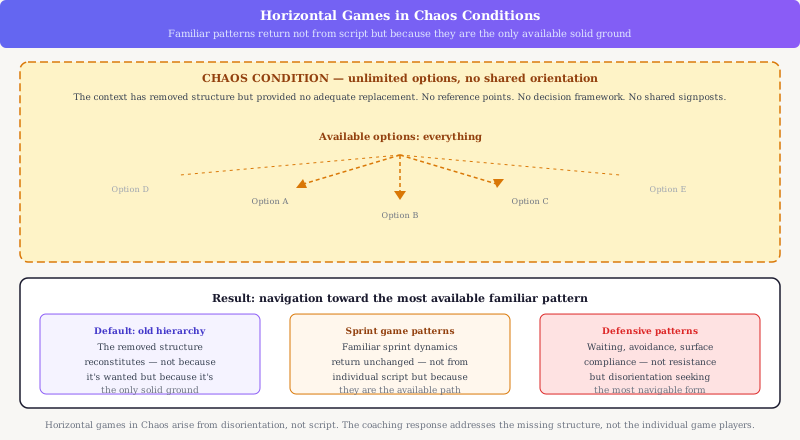
Sedgwick's account of horizontal games explains a specific feature of Chaos conditions that coaches often find puzzling: the persistence of patterns from the old world that should, in a genuinely self-organising team, have no reason to continue.
Horizontal games are patterns that circulate through shared vocabularies and social structures rather than arising from individual psychology. In a Chaos condition, people navigate toward horizontal games not from script but from disorientation. The familiar game — the old planning dynamic, the established pattern of who leads and who follows, the recognisable sprint ritual that used to be prescribed and is now technically abandoned — is the only territory solid enough to stand on. It is not chosen. It is default.
This is why the self-organising team that has been given full autonomy often reconstitutes the hierarchical structures it was meant to leave behind. The hierarchy is not the goal — it is the available form. When the context provides no other adequate form, the available form wins. Coaching that interprets this as resistance to self-organisation is misreading a navigation problem as a motivation problem.
What coaching under Chaos conditions provides
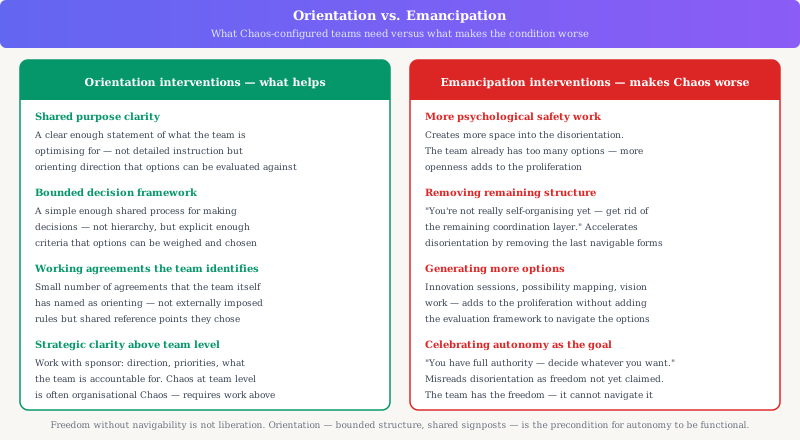
The coaching response to Chaos is structurally opposite to the coaching response to deprivation. Where deprivation requires more permission, more safety, more opening of space, Chaos requires less space — or more precisely, a better-bounded space. The coaching task is orientation: providing enough shared structure that the team can navigate within the freedom it has been given.
This does not mean reinstating hierarchy. It means identifying the shared reference points that make autonomy navigable: a clear enough shared purpose, a bounded enough set of working agreements, a decision-making framework simple enough to use under pressure. These are not constraints on self-organisation — they are the minimum conditions that make self-organisation functional rather than nominal.
The intervention that makes Chaos worse is more emancipation. Coaches who respond to a Chaos-configured team by creating more space, generating more permission, or reducing structure further are accelerating the disorientation. The team already has more freedom than it can navigate. What it needs is the Resourcefulness and Integrity components of the Good Enough World: what does the context actually provide to enable navigation, and how coherent is the team's collective sense of itself?
In practice, this often means working with the organisation above the team level: helping the sponsor provide clearer strategic direction, establishing shared frameworks that all teams in the organisation use, and creating enough stability in the team's context that it has ground to stand on. Chaos is an organisational condition as much as a team condition. Coaching that only works with the team will make modest progress against a contextual condition that the team alone cannot resolve.
Diagnosing before intervening
The team in the opening example was not stuck from lack of permission. The assessment that they needed more safety was not wrong as a general principle — safety is always valuable. It was wrong as a diagnosis of this team's particular situation. What they needed was not more opening of space but more structure within the space they already had.
When the coach shifted the approach — working with the team to develop a simple shared decision framework, creating clearer alignment on what the team was optimising for, establishing a small number of working agreements that the team itself had identified as orienting — the cycling stopped. Not because freedom had been removed but because the freedom finally had enough structure to be navigable.
Disorders of opportunity are not resolved by more opportunity. They are resolved by the conditions that make opportunity navigable. The distinction between deprivation and opportunity disorder is a diagnostic one — and getting the diagnosis right is the precondition for the intervention landing where the problem actually is.
Continue Exploring
Go deeper into the work
The Book
The Art of Creating Self-Organizing Teams
The full framework behind this article — contracting, team dynamics, and practical coaching tools for every stage of the journey.
Companion Toolkit
Resistance Radar & Resilience Scorecard
Practical tools for mapping resistance patterns and measuring whether interventions increased capacity — not just compliance.
TA for Agile
Co-creative TA in Agile Contexts
Ego states, psychological contracts, group imago, and the relational concepts that underpin this article — applied to real teams.