When the Facilitator Cannot Do What the Coach Can: The Real Distinction
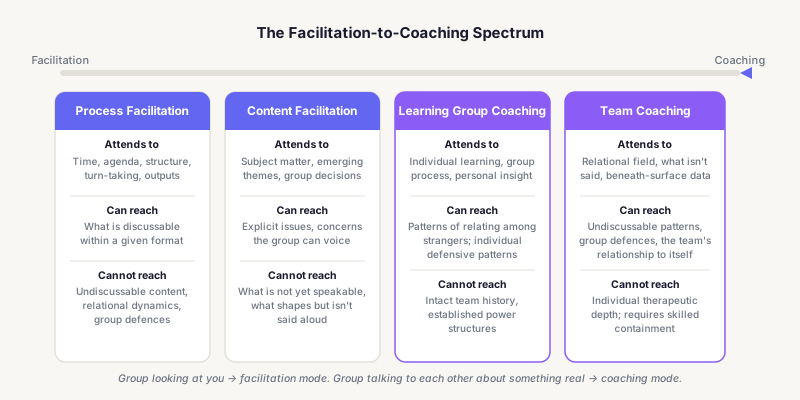
There is a diagnostic that takes about thirty seconds. If the group is looking at you, you are facilitating. If they are talking to each other about something that matters, you may be coaching. Most Agile practitioners spend their careers on the facilitation side of this line — not because they lack skill, but because nobody has been clear about what is on the other side of it.
The same retrospective, for eighteen months
A Scrum Master has been facilitating retrospectives for two years. They are skilled at it — time-boxed, structured, everyone contributes, action items logged. The team has had the same conversation in slightly different formats for eighteen months. Nothing structural has changed. The Scrum Master is doing exactly what they were trained to do.
The problem is that the problem requires something different. The retrospective keeps producing the same outputs because the facilitation keeps creating the same conditions — and the conditions are not the issue. The issue lives beneath the conditions, in territory that facilitation cannot reach.
A diagnostic that takes thirty seconds
Christine Thornton offers a formulation that is simple enough to carry in your head during a session: if the group is looking at you, you are facilitating. If they are talking to each other about something that matters, you may be coaching. This is not a value judgment. Facilitation is necessary. But it is a different activity — and most Agile practitioners spend their careers on the facilitation side of this line without knowing the line exists.
The direction of the group's attention is diagnostic. When attention flows through the facilitator — when the facilitator is the conduit, the timekeeper, the summariser — the group is in a facilitated mode. When attention moves between members, when the facilitator disappears from the functional centre of the room, something else has become possible.
What facilitation does and does not do
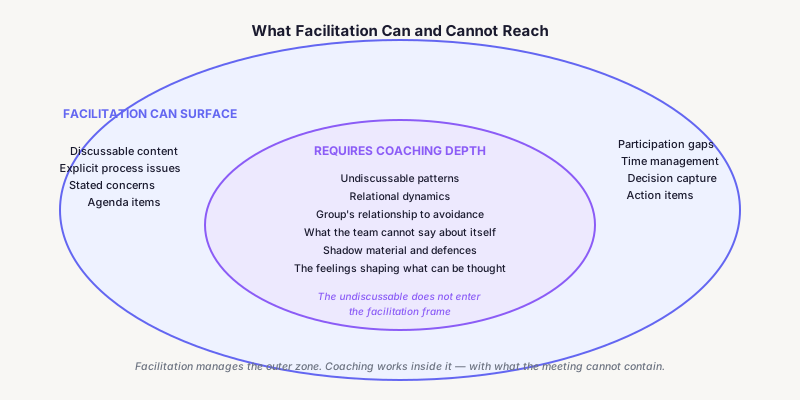
Facilitation manages process. It creates conditions for discussion, maintains time, ensures participation, and moves the group through an agenda. It is external to the content and to the relational dynamics of the group. A skilled facilitator can hold a space in which difficult topics become discussable — but only topics that are already capable of entering the frame.
The key limit of facilitation is structural: it can surface what is already discussable. It cannot surface what has been made undiscussable — because the undiscussable does not enter the facilitation frame. It waits outside. The retrospective format that asks "what went well, what could be improved" will reliably generate answers to those questions. It will not generate answers to the question the team is not able to ask about itself.
This is not a criticism of facilitation. It is a description of its scope. Facilitation is designed to work within the frame of what can be said. The material that lives outside that frame requires a different kind of attention.
What team coaching does instead
Team coaching works with what the meeting cannot contain. The coach attends to what is not being said, what the pattern of interaction reveals about the team's relational dynamics, and the feelings present in the room that are shaping what can be thought. This is different from facilitating well. A skilled facilitator manages the room from outside it. A coach is inside the relational field — part of the system, using their own responses as data.
The coach is not steering the group through an agenda. They are following the group's energy, noticing where it accelerates and where it goes flat, staying curious about what the flatness means. When someone says something that lands differently, the coach slows down rather than moving on. The retrospective that always produces the same conversation is producing the same conversation for a reason — and the reason is not visible from the facilitation position.
The learning group and the intact team
Thornton draws a distinction that has practical consequences for every Agile practitioner who has borrowed from the coaching literature: a learning group comes together as strangers for individual learning goals. An intact team has shared goals, established communication patterns, history, and an existing power structure.
These require fundamentally different interventions. A learning group can use exercises designed for strangers — the trust fall, the personal disclosure round, the getting-to-know-you check-in. These exercises assume that the primary work is building connection from scratch. In an intact team, connection already exists — and so does disconnection, hierarchy, resentment, and loyalty. An exercise designed for strangers may feel infantilising or beside the point to a team that has been working together for three years.
Many coaching approaches designed for learning groups are applied to intact teams — and fail because the context is wrong. The team already has a relational life. The coach's job is not to create one. It is to work with the one that exists.
Why Agile practitioners stay on the facilitation side
Facilitation is what is trained, certificated, and rewarded. The structure of ceremonies — time-boxed, agenda-driven, output-oriented — pulls practitioners toward facilitation. The artefacts of a facilitated session (a board of sticky notes, a list of action items, a documented decision) are legible to sponsors and stakeholders. They prove that something happened.
Coaching requires tolerating ambiguity, working without an agenda, and following the group's energy rather than steering it. The outputs of a coaching session are often invisible: a shift in what the team can say to itself, a reduction in the energy spent on avoidance, a moment in which something previously undiscussable enters the conversation. These are harder to justify to a sponsor, harder to put on a slide, harder to claim credit for.
The institutional pull is toward facilitation. Coaching exists in the gaps — which is exactly where the most important work tends to happen.
The moment when the work shifts
Experienced coaches learn to recognise the moment when facilitation tips into something else. Someone says something real — not performatively real, not in the language of retrospective outputs, but genuinely real. The room goes quiet in a different way. The conversation stops being about the topic and starts being about what is actually happening. The energy in the room changes quality.
The move at this moment is counter-intuitive for trained facilitators: slow down, stop steering, follow. The facilitator instinct is to harvest the moment — summarise it, add it to the board, move on. The coaching move is to stay with it. To ask what it is about. To resist the pull toward closure long enough for the group to find out what it is actually dealing with.
What this means for Scrum Masters
The Scrum Master role institutionalises facilitation. The role description specifies facilitated ceremonies. The coaching function exists outside the role description — not because it is unwanted, but because it is harder to specify, certify, and measure.
Scrum Masters who want to do coaching work often do it in the margins: in the one-to-ones, in the pauses, in the conversations that happen after the meeting ends. This is where the real work tends to live — not because ceremonies are unimportant, but because the structure of the ceremony keeps certain conversations from being possible. The coach finds the edges of the structure and works there.
Sequential, not opposed
Facilitation and coaching are not opposed. They are sequential. You need to be able to facilitate a group before you can coach it — the group needs to have enough structure to meet before the less structured work becomes possible. A coach who arrives without facilitation skills will create chaos. A facilitator who never develops coaching capacity will keep producing the same retrospective.
The question is not which one is better. The question is whether you know which one you are doing — and whether you know when one is no longer enough. The Scrum Master who has been running the same retrospective for eighteen months is doing the right thing. They are just doing it past the point where it stopped being enough.
Continue Exploring
Go deeper into the work
The Book
The Art of Creating Self-Organizing Teams
The full framework behind this article — contracting, team dynamics, and practical coaching tools for every stage of the journey.
Companion Toolkit
Resistance Radar & Resilience Scorecard
Practical tools for mapping resistance patterns and measuring whether interventions increased capacity — not just compliance.
TA for Agile
Co-creative TA in Agile Contexts
Ego states, psychological contracts, group imago, and the relational concepts that underpin this article — applied to real teams.