Four Conditions Instead of One: What Edmondson's Survey Cannot See
Edmondson's psychological safety construct is well-validated but structurally thin: it measures a perception without diagnosing the conditions that produce it. Sedgwick's four conditions — Resourcefulness, Responsiveness, Truthfulness, Integrity — provide a four-dimensional structural diagnostic. A team can score high on a safety survey while in deficit on Responsiveness or Integrity.
The declaration that changed nothing
The organisation had measured psychological safety across its product teams, identified the lowest-scoring groups, and developed an intervention programme. Senior leaders attended workshops. Teams ran retrospectives on what made them feel safe and unsafe. A set of team agreements was produced and displayed on walls and in shared documents. The language of psychological safety became part of the organisation's vocabulary.
Six months later, the safety survey scores had improved modestly. The coaches who had run the programme knew that something was incomplete. The teams were still not raising difficult things in sprint reviews. The sponsor was still hearing only the version of reality that people thought they wanted to hear. The pattern that the safety work was meant to address had shifted at the surface but not in the substance.
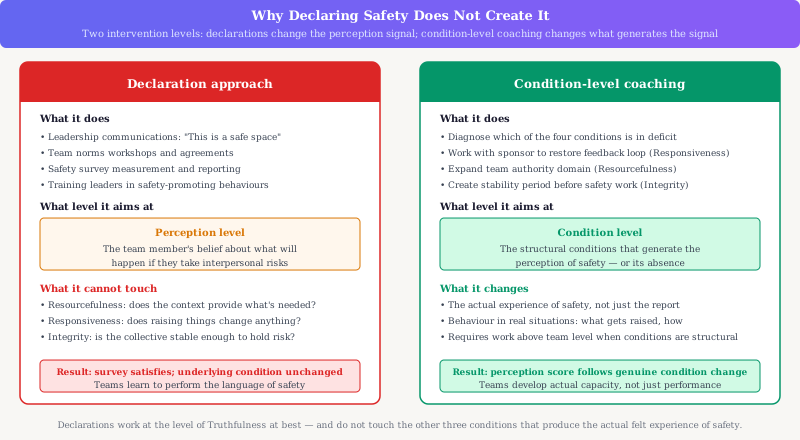
The problem was not measurement error, and it was not insufficient effort. The problem was that the intervention had aimed at the wrong level. Psychological safety, as Edmondson's construct captures it, is a perception — a team member's belief about what will happen if they take interpersonal risks. Declarations, workshops, and team agreements work at the level of that perception. They do not work at the level of the conditions that produce it.
What Edmondson's measure captures and what it misses
Amy Edmondson's psychological safety research is among the most cited in the organisational behaviour literature, and rightly so. The construct is well-validated: team members' beliefs about the interpersonal consequences of risk-taking reliably predict outcomes including learning behaviour, innovation, and error reporting. The measure works.
What the measure captures, however, is downstream of what creates it. A safety score is a symptom reading — accurate about the state of the symptom, silent about the conditions producing it. When organisations intervene on the symptom directly — by declaring safety, training leaders in safety-promoting behaviours, and asking teams to agree to norms — they are working on the signal rather than the conditions that the signal reflects.
The result is the pattern described in the opening: measurable improvement in the perception of safety that does not translate into the actual behaviour that safety is meant to enable. Teams learn to speak the language of safety without developing the capacity to take the risks the language is supposed to legitimate. The survey is satisfied. The underlying condition is unchanged.
Four conditions instead of one perception
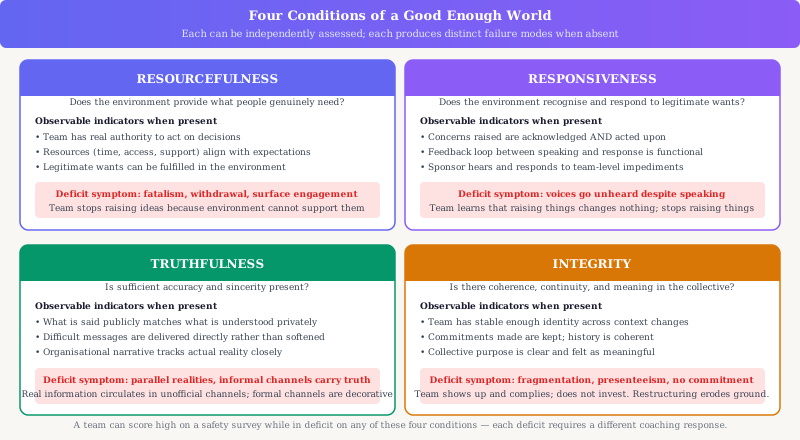
Sedgwick's concept of the Good Enough World provides a structural alternative. Rather than a single perception, it identifies four environmental conditions — each independently variable, each producing different failure modes when absent — that constitute the actual substrate of psychological safety in teams.
Resourcefulness is the degree to which the environment provides what people genuinely need. In a team context this includes the practical resources necessary to do the work, the authority required to make meaningful decisions, and the information needed to navigate the team's actual situation. A team working in a Resourcefulness deficit knows, at some level, that the environment cannot deliver what their efforts require. Risk-taking feels futile: even a good idea, honestly expressed, will encounter a context incapable of responding to it.
Responsiveness is the degree to which the environment recognises and responds to legitimate wants. This is distinct from Resourcefulness: the context may have the capacity to provide what people need (Resourcefulness) but consistently fail to acknowledge, engage with, or act on what team members raise (Responsiveness deficit). The most common Responsiveness failure in Agile teams is the sponsor who genuinely hears concerns but does not act on them — producing the experience that raising things changes nothing.
Truthfulness is the degree to which sufficient accuracy and sincerity are present in the team's communications and in the communications the team receives from its context. Truthfulness deficits include not only deliberate misleading but also the systematic softening of difficult messages, the omission of information that would be uncomfortable to share, and the gap between what is said publicly and what is understood privately. Teams in Truthfulness deficit develop a parallel culture of real information that circulates informally because it cannot be said directly.
Integrity is the degree to which coherence, continuity, and meaning are present in the collective. A team operating with Integrity has a stable enough sense of itself — its purpose, its relationships, its shared understanding — to sustain engagement with difficult material. Integrity is chronically undermined in organisations by constant restructuring, unclear mandates, and the accumulated history of commitments not kept. Teams in Integrity deficit have no stable ground from which to take risks because the collective itself is too uncertain to hold them.
Why declarations of safety do not create it
Safety declarations — leadership communications, team agreements, norms workshops — operate at the level of Truthfulness. They make a claim: this is a safe environment. In the best case, where the declaration is made in good faith and backed by some genuine change in leadership behaviour, they may modestly improve the Truthfulness condition. But they do not touch Resourcefulness, Responsiveness, or Integrity.
A team that knows — from experience — that its context cannot provide what it needs (Resourcefulness deficit) will not be reassured by a declaration of safety. The declaration says: it is safe to raise things. The team's experience says: raising things changes nothing. The more recent and compelling evidence wins, because it is about the actual conditions rather than the aspiration.
This is why teams in long-running safety deficits often present as deeply sceptical of safety initiatives. They have learned, through accumulation of evidence, that declarations do not correspond to conditions. Their scepticism is not resistance — it is rational. The coach who interprets this scepticism as a psychological problem to overcome is applying a vertical intervention to what is essentially a Truthfulness and Responsiveness problem: the team has accurate information about the gap between what is said and what is provided.
Which deficit produces which failure mode
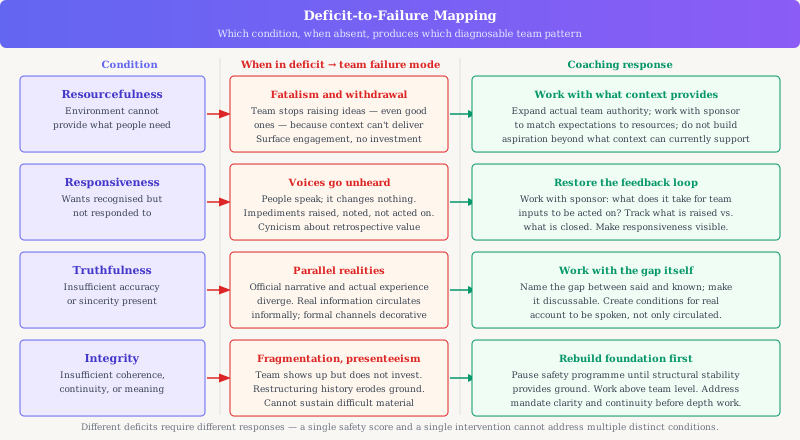
The four conditions are independently variable, which means a team's safety profile requires a four-dimensional assessment rather than a single score. More importantly, different deficits produce recognisably different failure modes — which is diagnostically useful because different failure modes call for different responses.
A Resourcefulness deficit produces fatalism and withdrawal. Team members stop raising possibilities because the environment has demonstrated its inability to support them. Engagement stays at the surface; people go through the motions of participation without genuine investment. The coaching response is not to encourage more investment but to work with what is actually available in the context — and, where possible, to expand it.
A Responsiveness deficit produces a specific variant of the same pattern: voices go unheard not because they lack authority but because the feedback loop between speaking and the environment responding has been broken. Teams in Responsiveness deficit often have members with plenty of things to say — who have stopped saying them because saying them demonstrably changes nothing. The coaching response addresses the feedback loop: what does it take to restore the team's experience that what they raise is heard and acted on?
A Truthfulness deficit produces parallel realities. The formal organisational narrative and the actual experienced reality diverge, and the gap between them is managed by the circulation of informal, unofficial, and often darker accounts. Teams in Truthfulness deficit are simultaneously more cynical than their formal communications suggest and more aware of the actual situation than anyone is supposed to acknowledge. The coaching response works with the gap itself — naming it, making it discussable, and creating conditions in which the real account can be spoken rather than only circulated.
An Integrity deficit produces fragmentation and presenteeism. Without a stable enough collective identity, team members cannot sustain the investment that genuine safety requires. They show up, they comply, they do not commit. The accumulated effect of repeated restructuring, unclear purpose, and unkept commitments is a team that has learned not to trust that the collective will hold. The coaching response — often requiring work above the team level — is about rebuilding a foundation coherent enough to sustain engagement.
What the organisation in the opening example needed
A careful assessment of the teams with the lowest safety scores would have found different profiles across different teams. One team was in a Responsiveness deficit: concerns were raised in retrospectives, recorded as action items, and consistently not acted on at the organisational level. Another was in an Integrity deficit: it had been restructured three times in eighteen months and had no stable ground from which to take the risks the safety programme was encouraging.
A single score and a single intervention could not address both profiles. What the organisation needed was a diagnostic process capable of distinguishing between them — and interventions calibrated to the actual conditions rather than the measured perception. For the Responsiveness-deficit team, that meant working with the sponsor relationship. For the Integrity-deficit team, it meant pausing the safety programme until a period of structural stability could provide the foundation for it to build on.
Safety is not a perception that can be declared into existence. It is an experience that arises from structural conditions. The four-condition framework does not make the work harder — it makes it more precise, and precision is the beginning of the kind of change that actually reaches the problem.
Continue Exploring
Go deeper into the work
The Book
The Art of Creating Self-Organizing Teams
The full framework behind this article — contracting, team dynamics, and practical coaching tools for every stage of the journey.
Companion Toolkit
Resistance Radar & Resilience Scorecard
Practical tools for mapping resistance patterns and measuring whether interventions increased capacity — not just compliance.
TA for Agile
Co-creative TA in Agile Contexts
Ego states, psychological contracts, group imago, and the relational concepts that underpin this article — applied to real teams.