The Group Holds What the Individual Cannot: Holding and Containment in Team Coaching
Organisations measure psychological safety and get back a number. Teams score 4.2 and still say nothing difficult. The problem is not the score — it is the assumption that safety is a belief rather than a felt experience. Winnicott called the condition that makes learning possible 'holding.' It has nothing to do with declarations.
The survey said 4.2. Nothing happened.
The coach ran the psychological safety survey on a Monday. The team was eight people: a mix of engineers, a UX designer, and a product manager who joined halfway through the last quarter. The questions were the standard Edmondson items. The aggregate score came back at 4.2 out of 5. That is, by most benchmarks, high. The coach shared the result with the team on Wednesday. There were some nods. One person said "that's reassuring."
On Friday the team held a retrospective. The coach watched for forty-five minutes as eight people said things that were technically true and completely safe. The technical debt item came up again. The definition of done had "some gaps." The cross-team dependency on the platform team was "a known issue." The product manager said they appreciated the team's effort. The retrospective ended four minutes early. People closed their laptops with what looked like relief.
The score was accurate. Four point two is what these people genuinely believed on the day they answered. Nobody was lying. Something else was missing — something the survey does not and cannot measure — and its absence was the reason nothing real could be said in the room.
Psychological safety is a measure, not a mechanism
Amy Edmondson's construct of psychological safety, introduced in her 1999 paper on team learning, measures something specific and valuable: the cognitive belief that one will not be punished or humiliated for speaking up, asking questions, or making mistakes. It is a belief about interpersonal risk. The research supporting its relationship to team performance is robust. The problem is not with the construct. The problem is with how it has been operationalised in practice — as a target to be achieved, a score to be optimised, a box to be checked before the real work begins.
Psychological safety describes a cognitive belief. It does not describe the relational experience that makes it possible to act on that belief. A person can genuinely believe they will not be punished for speaking up, and still be unable to speak up — because the room does not feel held, because the group does not feel safe in the deeper sense of being able to tolerate what might emerge if real material were brought into it. These are different things. Confusing them produces the 4.2 retrospective: people who believe, correctly, that they are technically safe, and who nonetheless cannot access anything that matters.
The relational experience that makes genuine speech possible was theorised not by organisational researchers but by a paediatrician and psychoanalyst working in post-war Britain. Donald Winnicott called it holding, and his account of it is more useful for coaches than anything in the team effectiveness literature.
Winnicott's holding: alone in the presence of another
Winnicott's concept of holding came from his observation of infants and mothers. The holding he described was not simply physical — not just the act of being carried. It was the total environmental provision that allows a developing person to exist without having to manage the environment: to be, rather than to react. In this held state, the infant can begin to develop what Winnicott called the true self — the spontaneous, authentic expression of experience. Without adequate holding, the person develops a false self: a managed presentation that protects against an environment that cannot be trusted.
One of Winnicott's most precise phrases is that the well-held infant can be "alone in the presence of the mother." This aloneness-in-company — being genuinely oneself, not performing, not managing, in the presence of another who is reliably there — is what holding makes possible. It is not warmth. It is not agreement. It is not the removal of all challenge. It is groundedness: the felt sense that the environment can tolerate whatever emerges.
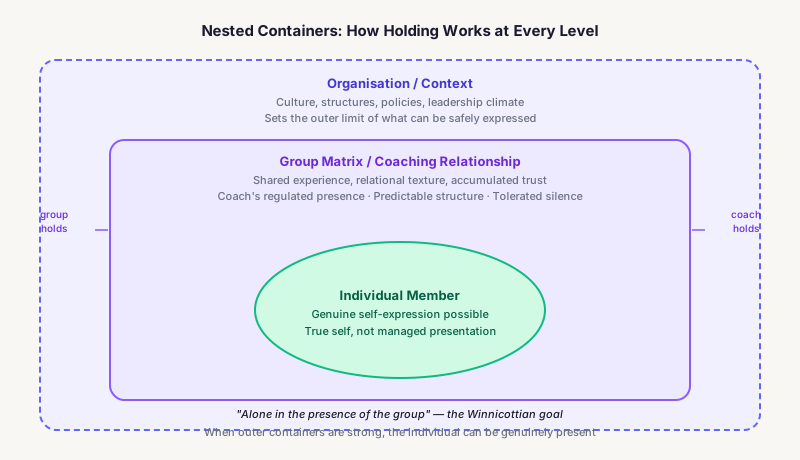
Applied to groups: a held group is one in which members can bring something real — an observation that might be unwelcome, a confusion that might look like incompetence, a feeling that was not planned — without needing to manage the group's reaction to it. The coach who provides holding is not the coach who is warm and validating. They are the coach who remains stable and present when difficult material emerges, who does not rush to resolve discomfort, who communicates through their own regulated presence that whatever comes up can be survived.
Bion's containing: metabolising what cannot yet be thought
Where Winnicott's holding describes the environmental provision of safety, Bion's concept ofcontainment describes what happens to difficult emotional material within that safe environment. Bion drew on the same infant-caregiver observation. The infant, he proposed, experiences states of raw anxiety — what he called beta elements: unprocessed sensory and emotional experience that cannot yet be thought. The infant projects these into the mother through crying, demanding, clinging. The good-enough mother receives this projection, tolerates the anxiety herself, transforms it into something manageable, and returns it to the infant in a form that can be used: as comfort, as understanding, as a felt sense that the unbearable is not actually unbearable.
This transformation — the metabolising of raw anxiety into thinkable experience — is containment. In groups, containment is what allows a team to work with material it previously could not approach. Without containment, anxiety remains raw: it drives fight/flight, dependency, paralysis. With containment, the anxiety becomes information. The team can think about why the deployment pipeline has become the focus of so much feeling. It can examine what its dependency on the product owner is actually about. It can notice the deferral pattern without defending against the noticing.
The coach who provides containment is not providing answers. They are providing acontainer: a relational space in which the group's anxiety can be received, tolerated, and gradually transformed into something that can be thought about. This is an active function, not a passive one. It requires the coach to be able to hold anxiety themselves — to sit with the group's distress without needing to resolve it prematurely. The coach who cannot tolerate the group's anxiety will rush to fill silences, redirect difficult conversations, or offer reassurance that closes down inquiry. The result is a group that learns, correctly, that its real material cannot be brought into this space.
The group as the container
In the early stages of a group's life, the holding and containment functions rest primarily with the coach. Members look to the coach's presence and regulation to tell them whether the space is safe. They test the coach — with provocative statements, with silences, with material that is slightly more personal than expected — to see whether the container holds. If the coach can receive these tests without becoming anxious, defensive, or controlling, the group begins to trust the space.
Over time, in a group that is developing well, something more significant occurs: the holding function distributes. The group matrix — the web of relationships, shared experience, and tacit understanding that constitutes the group as a whole — begins to carry some of the containment work. Members hold each other. Someone says something honest, and instead of the awkward deflection or the coach's careful re-framing, another member responds with recognition. The group itself metabolises the material. The coach's role shifts: no longer the sole container, but the gardener of the group's own containment capacity.
This is the difference between a facilitated meeting and a genuine group. In the former, the facilitator is always the container and the meeting cannot function without them. In the latter, the group has developed enough relational depth that it can, to a meaningful degree, hold itself. The coach who understands this distinction stops measuring their success by how well they ran the session and starts measuring it by how much the group needed them to run it.
What happens when holding breaks down
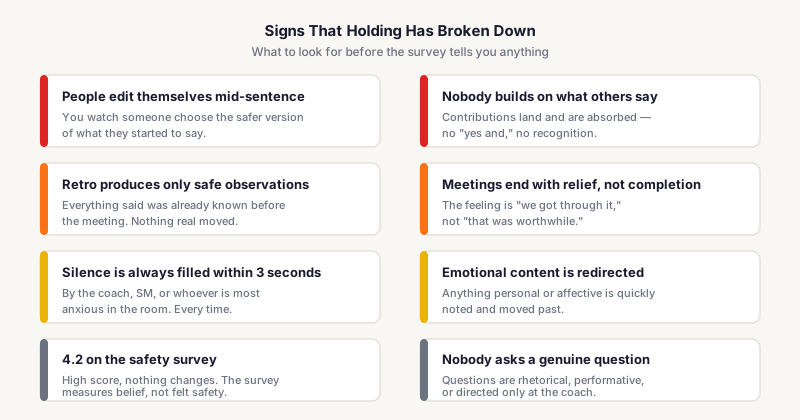
Holding is not a permanent achievement. It can be lost — through changes in membership, through organisational disruption, through a single session in which something difficult was mishandled and the group learned that the container is not reliable. When holding breaks down, the indicators are specific and recognisable if you know what to look for.
People edit themselves mid-sentence: you watch someone begin to say something that might matter, and then watch them recalibrate in real time, choosing the safer version. Nobody builds on what others say: contributions land and are absorbed, generating no further exchange, no "yes, and," no "I noticed that too." The retrospective produces only observations that everyone already knew before the meeting began: process-level, technical, solvable without anyone having to take a risk. Meetings end with relief rather than completion — the feeling is not "that was worthwhile" but "we got through it." Silence is filled by the coach or Scrum Master within three seconds, every time, without exception.
The uncontained group is not a broken group. It is a group that has learned, through experience, that certain kinds of experience cannot be brought into the space. That learning is adaptive: the group is protecting itself from an environment that has, at some point, been unreliable. The coach's task is not to confront this learning but to provide enough consistent holding over enough time that the group can revise it.
Holding to exchange: the sequence that underpins all learning
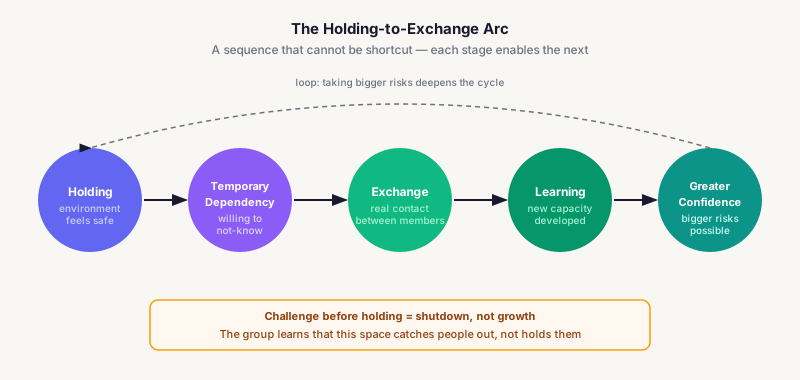
There is a sequence that underlies all genuine learning in groups, and it cannot be shortcut. It begins with holding: the group must experience the environment as reliably safe before it will take the risks that learning requires. From holding comes the possibility oftemporary dependency — the willingness to not-know, to be in a learning position, to let someone else carry knowledge while you are uncertain. This temporary dependency is not the pathological dependency of Bion's basic assumption. It is the ordinary vulnerability of anyone who is genuinely learning something.
From temporary dependency comes exchange: the actual transmission of experience, understanding, and perspective between group members. Not the exchange of information — teams do that constantly without learning anything. But the exchange of something that changes the person receiving it: a reframe that destabilises an assumption, a recognition that produces connection, an honest account of difficulty that gives permission for others to acknowledge their own. This exchange is what produces learning in the group-analytic sense: not the acquisition of new content but the development of new capacity.
From exchange comes learning, and from learning comes something important: not just the accumulation of knowledge, but an increase in the group's confidence in its own capacity to learn. The group that has successfully worked through something difficult together develops a felt sense of its own resilience. This confidence creates the conditions for taking bigger risks, which creates the conditions for deeper exchange, which closes the loop. The sequence is cumulative and self-reinforcing — but only if holding is established first.
The coach who moves to challenge before holding is established will generate shutdown rather than growth. Challenge without holding feels like attack. The group's defences engage. People become careful. The group learns that this space is one where you can be caught out, not one where you can be genuinely uncertain. No amount of psychological safety survey score will tell you that this has happened. But you will see it in the retrospective. You will see it in who speaks, what they say, and the relief with which the meeting ends.
What coaches actually do to build holding
Building holding is not a technique. It is a practice that works through accumulated consistency over time. But there are specific behaviours that either contribute to it or undermine it, and naming them makes the practice more intentional.
Consistent arrival: the coach who is reliably present, who starts on time, who brings the same quality of attention to the eighth retrospective that they brought to the first, is communicating something important about the reliability of the container. This sounds trivial. In groups that have experienced unreliable leadership or repeated organisational disruption, it is not trivial. It is the primary evidence on which the group builds its assessment of whether this space can be trusted.
Predictable structure in the opening of sessions: not rigidity, but a recognisable shape to how sessions begin. A consistent check-in question, a brief orientation to what the session will hold, a moment before diving in. This predictability reduces the group's need to scan for threat at the start of each session, and frees cognitive and emotional resources for the actual work.
Naming what is happening without judgment: when the group is doing something — going quiet, rushing through an item, returning to the same complaint — the coach names it as observation rather than diagnosis. "I notice we've moved quickly past that" is different from "I think you're avoiding something." The first keeps the group as the authority on its own experience. The second positions the coach as the expert on the group's hidden life, which can be felt as intrusive and shuts down exploration rather than opening it.
Tolerating silence: silence in a group is almost always being processed somewhere. The coach who can wait — for ten seconds, fifteen, twenty — is communicating that the space can hold whatever is happening in the silence. The coach who fills it immediately is communicating that silence is a problem to be solved. Groups learn quickly which coach they have.
Not rushing to fill discomfort: closely related to tolerating silence, but broader. When something difficult is said, when there is an awkward moment, when the group moves into unfamiliar territory, the holding coach stays present and regulated rather than quickly redirecting. The ability to sit in the uncomfortable moment without managing it away is possibly the most important single behaviour in the holding repertoire.
The survey will never tell you whether the group is held
The 4.2 score is real, and it is not sufficient. What it measures — the cognitive belief that you won't be punished — is a necessary precondition for a held group, but it is not holding itself. Holding is experienced in the body, in the felt sense of the room, in whether people are present or managed, in whether the retrospective ends with relief or with something having been genuinely worked. These are not measurable, and that is not a limitation to be overcome. They are the nature of the thing.
The coach who wants to know whether a group is held has to be in the room. They have to pay attention not to what is said but to what is not said; not to the score but to the quality of contact; not to whether the retrospective produced action items but to whether anything real moved. This kind of attention is itself a form of holding. The group that is attended to in this way — where someone is genuinely present to what is happening, not just managing the process — is already, in a small measure, more held than it was before the coach arrived.
Continue Exploring
Go deeper into the work
The Book
The Art of Creating Self-Organizing Teams
The full framework behind this article — contracting, team dynamics, and practical coaching tools for every stage of the journey.
Companion Toolkit
Resistance Radar & Resilience Scorecard
Practical tools for mapping resistance patterns and measuring whether interventions increased capacity — not just compliance.
TA for Agile
Co-creative TA in Agile Contexts
Ego states, psychological contracts, group imago, and the relational concepts that underpin this article — applied to real teams.