What Groups Remember: The Matrix, Membership Change, and Why Restructuring Doesn't Reset a Team
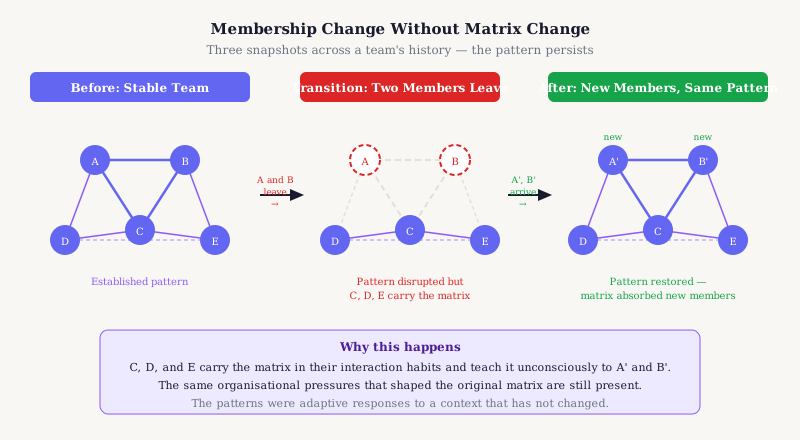
The manager replaces two members of a stuck team and waits for the pattern to change. The pattern does not change. The new members, within three sprints, are doing exactly what their predecessors did — sometimes down to the phrasing. The team was not changed by changing its members. The matrix was not touched.
The pattern comes back
The manager replaced two members of a stuck team. The replacements were careful hires: different backgrounds, different working styles, different energy to what had been there before. The hope was that new people would shift something that had proved impervious to coaching, process change, and two rounds of team agreements.
Within three sprints, the pattern was back. The new members were doing almost exactly what the previous members had done. The same conversations were being avoided. The same person was being talked over in the same circumstances. The same defensive response appeared when delivery pressure increased. In some cases, almost word for word.
The team was not changed by changing its members. Something else was never touched. To understand what that something else is, it helps to begin with what S.H. Foulkes observed about groups — and what he found that no individual in the group could account for.
What S.H. Foulkes observed
S.H. Foulkes was the founder of group analysis, a tradition of therapeutic group work developed in the mid-twentieth century from psychoanalytic roots. His central contribution was the concept of the group matrix: the network of communication, meaning, and relationship that forms as a group develops over time.
The matrix is not the people in the group. It is the pattern of interactions, shared understandings, and implicit meanings that the people have created together — and that now has an existence independent of any individual member. Foulkes described it as the common ground from which all communication in the group proceeds: the background that makes certain things sayable and others unsayable, certain roles available and others foreclosed, certain responses predictable and others unthinkable.
The matrix is invisible to the people inside it precisely because it is the medium they inhabit, not an object they can observe. It is what Foulkes called the group's transpersonal network — a structure that operates through individuals without being located in any of them. To change the matrix, you have to work with the network itself. Changing the nodes does not change the network.
The matrix is not reducible to its current members
This is the central claim, and it is worth pausing on it because it contradicts the intuitive model most managers and coaches hold: that a team is its people, and that changing the people changes the team.
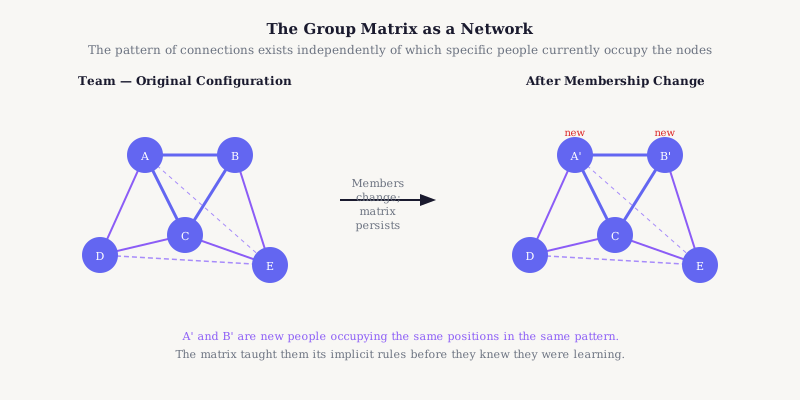
The matrix outlasts member turnover. Members who leave do not take their share of the matrix with them. The patterns they participated in — the communication habits, the unspoken rules, the established avoidances — persist in the group after they have gone. Members who arrive enter the matrix and begin to be shaped by it before they can consciously name what is happening to them.
This is not metaphor or theoretical abstraction. It is observable. Teams teach new members their implicit rules through dozens of micro-interactions: who speaks first, which topics are handled with care, how disagreement is managed, what happens when someone names something that is usually avoided. The new member absorbs this curriculum without a syllabus, without knowing they are learning, and usually without any existing member knowing they are teaching. The matrix is self-transmitting.
What new members actually join
A new team member joins not just a set of people but a system with established properties. They join the team's existing communication patterns: who talks to whom, which channels carry important information, which relationships are load-bearing. They join its unspoken rules about what can and cannot be said in which forums, in whose presence, and with what level of directness.
They join the team's existing power structure — not the formal hierarchy, but the actual influence map: who shapes decisions, whose concerns are taken seriously, who has the informal authority to shift the group's direction. They join the team's current basic assumption state: if the team is in Bion's fight/flight mode, the new member will find themselves in conflict within weeks without knowing why. If the team is in dependency mode, they will find themselves waiting for direction without understanding the wait.
Most onboarding processes address the technical and process dimensions of joining: access to systems, introduction to workflows, explanation of the team's current projects. None address the matrix. The new member is given a map of the technical landscape and left to navigate the relational landscape alone. The relational landscape is the one that will actually determine whether they thrive or become absorbed into the team's existing pattern.
Why restructuring rarely resets a team
The pattern that returned within three sprints in the opening example is not unusual. It is the expected outcome when restructuring addresses membership without addressing the matrix. The reasons for this are layered.
The longer-standing members of the team carry the matrix in their interaction patterns and unconsciously teach it to new arrivals. Even with good intentions — "we want this team to be different" — the habits of communication are deeper than conscious intention. The teacher teaches what they know. What they know is the existing matrix.
The team's environment reinforces it. The organisation, the management structure, the stakeholder relationships, the political dynamics — all of these shaped the matrix in the first place and continue to exert pressure in the same directions. New members encounter the same pressures and make the same adaptive responses that their predecessors made, for good reasons.
Most fundamentally: the patterns in the matrix were created in response to something real. The avoidance of a particular topic exists because someone learned, at some point, that raising it was costly. The communication flowing through one dominant node exists because the team found that this worked, or because the alternative was unsafe. The patterns are not irrational. They are adaptive responses to a context that has not changed. New members encounter the same context and make the same adaptations.
What a healthy matrix looks like versus a constricted one
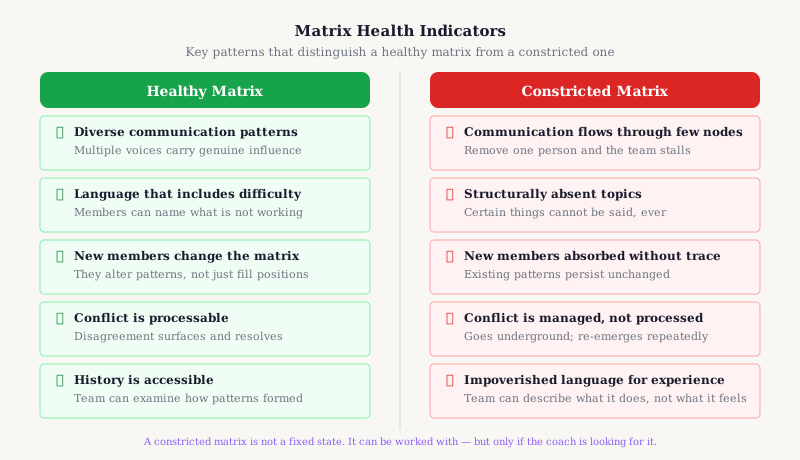
Not all matrices are equivalent. The health of a group's matrix is diagnostically significant — it shapes what the group can and cannot do, what it can and cannot discuss, and whether new members have any prospect of changing the system they enter.
A healthy matrix has diverse communication patterns: multiple voices carry genuine influence, and different members hold the floor in different contexts. The team has a shared language that includes difficulty — members can name what is not working without the naming itself becoming an event. New members are integrated into the matrix and, over time, genuinely change it: they introduce new patterns that alter the network rather than being absorbed without trace.
A constricted matrix shows a different configuration. Communication flows through one or two dominant nodes; remove those individuals and the team struggles to function. Certain topics are structurally absent — not because no one has anything to say about them, but because the matrix makes them unsayable. New members are absorbed into the existing pattern rather than shifting it. The team's language for its own experience is impoverished: members can describe what they do but not what they feel about it, can articulate the process but not the dynamic.
Membership transitions as coaching opportunities
There are moments when the matrix becomes unusually visible, and these moments are among the most valuable in team coaching. The first is onboarding: a new member encountering the matrix's implicit rules for the first time has a period — brief, and rapidly closing — in which the rules are visible to them precisely because they have not yet internalised them. The new member's confusion, their questions, their surprised reactions are diagnostically rich. Experienced coaches work with new members explicitly during onboarding, treating their observations as data about the matrix.
Departure is equally significant. When a member leaves, the matrix adjusts. The functions that member served — whether formal or informal, acknowledged or unconscious — are redistributed. Coaches who work with teams through departures often see the matrix reorganise in real time: the communication patterns that flowed through the departing member find new channels, or expose the absence of channels, in ways that the team had not previously noticed.
Team splits and merges are the highest-intensity matrix events. When two teams merge, two matrices collide. Each has its implicit rules, its established communication patterns, its characteristic ways of managing anxiety. What was invisible within each team becomes visible through the friction between them. The new team's early conflicts are rarely about what they appear to be about. They are the matrices negotiating their encounter.
What coaches can do with the matrix
The first move is to name patterns without attributing them to current members. "I've noticed the team tends to move away from this topic very quickly" is a different intervention from "you avoid this topic." The first names the matrix pattern and opens it for examination. The second invites defensiveness and implicit blame. Current members did not create the matrix alone. They inherited much of it and are reproducing it, often without awareness that they are doing so.
The second move is to ask historical questions. "Has this happened before? How long has this been the way things work here? What do people remember about when this pattern started?" These questions make the matrix's history visible. Teams that have only existed in the present tense — responding to immediate pressures, never reflecting on how they came to be as they are — are particularly susceptible to treating their patterns as natural features of reality rather than responses to a history that can be examined.
Onboarding deserves deliberate slowing down to include relational integration alongside technical. This does not require extensive process or elaborate ritual. It requires someone — the coach, a team lead, a thoughtful colleague — to say to a new member: "Tell me what you're noticing. What seems unusual about how this team works? What questions do you have that you haven't known how to ask?" The observations of a new member in their first weeks are among the most diagnostically useful data available about the matrix.
Team splits and merges should be treated as significant system-level events requiring dedicated coaching attention — not a single workshop, but sustained engagement through the transition period. The two matrices need time and space to encounter each other explicitly before the friction becomes entrenched as conflict. Coaches who treat merges as primarily a process design problem miss the relational work that determines whether the new team's matrix will be a creative synthesis or a suppressed collision.
What the team carries
The manager who replaced two members of the stuck team was not wrong about the team needing something to change. They were wrong about what needed to change. The members were a symptom of a pattern; the pattern was in the matrix; the matrix was untouched.
You cannot change a team by changing its members. You can change the members as many times as the organisation has patience for, and the pattern will return — sometimes faster with each iteration, as the matrix becomes more established with each cycle of apparent change that changes nothing.
You can only change a team by changing what the team carries: the shared understandings, the implicit rules, the communication patterns, the collective relationship to difficulty. The matrix is where that work happens. And working with the matrix requires a different kind of attention — to patterns rather than people, to history rather than just the present, to what is absent as much as what is present. This is what group-analytic thinking offers to team coaches. Not a technique, but a lens.
Continue Exploring
Go deeper into the work
The Book
The Art of Creating Self-Organizing Teams
The full framework behind this article — contracting, team dynamics, and practical coaching tools for every stage of the journey.
Companion Toolkit
Resistance Radar & Resilience Scorecard
Practical tools for mapping resistance patterns and measuring whether interventions increased capacity — not just compliance.
TA for Agile
Co-creative TA in Agile Contexts
Ego states, psychological contracts, group imago, and the relational concepts that underpin this article — applied to real teams.