The Team That Always Agrees Is at Risk: Groupthink in Agile Settings
Psychological safety is often described as the condition where people feel free to disagree. But teams can score high on safety surveys and still be incapable of genuine disagreement. This is not safety. It is collusion. The mechanism has a name — groupthink — and Agile creates many of the conditions that make it more likely, not less.
Twelve action items, unanimous agreement, eighteen months later
The retrospective generates twelve action items and unanimous agreement. The team is well-functioning, the coach thinks. Six months later, the coach reviews the retrospective archive and notices: the same twelve items appear in slightly different wording every third sprint. The team has not been agreeing. It has been rehearsing its agreement.
The difference between agreement and the rehearsal of agreement is one of the harder things to see from inside a team. The surface looks identical. The action items are genuine. The commitment is real, in the moment. But the conversation that would challenge the frame is never had — and each sprint that passes without it makes it slightly less possible to have.
What groupthink is — and what it isn't
Irving Janis coined the term groupthink in 1972, after studying a series of US foreign policy failures — the Bay of Pigs invasion, the escalation in Vietnam — in which highly competent groups produced catastrophically poor decisions. His finding was not that the groups lacked intelligence or information. They had both. What they lacked was the capacity to use that intelligence and information in the service of accuracy rather than cohesion.
Groupthink is not conflict avoidance. It is not politeness. It is not even what is commonly called psychological safety — in fact, a team can score high on psychological safety surveys while exhibiting classic groupthink. Janis defined it as the deterioration of mental efficiency, reality testing, and moral judgment in the service of group cohesion. The group has unconsciously decided that cohesion matters more than accuracy.
This is a group-level process, not a collection of individual choices. No one decides to stop thinking clearly. The deterioration happens in the interaction — in what the group makes rewarding (agreement, smoothness, forward motion) and what it makes costly (friction, doubt, dissent).
The Agile conditions that make groupthink more likely
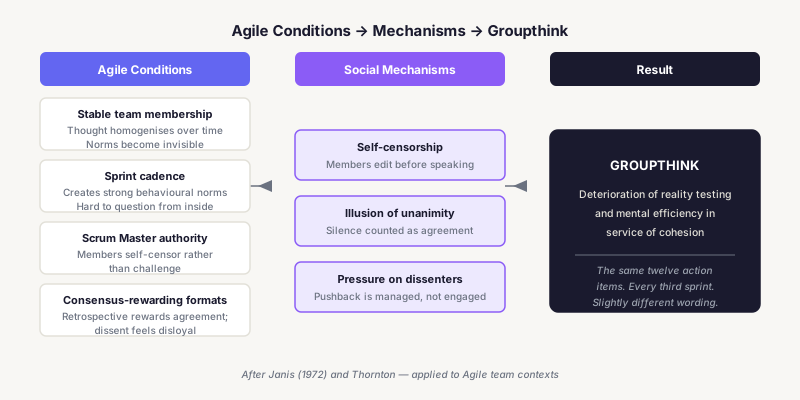
Several features of Agile practice create conditions that favour groupthink over time. Stable team membership — the cross-functional, long-lived team that Agile recommends — produces homogenisation of thought as members adapt to each other's preferences and sensitivities. The team becomes fluent in its own idiom. The idiom becomes a frame that excludes alternatives.
Sprint cadence creates strong norms quickly. The two-week rhythm establishes what counts as a reasonable conversation, what pace decisions should move at, what level of challenge is appropriate. These norms become invisible — which is what makes them effective and what makes them difficult to question.
The Scrum Master role, even when occupied skillfully, carries implicit authority. Members often self-censor rather than challenge a direction the Scrum Master seems invested in. And the retrospective format itself — designed to surface issues — can paradoxically reward consensus: action items that everyone agrees on, positive framing, the feeling of shared forward motion. Dissent in a retrospective feels like a vote against the team.
Eight signs to look for
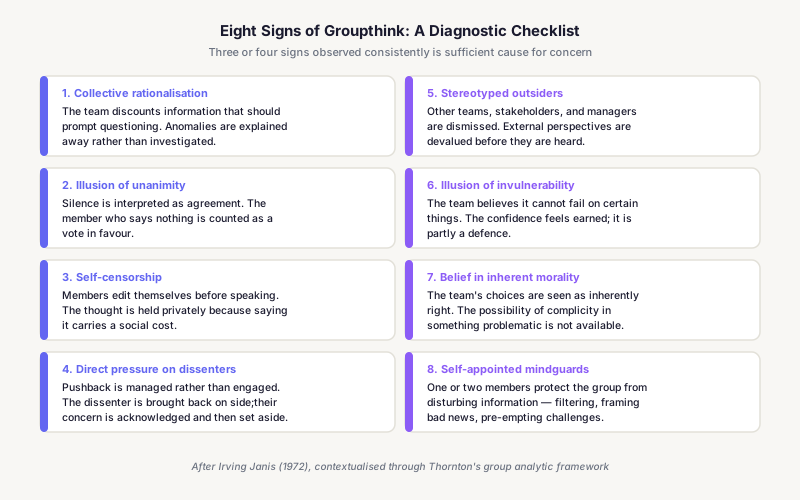
Janis identified eight symptoms of groupthink, which Thornton contextualises for group analytic work. They do not all need to be present. Three or four, consistently observable, are enough to take seriously.
Collective rationalisation: the team discounts information that should prompt questioning. Data that challenges the direction is reinterpreted until it fits. The anomaly is explained away rather than investigated.
Illusion of unanimity: silence is interpreted as agreement. The member who says nothing is counted as a vote in favour. What goes unsaid is treated as endorsement.
Self-censorship: members edit themselves before speaking. They know what they think, but they also know that saying it will cost something — a raised eyebrow, a moment of awkward silence, a subtle shift in how they are perceived. The thought stays private.
Direct pressure on dissenters: when someone does push back, they are handled rather than engaged. The response to dissent is management — being brought back on side, having their concern acknowledged and then set aside, being made to feel that their doubt is a problem of their own making.
Stereotyped outsiders: other teams, stakeholders, and managers are dismissed as not understanding, not aligned, or simply wrong. The outside perspective is devalued before it is heard.
Illusion of invulnerability: the team believes it cannot fail on certain things. There is a category of risk that the team has implicitly agreed not to take seriously. The confidence feels earned. It is partly a defence.
Belief in inherent morality: the team believes its choices are inherently right — ethically, technically, culturally. The possibility that the team could be complicit in something problematic is not available for consideration.
Self-appointed mindguards: one or two members take it upon themselves to protect the group from disturbing information — filtering what reaches the team, managing the framing of bad news, pre-empting challenges before they can be voiced.
Groupthink and splitting: an important distinction
Splitting is a different group dynamic: the team projects difficulty outward onto an enemy — another team, management, a stakeholder, the organisation. The external other becomes the location of everything difficult, while the team maintains an idealised view of itself. Splitting is visible in "us vs. them" discourse that carries more heat than the actual conflict warrants.
Groupthink is internal homogenisation — the suppression of internal difference, not the projection of it outward. A team can do both simultaneously: unified internally (groupthink) against a common external enemy (splitting). The coach needs to distinguish them because the interventions are different. Splitting requires working with the relationship to the outside. Groupthink requires working with the team's relationship to its own internal dissent.
The difference between cohesion and collusion
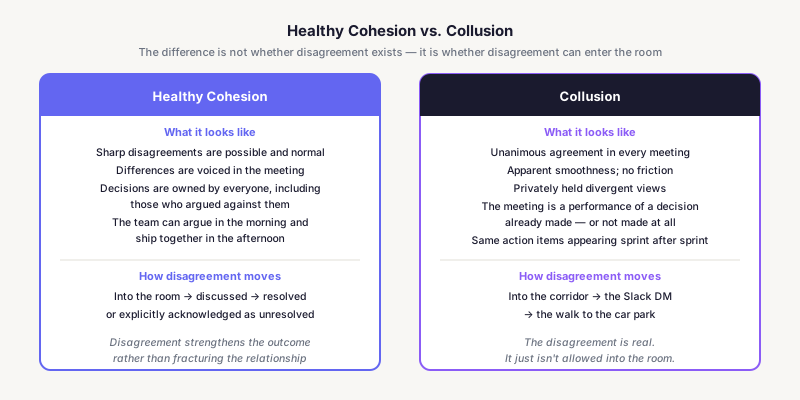
Healthy cohesion is not the absence of disagreement. It is the capacity to disagree productively and still coordinate. A cohesive team can have a sharp argument in the morning and ship together in the afternoon. The disagreement strengthens the outcome rather than fracturing the relationship.
Collusion maintains the appearance of agreement while individual members privately hold different views. The team presents a unified front. The real conversations happen in the corridor, in the Slack DM, in the walk to the car park. In collusion, the meeting is a performance of a decision that has already been made — or that everyone knows will not be revisited. The disagreement is real. It just isn't allowed into the room.
What coaches can do
Structural antidotes work at the level of the retrospective format itself. Anonymous input before the session reduces the cost of dissent by removing the social exposure. A devil's advocate role, rotated deliberately so no one is permanently cast as the troublemaker, normalises challenge. The question "what would our critics say?" built into planning creates a legitimate channel for doubt that the planning frame would otherwise exclude.
The coach can also name it when unanimous agreement seems too easy: "We've reached consensus on this quite quickly — I want to slow down and check whether there's anything that hasn't been said." This is not an accusation. It is an invitation. It signals that dissent is welcome without requiring any individual to volunteer as the dissenter.
The relational intervention names the pattern without attributing it to any individual: "I notice we tend to reach agreement quickly here — I'm curious what that's about." This opens the question of why agreement has become so important without identifying anyone as the problem. It invites the group to examine its own dynamic rather than defending against an accusation.
Making truth slightly safer than agreement
A team that always agrees is not a safe team. It is a team that has decided agreement is safer than truth. The decision is usually made without anyone choosing it — it emerges from the accumulated small moments in which doubt was swallowed, dissent was smoothed over, and the uncomfortable question was not asked. The coach's job is not to blow the agreement apart. It is to make truth slightly safer than agreement — to lower the cost of saying the thing that everyone knows but no one has said. That shift, compounded over time, is what makes a team capable of doing something it has not done before.
Continue Exploring
Go deeper into the work
The Book
The Art of Creating Self-Organizing Teams
The full framework behind this article — contracting, team dynamics, and practical coaching tools for every stage of the journey.
Companion Toolkit
Resistance Radar & Resilience Scorecard
Practical tools for mapping resistance patterns and measuring whether interventions increased capacity — not just compliance.
TA for Agile
Co-creative TA in Agile Contexts
Ego states, psychological contracts, group imago, and the relational concepts that underpin this article — applied to real teams.