What the team isn't saying about what it wants
Hidden agendas are personal goals at cross-purposes with the sprint that nobody named in planning. They are not sabotage — they are legitimate. Here is how to tell them apart from resistance and drama, and when to surface them.
The sprint goal was clear. Something else wasn't.
Planning went well. The goal was sharp, the scope was reasonable, and everyone nodded. By day three, one engineer is rewriting a module that isn't in scope. A designer is running discovery nobody requested. The sprint is technically on track but pulling in three directions.
The question that surfaces is almost always the same: did we communicate the goal badly? Usually, the answer is no. The goal was understood. What wasn't visible were the individual goals each person carried into the room alongside it.
What a hidden agenda actually is
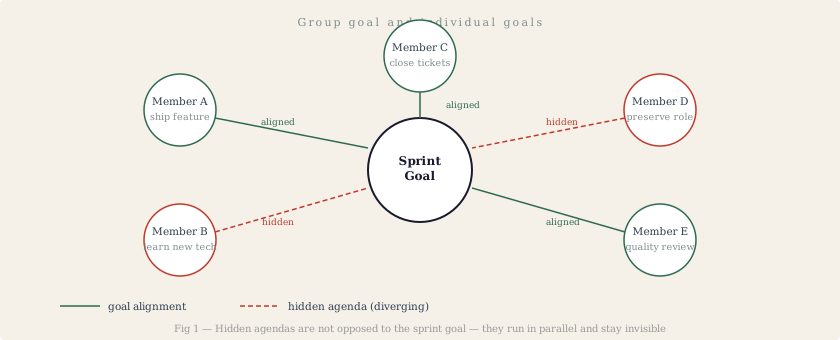
A hidden agenda is a personal goal that is unknown to other group members and at cross-purposes with the declared group goal. The phrase carries a manipulative connotation that is mostly undeserved. Johnson and Johnson's group theory is precise on this: hidden agendas "are present and legitimate and are simply problems to be solved." They are not sabotage. They are the ordinary personal motivations — career concerns, recognition needs, interpersonal dynamics — that every member brings into every group, and that the group's goal-setting process rarely makes visible.
The problem is not the agenda. The problem is that it is hidden — which means it cannot be negotiated, incorporated, or acknowledged. The group goal proceeds as if the personal goals don't exist, and the personal goals proceed as if the group goal is optional.
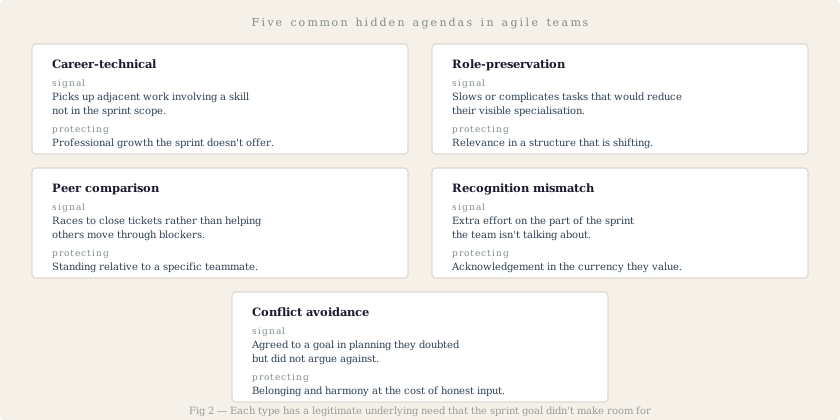
Five common types in agile teams
Not all hidden agendas look the same. These five patterns appear most frequently. The behavioural signal is the observable surface; the protecting function is what the agenda is actually serving.
Career-technical
Signal: Picks up work adjacent to the sprint that uses a technology they want to learn.
Protecting: Professional growth the sprint doesn't offer.
Role-preservation
Signal: Slows down or complicates tasks that would reduce their visible specialisation.
Protecting: Relevance in a structure that is shifting.
Peer comparison
Signal: Races to close tickets visibly rather than helping others move through blockers.
Protecting: Standing relative to a specific teammate.
Recognition mismatch
Signal: Puts extra effort into the part of the sprint the team is not talking about.
Protecting: Acknowledgement in the currency they value.
Conflict avoidance
Signal: Agreed to a goal in planning they visibly doubted but did not argue.
Protecting: Belonging and harmony at the cost of honest input.
How to tell a hidden agenda from resistance or drama
Hidden agendas, resistance, and game patterns all produce similar surface behaviour: off-task work, low commitment, indirect communication, and a sense that the agreed direction isn't actually being followed. The distinction matters because each requires a different response.
Resistance operates at the relational level — something in the environment or the ask is experienced as threatening, and the protective response is aimed at the system. The question resistance asks is: what is this person protecting, and from what? Drama patterns are patterned interactional games where participants rotate predictable roles and collect predictable feelings. The question drama asks is: what game is running, and what transaction is being repeated?
Hidden agendas operate at the goal level. The person is not protecting themselves from the environment, and they are not playing a game. They simply want something the sprint doesn't include, and they haven't said so. The diagnostic question is: what does this person actually want that isn't in the sprint goal?
Three diagnostic conversations
These conversations are exploratory, not interrogative. The goal is to open space for the member to name what they want — not to extract a confession. Each works best one to one, briefly, in the first few days of a sprint.
The goal-mapping conversation
"If this sprint went well for you personally, what would that look like?"
Not what the team needs — what would make this period feel worthwhile to them specifically.
The recognition conversation
"What kind of contribution do you most want to make visible this sprint?"
Opens the gap between the sprint's recognition structure and what the individual actually values.
The constraint conversation
"Is there anything you'd like to be doing that this sprint doesn't make room for?"
Names the constraint without naming the agenda. The member decides how much to surface.
When to leave a hidden agenda undisturbed
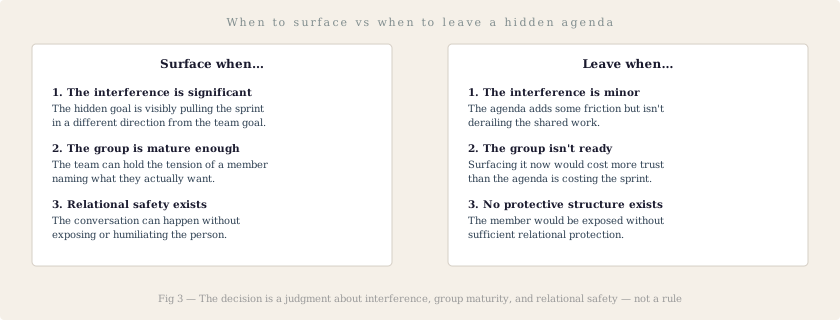
Not every hidden agenda needs surfacing. Johnson and Johnson are clear that "a judgment must be made about the consequences of bringing hidden agendas to the attention of the entire group." Three conditions suggest leaving it alone:
The agenda is not substantially interfering with the sprint. The group is not yet mature enough to hold the tension that surfacing it would create. Or the cost of surfacing it — loss of trust, exposure of the member, political risk — is greater than the cost of working around it quietly.
Surfacing a hidden agenda is a diagnostic act, not a disciplinary one. The appropriate register is curiosity, not confrontation.
The coach's responsibility is diagnostic, not confessional
The aim is not to make hidden agendas visible for their own sake. It is to understand enough about what each person actually wants to design goals and structures that make alignment more likely. A sprint goal that genuinely incorporates what members care about needs fewer conversations about hidden agendas because there are fewer agendas to hide.
The deeper question is not "what is this person hiding?" It is "what did our goal-setting process fail to ask about?"
Continue Exploring
Go deeper into the work
The Book
The Art of Creating Self-Organizing Teams
The full framework behind this article — contracting, team dynamics, and practical coaching tools for every stage of the journey.
Companion Toolkit
Resistance Radar & Resilience Scorecard
Practical tools for mapping resistance patterns and measuring whether interventions increased capacity — not just compliance.
TA for Agile
Co-creative TA in Agile Contexts
Ego states, psychological contracts, group imago, and the relational concepts that underpin this article — applied to real teams.