Why Sprint Patterns Repeat Without Anyone Choosing to Repeat Them
The standard TA account of games explains recurring interpersonal patterns through individual scripts. Sedgwick's horizontal account inverts this: some recurring patterns arise from above, transmitted and circulated by shared vocabularies that foreclose alternative options. Good retrospectives don't stop them because they don't change the vocabulary that generates them.
The sprint that ends the same way every time
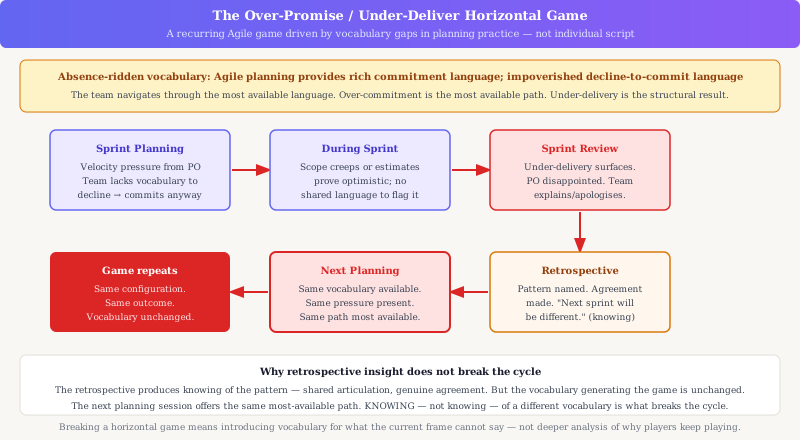
The pattern had been named in the very first retrospective the coach attended. The team was over-committing in planning, under-delivering by sprint end, and carrying the same conversation about it every two weeks. The why was clear: pressure from the product owner to maintain velocity, reluctance from the team to push back, and a shared tacit agreement not to make the conversation uncomfortable.
The team named it, made agreements, ran the next planning session differently. By the end of that sprint, the same over-commitment had happened again. The following retrospective produced the same naming, similar agreements, and another cycle began. After six months, the coach had done everything the standard toolkit offered: making it safe to say no, working with the product owner on realistic expectations, bringing historical data into planning, tracking the pattern explicitly. The pattern was more discussed. It was not more resolved.
What the coach had not done — and what no standard framework would have prompted — was to ask whether this pattern arose from script at all. Whether individual psychology was even the relevant level of analysis. Whether the pattern was vertical or horizontal.
Two accounts of why games persist
The standard TA account of games — developed by Berne and extended by subsequent practitioners — locates recurring interpersonal patterns in individual scripts. People play games because their early decisions, laid down in childhood contexts, created templates for navigating situations in ways that offer psychological payoffs. The game is repeated because the script is active, and the script changes through therapeutic or coaching work that reaches the decisions underlying it.
Sedgwick's horizontal account is structurally different. It does not deny that script-driven games occur. But it identifies a different mechanism: patterns that arise from above, transmitted and circulated through the shared vocabularies and social structures that a team or organisation inhabits. These are not expressions of individual psychological templates. They are pathways worn by the accumulated traffic of a shared form of life.
The distinction matters because it determines where the intervention should be aimed. A script-driven game changes through work with the individuals playing it — their histories, their decisions, their psychological needs. A horizontal game changes through work with the vocabulary and structure that generates it — the shared framework within which the pattern is the most available option.
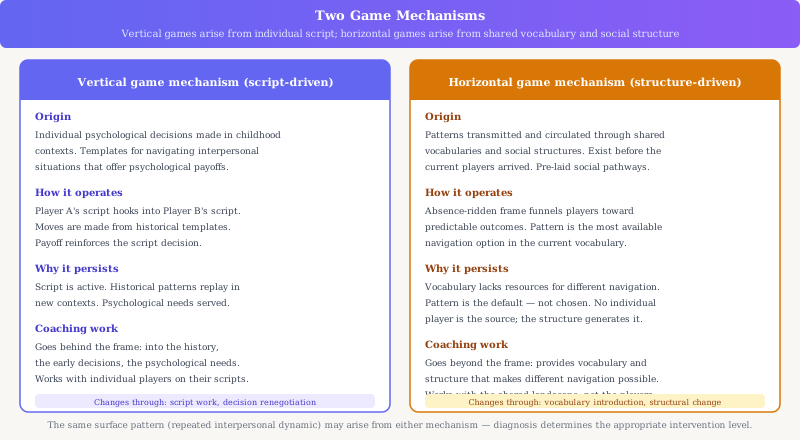
How horizontal games operate: pre-laid social pathways
Sedgwick describes horizontal games as patterns that have been transmitted and circulated — existing before the current players arrived, available as the most well-worn pathway through a shared social landscape. The game is not chosen. It is the default navigation option in a situation that the shared vocabulary does not yet have the resources to traverse differently.
The over-promise and under-deliver cycle in sprint planning is recognisable across hundreds of teams in different organisations, different sectors, and different cultural contexts. It is not a coincidence that so many different teams, composed of different people with different individual histories, reproduce the same pattern. The pattern is in the structure of the situation — in the shared vocabulary of Agile planning, in the implicit understanding of what "velocity" means and who it serves, in the social dynamics of product owner and development team relationships — not in the psychology of the people navigating it.
The absence-ridden frame that generates the game is this: Agile planning practice provides extensive vocabulary for estimation and commitment but relatively impoverished vocabulary for declining to commit, for naming structural impediments, for making explicit the gap between delivery pressure and delivery capacity. The most available language is the language of optimism and commitment. The team navigates through the most available language.
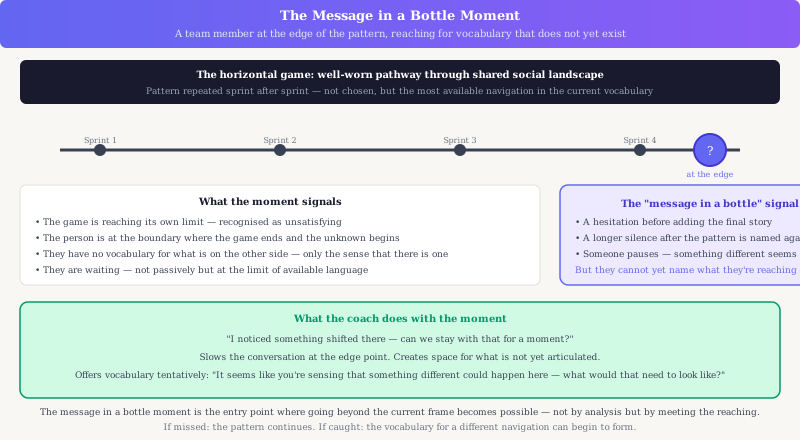
The "message in a bottle" moment
Sedgwick offers a distinctive diagnostic signal that coaches working with horizontal games can learn to track. He calls it the "message in a bottle" moment: the instance when a team member reaches the edge of the pattern and seems to be waiting for something they cannot yet name. A hesitation that is not quite reluctance. A pause in a familiar conversation that indicates, for a moment, that the person can sense that something different is possible without having the vocabulary to access it.
These moments are brief and easily missed. In a planning session, it might be a team member who pauses before adding the final story to the sprint backlog, whose hesitation suggests an internal conversation that the external conversation has no room for. In a retrospective, it might be the slightly longer silence after someone names the pattern again — a silence that suggests something is different this time, though no one can quite locate what.
The message in a bottle moment is the game reaching its own limit. The pattern is recognised as unsatisfying by the people inside it. They are returning to it not because it works but because they do not yet have an alternative. The coach who catches the moment and creates space for it — "I noticed something shifted there, can we stay with that for a moment?" — is working at the edge where the horizontal game can begin to loosen.
Going beyond the frame, not behind it
Working with horizontal games requires a different coaching move than working with vertical games. In a vertical game, the coaching work goes behind the frame — into the history, the decisions, the psychological needs that the game serves. In a horizontal game, the coaching work goes beyond the frame — into the vocabulary and structures that currently constitute the only available landscape.
Going beyond the frame means providing vocabulary that the team does not yet have. This is not analysis delivered from above — it is collaborative exploration of what lies outside the current shared language. What would it mean for this team to have a genuine conversation about delivery capacity without the commitment vocabulary getting in the way? What language would make it possible to say "we cannot do this at this quality in this time" without that statement being heard as failure?
Going beyond the frame also means attending to the structural conditions that the vocabulary is embedded in. The over-promise and under-deliver game is not only a vocabulary problem — it is a structural problem: the incentive structure that rewards commitment and penalises accurate estimation, the relationship between the team and its product owner that makes pushback feel costly, the organisational norms that treat delivery pressure as a legitimate management tool. Vocabulary alone cannot change these conditions. But changing vocabulary is often the first accessible lever that begins to loosen them.
What changed in the opening team
The shift, when it came, was not from any individual team member's change of behaviour. It came from the introduction of new shared language — specifically, a way of talking about capacity that was distinct from commitment, that could be used in planning without triggering the defensive dynamics that commitment language produced.
The team needed to be able to say "this is what we can do at the quality level the work requires" rather than "this is what we'll commit to." The first sentence exists in a different vocabulary from the second — one that does not activate the same implicit game structure. Once the team had the vocabulary, the message in a bottle moments stopped being pauses that went nowhere and started becoming entry points into a different conversation.
That is what working with horizontal games looks like. Not deeper work into individual psychology. Not more sophisticated game analysis. Not better retrospective facilitation. Going beyond the current frame to provide the vocabulary that makes a different navigation possible. The pattern that repeats without anyone choosing to repeat it persists until the shared landscape changes enough to offer a different path through.
Continue Exploring
Go deeper into the work
The Book
The Art of Creating Self-Organizing Teams
The full framework behind this article — contracting, team dynamics, and practical coaching tools for every stage of the journey.
Companion Toolkit
Resistance Radar & Resilience Scorecard
Practical tools for mapping resistance patterns and measuring whether interventions increased capacity — not just compliance.
TA for Agile
Co-creative TA in Agile Contexts
Ego states, psychological contracts, group imago, and the relational concepts that underpin this article — applied to real teams.