When the Problem Isn't Inside Anyone: Horizontal Problems in Agile Teams
Most Agile team coaching assumes the difficulty lives inside team members — scripts, defences, underdeveloped skills. Sedgwick's horizontal/vertical distinction names the alternative: many Agile team problems arise from what the organisational context is withholding, not what people carry. Applying vertical interventions to horizontal conditions keeps teams stuck at symptom level.
The intervention that doesn't reach the problem
The coach had worked with the team for four months. The diagnostic work had been careful: a thorough assessment of the team's dynamics, clear identification of the patterns, good working hypotheses about the underlying causes. The interventions that followed were well-designed, professionally executed, and grounded in solid theory.
At the end of four months, the team's retrospective data showed modest improvement. The coach's own sense was that something essential had not shifted. The patterns were less intense, perhaps. But the team still functioned within the same basic structure. The same voices dominated. The same topics were avoided. The same tension between the team and its stakeholders produced the same strain.
What the coach had missed — and what most Agile coaching frameworks are not equipped to help practitioners see — was that the problem was not where the coaching had been directed. The difficulty did not live inside the team members. It lived in the structure of the situation the team was embedded in. The coach had applied a vertical intervention to a horizontal problem. And that is not, in Sedgwick's terms, an error of technique. It is an error of diagnosis.
The vertical assumption in Agile coaching
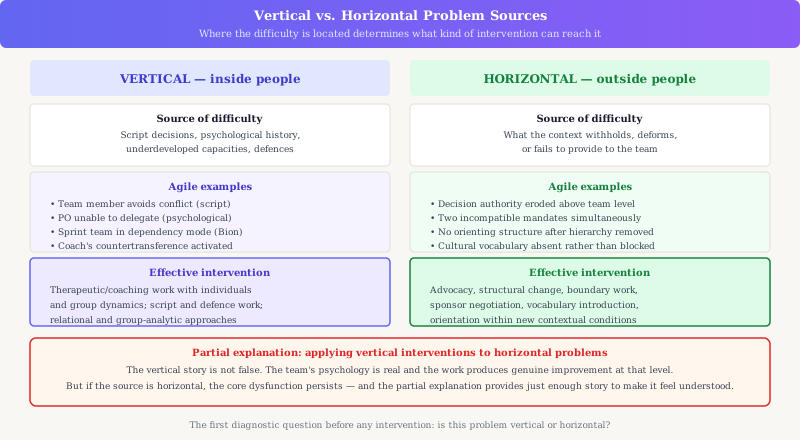
James Sedgwick's first major contribution in Contextual Transactional Analysis is a distinction that cuts across the entire field of team and organisational coaching: the difference between vertical problems and horizontal problems.
Vertical problems are located inside people. They arise from what individuals and teams carry — psychological history, script decisions, underdeveloped capacities, defences formed in earlier contexts. The therapeutic and coaching traditions that inform most Agile coaching work are fundamentally oriented to vertical problems. They assume that the difficulty is in the person or the group, and that the coach's task is to unlock, develop, or work through what is inside.
Horizontal problems are located outside people. They arise from what the organisational context has withheld, deformed, or failed to provide. They exist not in the team's psychology but in the structural conditions the team is embedded in. Coaching approaches built on vertical assumptions cannot see these problems clearly. When they encounter them, they typically produce a story about the team that is not false but is also not useful — because the story points in the wrong direction.
Three horizontal configurations
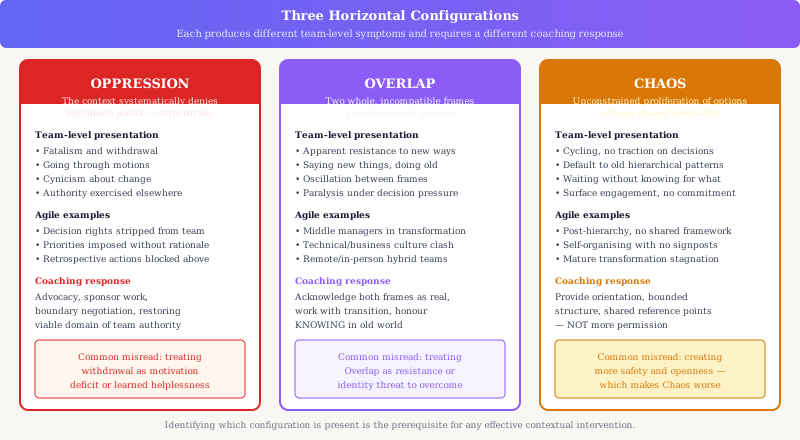
Sedgwick identifies three distinct horizontal configurations, each producing a recognisable pattern of team dysfunction that vertical interventions consistently fail to resolve.
Oppression is the configuration in which the context systematically denies team members' legitimate wants. The organisational hierarchy, the power structure, or the cultural norms consistently override what team members need in order to function effectively. This is not — crucially — a matter of bad intentions. Oppression in Sedgwick's sense is structural: it describes a situation in which the context is organised in a way that withholds what people need, regardless of what any individual actor intends. In Agile teams, Oppression typically shows up in the relationship between the team and its organisational context: decisions made above the team's authority level, requirements imposed without rationale, priorities shifted without consultation.
Overlap is the configuration in which two incompatible frames of reality are simultaneously present. The team, or particular members of it, must navigate between two whole yet mutually exclusive worldviews — each of which carries legitimacy, neither of which can be easily reconciled with the other. In Agile transformations, Overlap is endemic among middle managers, who are simultaneously embedded in the old world and being asked to inhabit the new one. But it appears throughout organisations: in teams that span technical and business cultures, in groups that bridge remote and in-person working norms, in roles that carry both managerial and team-member responsibilities.
Chaos is the configuration in which the context has provided so little structure that orientation becomes impossible. This is different from Oppression (which provides the wrong structure) and different from Overlap (which provides two incompatible structures). Chaos provides no coherent structure at all. The Agile transformation that dismantles hierarchy without building shared frameworks, the self-organising team that has been handed full autonomy without any orienting reference points — these are Chaos configurations. The result is not liberation. It is disorientation.
The mechanism of partial explanation
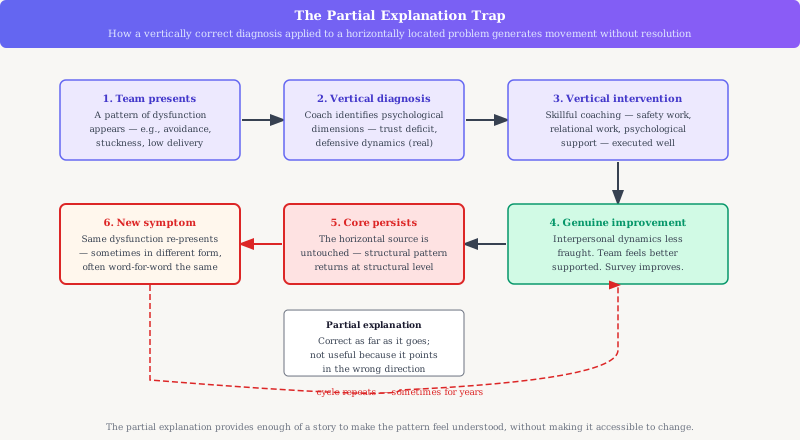
Sedgwick names the mechanism by which vertical interventions applied to horizontal problems produce the appearance of progress while leaving the core difficulty intact. He calls it partial explanation.
Partial explanation operates as follows: a team presents with a pattern of dysfunction. A vertically oriented coach correctly identifies some of the psychological dimensions of the pattern — there may well be defensive dynamics, underdeveloped trust, imperfect communication habits. These are real. The coach works with them skillfully and produces genuine improvement at that level. The team's interpersonal dynamics are less fraught. Individual team members feel better supported. The coaching is working.
And yet the core dysfunction persists. The same structural pattern returns. The team is better at managing its anxiety about the pattern, perhaps. It has more tools for discussing it. But the pattern itself — because it originates in the horizontal structure, not the vertical psychology — is unaffected by the intervention. The explanation the coach has offered is partial: correct as far as it goes, but not reaching the source.
This is why teams can spend years in Agile coaching and remain, at the structural level, fundamentally unchanged. The coaching has been real. The change has been real. But the change has been at the wrong level — and partial explanation has provided just enough of a story to make the pattern feel understood without making it accessible to change.
What a contextual diagnostic looks like
Sedgwick's framework does not ask coaches to abandon vertical assessment. Vertical problems are real and vertical interventions are valuable. The diagnostic move that Contextual TA adds is a prior question: before deciding whether a problem is vertical, ask whether it might be horizontal. Before working with what the team carries, ask what the context has withheld.
In practice, this means attending to a different set of questions. Is the pattern consistent across team members, or does it particularly affect certain roles or identities? (If consistent across diverse individuals, the cause is more likely horizontal.) Does the pattern change when the organisational context changes, or does it persist across context shifts? (Persistence across context changes suggests vertical; context-dependency suggests horizontal.) Is the team's dysfunction better explained by what they are doing or by what the situation is preventing them from doing?
The question of which horizontal configuration is present matters for intervention choice. Oppression calls for advocacy, boundary work, and negotiation with the organisational context. Overlap calls for acknowledging both frames as real and working with the transition rather than trying to eliminate one side of it. Chaos calls for providing orientation, bounded structure, and shared reference points — not more freedom, which makes the situation worse.
A different kind of coaching question
The coach from the opening example, working with a team that was not substantially changing despite skilled intervention, was asking: "What is happening inside this team that I am not reaching?" The better question — the question that Contextual TA makes available — was: "What is this team's context withholding that no amount of coaching can supply?"
The answer, in that particular case, was structural: the team's authority to make meaningful decisions had been progressively eroded by organisational changes over the previous year. The team was not resistant. It was doing the best available thing in an Oppression configuration — and the best available thing, under Oppression, is often to manage the anxiety of powerlessness rather than to exercise the agency that the context has withdrawn.
Once the horizontal diagnosis was made, the coaching shifted. The work became about the team's relationship to its organisational context — naming the structural reality, identifying what leverage was available, and working with the sponsor to restore a viable domain of team authority. That is a different kind of coaching. It is also, in this case, the kind that could actually reach the problem.
Continue Exploring
Go deeper into the work
The Book
The Art of Creating Self-Organizing Teams
The full framework behind this article — contracting, team dynamics, and practical coaching tools for every stage of the journey.
Companion Toolkit
Resistance Radar & Resilience Scorecard
Practical tools for mapping resistance patterns and measuring whether interventions increased capacity — not just compliance.
TA for Agile
Co-creative TA in Agile Contexts
Ego states, psychological contracts, group imago, and the relational concepts that underpin this article — applied to real teams.