What Your Team Knows Is Not What Your Team KNOWS
Teams that can perfectly articulate what needs to change in a retrospective and then do exactly the same thing next sprint. Sedgwick's knowing/KNOWING distinction provides the explanation. Facilitation reliably produces knowing. Coaching at its best produces KNOWING — the deep familiarity when a team's understanding of its pattern genuinely shifts.
The sprint that understood everything
The retrospective went well. The team identified the pattern clearly: they had been cutting corners on acceptance criteria when under delivery pressure, which was creating rework in subsequent sprints. They named it precisely. They could trace it through the last four sprints. They understood why it was happening. They agreed, with apparent conviction, that next sprint would be different.
Next sprint, the same thing happened. The same corners were cut. The same pressure appeared, the same decision was made, and three weeks later the same rework arrived. In the following retrospective, the team identified the pattern again — almost word for word — and agreed again that it would change.
The coach had run dozens of well-structured retrospectives. The team had demonstrated, repeatedly, that they understood the problem. And yet understanding the problem had produced no change in the pattern. Something was missing between knowing what was wrong and being able to do anything different about it.
Knowing and KNOWING: a distinction worth making precisely
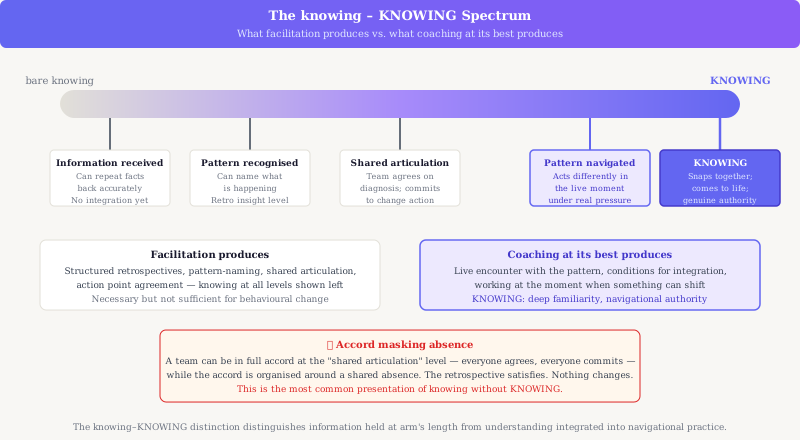
James Sedgwick, drawing on Wilfred Bion and the philosopher Robert Brandom, distinguishes between two qualitatively different relationships to knowledge. Knowing (lower case) is bare command of facts — the ability to recognise, articulate, and work with information. A team member who can describe their sprint pattern accurately, name what triggers it, and explain why it persists has knowing of the problem. This is not nothing. It is the output of good facilitation and careful retrospective work.
KNOWING (upper case) is something qualitatively different. Sedgwick describes it as deep familiarity — the moment when a way of seeing things "snaps together and comes to life," when a person can commit to its full meaning and resonance, not just its content. KNOWING carries what Brandom calls authority: the entitlement to act from a position, to navigate genuine uncertainty from within a framework that is not just intellectually held but inhabited.
A team with knowing of their pattern can describe it. A team with KNOWING of it can navigate it differently in the moment when it matters — not because they remember the retrospective insight, but because the insight has become part of how they see the situation as it unfolds. The difference is not a matter of more information. It is a matter of a different quality of understanding.
Why facilitation reliably produces knowing
Agile ceremonies — retrospectives, reviews, planning sessions — are structured for knowing production. They surface information, name patterns, generate action points, and create shared articulation of what is happening. A well-facilitated retrospective is an efficient knowing machine: it takes a group of people with distributed knowledge and produces a shared, explicit account of the team's situation.
This is genuinely valuable. Teams that cannot articulate their patterns cannot even begin to work with them. The retrospective as a format has served Agile teams for decades precisely because it makes the implicit explicit and the distributed shared. Knowing is not a consolation prize — it is a necessary condition.
But it is not a sufficient one. Knowing is information held at arm's length — understood, acknowledged, agreed with, and yet somehow not yet integrated into the way the team navigates its actual situations. The knowing produced in a well-run retrospective on Friday afternoon does not automatically become the frame through which a team member makes a decision under pressure on Tuesday morning. For that translation to happen, something further is required.
When accord masks absence
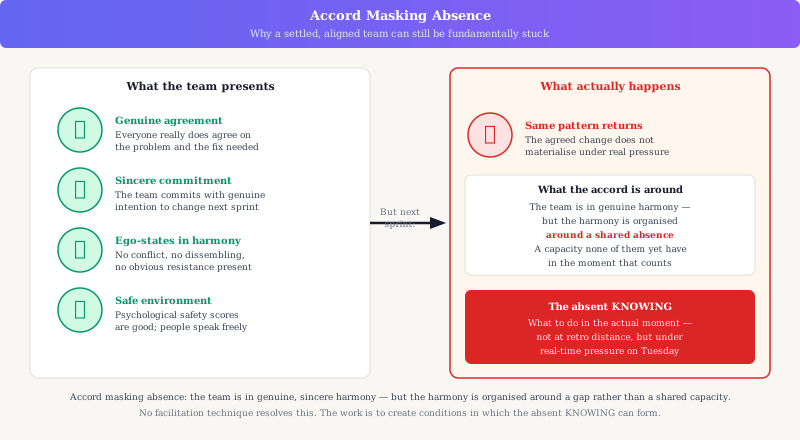
Sedgwick introduces a concept that explains one of the most confusing coaching experiences: the team that feels settled, aligned, and clear — and is yet still stuck. He calls it accord: a state in which ego-states come into harmony around a shared absence. The team is in genuine agreement. No one is dissembling. The accord is real.
What the accord is organised around, however, is not a shared understanding but a shared gap — a piece of knowledge that everyone in the team lacks, or a capacity that no one has yet developed, or a frame of reference that the team does not possess and does not know it does not possess. The team can be entirely coherent in their agreement, entirely sincere in their commitment to change, and still be in accord around an absence that makes the change impossible.
The team from the opening example was in accord. Everyone genuinely agreed that the pattern needed to change. The accord was real and the commitment was sincere. But what they lacked was KNOWING of what to do in the moment when the pressure arrived — not knowing about the pattern at sprint review distance, but KNOWING of it in the moment when acceptance criteria started to slip under deadline stress. The accord was organised around that gap. It felt like alignment. It produced no change.
What KNOWING requires
KNOWING does not arrive through more information. A longer retrospective, a better facilitation technique, a more precise diagnosis of the pattern — none of these reliably produce it. KNOWING arises through a different kind of engagement: one that creates the conditions for something to shift rather than delivering content for the team to receive.
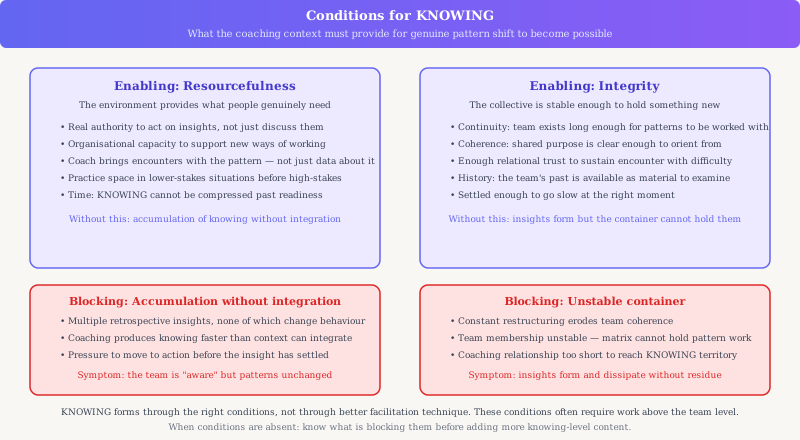
Sedgwick identifies Resourcefulness and Integrity as two of the contextual conditions that make KNOWING possible. Resourcefulness is the environment's capacity to provide what people genuinely need — not just information but the actual support, authority, and possibility that a new way of navigating requires. Integrity is the coherence and continuity of the collective — the degree to which the team is a stable enough container for something genuinely new to form within it.
When these conditions are absent, knowing accumulates and KNOWING does not form. Teams collect retrospective insights the way some people collect self-help books: sincerely, without the insights changing anything, because the conditions for integration are not present.
Coaching — as distinct from facilitation — works at the level of these conditions. It asks not "does the team understand the problem?" but "does the team have what it needs to navigate the situation differently?" It creates encounters with the pattern in the moment, not just at retrospective distance. It works with the team's actual experience rather than its retrospective account of that experience.
KNOWING as the right outcome marker for team coaching
The challenge of evaluating team coaching is that most available metrics measure knowing. Velocity, survey scores, action-point completion rates — these capture what a team can articulate and execute at the level of knowing. They do not capture whether the team's actual navigational capacity has changed.
KNOWING manifests differently. It shows up in the team's behaviour in real-time situations — the moments when the familiar pattern arrives and something different happens, not because someone remembered the retrospective insight but because the team is navigating from a different place. It shows up in the quality of the team's conversation about its own situation: richer, less defended, more willing to stay with difficulty rather than resolve it prematurely.
Coaches who use KNOWING as their outcome marker attend to different things. They notice when a team's retrospective language starts to shift — not just what is said but how it is held, how directly it connects to actual decisions, how much authority the team speaks with about its own situation. They notice the "message in a bottle" moments when someone seems to be reaching for something they can't quite yet name. These are signals that KNOWING is forming or that the team is at the edge of its current frame.
What follows for coaching practice
The knowing/KNOWING distinction has immediate practical implications. The first is diagnostic: when a team's retrospective insights are not translating into changed behaviour, the question is not "did we facilitate clearly enough?" but "what conditions for KNOWING are missing?" This redirects attention from the quality of the insight to the context in which the insight is expected to take effect.
The second implication is interventional. KNOWING is more likely to form in direct encounter with the pattern than in retrospective analysis of it. Coaches who create live work — who bring the team's attention to what is happening in the room as it happens, who name what they observe in the moment rather than waiting for the retrospective — are working at a level more likely to produce KNOWING. The team encounters its pattern in the present tense, where it can be met differently rather than just described later.
The third implication concerns pace. KNOWING cannot be accelerated past the point the team is ready for. Coaches who push harder because the insight was clear often discover that pressure does not produce KNOWING — it produces more knowing, more articulate, more agreed, still not integrated. Working at the pace KNOWING requires sometimes means slowing down at the moment when the insight has landed and allowing time for it to settle rather than moving immediately to action planning.
What the team from the opening example needed
The team that kept arriving at the same retrospective insight sprint after sprint did not need a better retrospective. They needed KNOWING of what to do in the moment on Tuesday when the pressure arrived — and KNOWING cannot be delivered in a Friday afternoon session. It has to form through encounter with the actual situation.
What helped, eventually, was not a better retrospective but coaching in the moment: a coach who was present in the planning session and named what was happening as the acceptance criteria started to slip, who asked the team what they wanted to do about it right now, who created the encounter rather than waiting for the report. Three sprints later the pattern had genuinely shifted — not because the insight had changed but because the team had KNOWING of it in the only place that mattered.
The knowing/KNOWING distinction is not an argument against retrospectives. It is an argument for understanding what retrospectives can and cannot produce, and for knowing — in the KNOWING sense — what kind of coaching work produces what kind of change. That clarity is the foundation of effective team coaching.
Continue Exploring
Go deeper into the work
The Book
The Art of Creating Self-Organizing Teams
The full framework behind this article — contracting, team dynamics, and practical coaching tools for every stage of the journey.
Companion Toolkit
Resistance Radar & Resilience Scorecard
Practical tools for mapping resistance patterns and measuring whether interventions increased capacity — not just compliance.
TA for Agile
Co-creative TA in Agile Contexts
Ego states, psychological contracts, group imago, and the relational concepts that underpin this article — applied to real teams.