Learning Spaces: Designing Reflection Into the System, Not Just the Session
Andrew Bain, researching what enabled organisations to sustain genuine learning — not training, not ceremony, but actual modification of defensive patterns — identified a specific structural element common to all cases: a dedicated learning space. Not a coach's session. Not a retrospective. A recurring, boundaried occasion in which the organisation's members could observe their own dynamics and make connections between what they were doing and what was happening. Coaches who do not help organisations build these structures make themselves structurally indispensable. The organisation learns only as long as the coach is present.
The coach who became the architecture
Two years into an engagement, the coach knew the team well. Progress had been real. The team could name its dynamics, raise difficult topics in the retrospective, and manage conflict without escalation. When a three-month budget freeze removed the coaching, the team regressed — not to the worst of where it had been, but unmistakably backward. The coach returned, rebuilt, and watched the pattern repeat at the next gap.
The coach had not failed at the work. The coach had become the work. Every session had been a container for the team's reflective capacity — and when the container was removed, the capacity disappeared with it. The problem was architectural. Two years of coaching had built no structure that could hold the learning after the coach left.
What Bain found
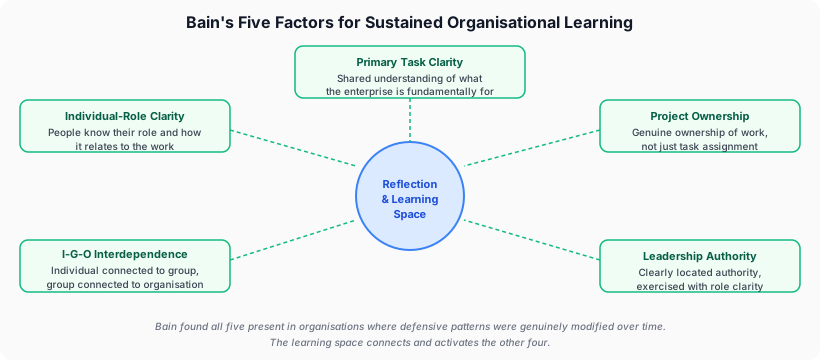
Andrew Bain, conducting action research across three organisations where genuine organisational learning was taking place — not training, not ceremony compliance, but actual modification of defensive patterns over time — identified five structural factors common to all three cases. The factors were not programme-related. They were not the result of having an outstanding coach or a particularly capable leadership team. They were structural conditions without which sustained learning did not occur.
The five factors: primary task clarity — the organisation's members had a shared, clear understanding of what the enterprise was fundamentally for; project ownership — people had genuine ownership of the work, not just task assignment; leadership authority and role clarity — authority was clearly located and exercised with appropriate role definition; individual-group-organisation interdependence — people understood how their work connected to the group and the group to the organisation; and dedicated reflection and learning spaces. The fifth factor is what Bain found most consistently absent in organisations that described themselves as learning organisations but could not demonstrate it.
What a learning space is
A learning space, in Bain's sense, is not a coaching session. The coach's session is valuable but coach-dependent — it exists because the coach contracts for it and facilitates it. When the coach leaves, the session ends. A learning space is not a retrospective, which is output-oriented and governed by the sprint cycle. It is not training, which transfers knowledge rather than developing the capacity for reflective awareness.
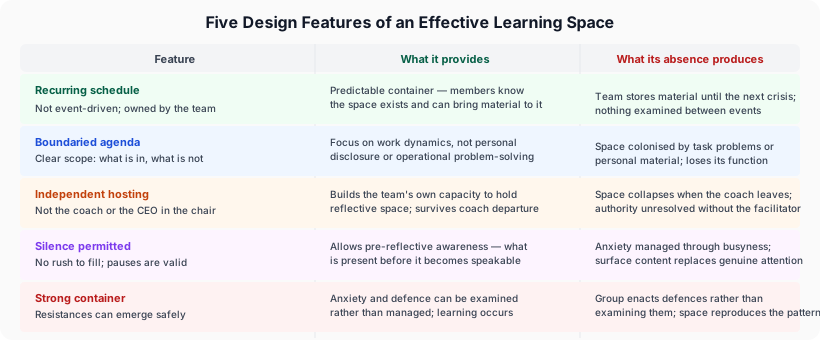
A learning space is a recurring, boundaried occasion — owned by the team or organisation, not by the coach — in which the dynamics of the work are available for examination without output pressure. The key conditions: it recurs on a regular schedule that is not event-driven; it has a defined boundary (what is in scope, what is not); it is not facilitated by the coach or the most senior person in the room; silence is permitted and not rushed to fill; the container is strong enough that anxieties and resistances can emerge and be worked with rather than avoided.
What learning spaces enable is slow, cumulative. They create the occasion for patterns to become visible to the people enacting them. As those patterns become visible, repeatedly, across many sessions, they become less automatic. The group develops the capacity to pause before enacting a familiar defensive move and to choose differently. This is different from being told about defensive patterns in a workshop, which produces awareness without the capacity to act on it.
The architectural difference
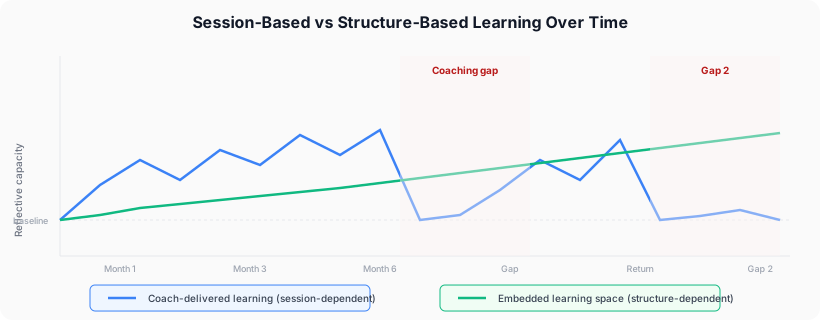
A coach who delivers learning session by session creates a particular pattern of capacity over time: it rises during active coaching, declines between sessions, and returns to baseline when coaching ends. The peaks may be high. But the baseline does not move, because the structure that could sustain the learning has not been built.
An organisation with an embedded learning space shows a different pattern: lower amplitude peaks, but a continuously rising baseline. The team does not produce the same insights in the learning space that it would produce in a coach-facilitated session. But it produces consistent, cumulative awareness over time that the coach-only model cannot generate. And it survives the coach's absence.
This is not an argument against coaching. It is an argument for building the structure that coaching is meant to develop. The coach who does not help the organisation build the learning space has made themselves structurally indispensable — which is a comfortable position for the coach and a limiting one for the organisation.
What learning spaces are not
A learning space is not a renamed retrospective. The retrospective is output-oriented and sprint-governed. Adding a reflective opening to a retrospective is useful; it is not sufficient to constitute a learning space. The retrospective's primary loyalty is to the sprint and the delivery system. The learning space's primary loyalty is to the team's capacity to examine itself.
A learning space is not a team therapy session. It does not have a therapeutic contract. It does not invite disclosure of personal material. It is explicitly focused on the team's work — the dynamics of that work, the patterns of interaction that the work produces, the anxieties that the work generates. The boundary is clear and must be maintained.
A learning space is not an open forum or a complaints mechanism. The absence of output pressure does not mean the absence of structure. The learning space has a defined scope, a consistent rhythm, and a host — not a facilitator in the ceremonial sense, but a person who holds the boundary and notices when the group is avoiding what is present.
Three moves
Assess whether the team has any existing learning space. The diagnostic question is not "do you have retrospectives?" but "is there a recurring occasion in which the team can examine its own dynamics without output pressure?" Most teams will answer no. The retrospective is close but not sufficient. The coaching session is not it, because it is coach-dependent.
Design the minimal viable version that fits the team's context. The first learning space does not need to be a formal structure. It needs to be recurring, boundaried, not output-oriented, and not facilitated by the coach. A thirty-minute fortnightly conversation with a clear scope ("what patterns are we noticing in how we work together?") and a consistent host is a starting point. The structure can develop its own character over time.
Contract with the sponsor for the learning space to survive the coach's departure. This is the most important and most often omitted element. The learning space must be part of the coaching contract — not as an add-on but as the primary delivery. The coach's job is not to provide insight. It is to build the structure through which the team can produce its own insight after the coach has left.
The question of the coach's goal
The coach who is the learning structure will always be necessary. The team will need them for as long as it needs to learn. The organisation will continue to purchase coaching sessions because the capacity that coaching produces does not survive coaching's absence.
The coach who builds the learning structure into the system will eventually be redundant. The team will develop the capacity to examine its own dynamics without the coach's presence. The learning will become an organisational property rather than a consultant's service. This is the goal that most coaching engagements articulate and most coaching structures undermine. The learning space is the structural element that makes it achievable.
Continue Exploring
Go deeper into the work
The Book
The Art of Creating Self-Organizing Teams
The full framework behind this article — contracting, team dynamics, and practical coaching tools for every stage of the journey.
Companion Toolkit
Resistance Radar & Resilience Scorecard
Practical tools for mapping resistance patterns and measuring whether interventions increased capacity — not just compliance.
TA for Agile
Co-creative TA in Agile Contexts
Ego states, psychological contracts, group imago, and the relational concepts that underpin this article — applied to real teams.