What no one has to say twice
Explicit working agreements sit above a deeper normative field that no one negotiated and everyone obeys. BART diagnoses structure. Norms diagnose the emergent behaviour that fills that structure. Coaching the wrong layer explains why the behaviour returns.
The format returned. The conversation didn't.
A coach introduced a new retrospective format in week three. The team followed it carefully. By week seven, the format was still present — the cards were still filled in, the columns were still used — but the conversations had reverted. Concerns that had emerged briefly in weeks four and five were no longer named. The room had found its way back to what it was before.
Nothing explicit was decided. No one refused the format. The old norm simply reasserted itself through the new one. Coaching that changes only explicit agreements leaves the normative field untouched — and it is the normative field that actually shapes what happens in the room.
What norms are, and why they're different from rules
Rules are explicit and enforced by authority. Norms are implicit and enforced by the group on itself. Nobody directs norm enforcement: members self-correct and correct each other without any conscious instruction. The mechanism is social approval and disapproval — a constant background signal that teaches each member, through thousands of small interactions, what is acceptable here and what is not.
This is what makes norms more durable than rules. A rule changes when someone with authority says so. A norm changes only when the group's pattern of social response changes — and that requires something different from announcing a new agreement.
The BART model diagnoses the designed structure of a team: boundary, authority, role, and task. Norms are the emergent behavioural field that fills that structure. BART tells you how the room was designed. Norms tell you what actually happens inside it.
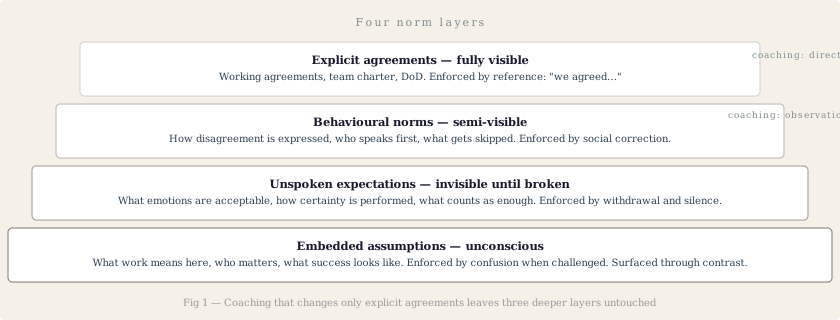
The four norm layers
Norms operate at different depths. The intervention that reaches one layer rarely reaches the next.
Explicit agreements(Fully visible)
Examples: Working agreements, team charter, Definition of Done
Enforced by: By reference: 'we agreed...'
Coaching access: Direct conversation or retro format
Behavioural norms(Semi-visible)
Examples: How disagreement is expressed, who speaks first, what gets skipped
Enforced by: Social correction: 'we don't usually...'
Coaching access: Naming the pattern; participant-observer observation
Unspoken expectations(Invisible until broken)
Examples: What emotions are acceptable, how certainty is performed, what counts as enough
Enforced by: Silence, withdrawal, awkwardness
Coaching access: Asking what the violated norm was after a rupture
Embedded assumptions(Unconscious)
Examples: What work means here, who matters, what success looks like
Enforced by: Confusion and projection when challenged
Coaching access: Surfacing through contrast with other teams or contexts
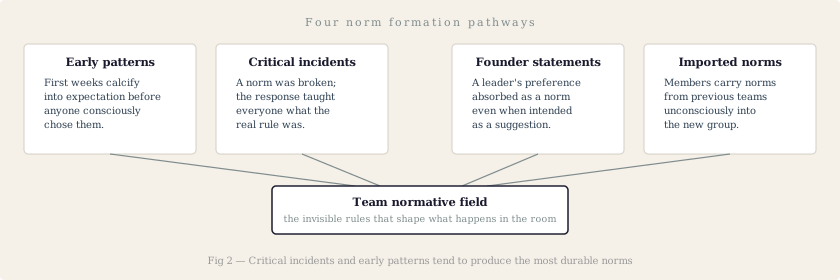
How norms form
Four formation pathways account for most of what a team's normative field contains. Understanding which pathway produced a norm usually points to what kind of intervention can shift it.
Early interaction patterns
The first few weeks of a team's life set expectations that calcify into norms before anyone consciously chose them.
Critical incidents
A norm was broken and the response taught everyone what the real rule was — regardless of what was written.
Founder statements
An explicit statement from a leader or founding member was absorbed as a norm even when it was only intended as a preference.
Imported norms
Members unconsciously carry norms from previous teams, organisations, or professional cultures into the new group.
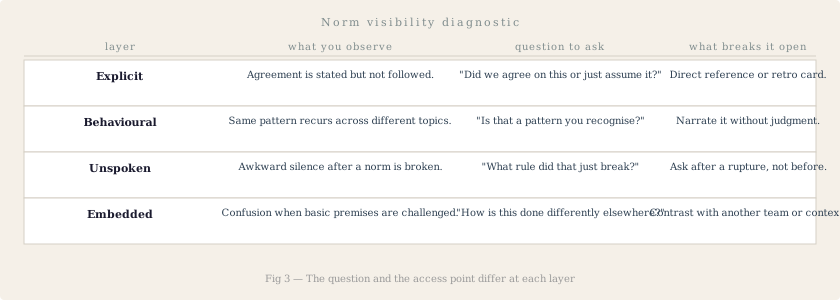
Making norms visible without naming them as problems
Naming a norm as a problem usually produces defensiveness. The more productive move is narration without judgment: "I notice that when someone disagrees here, the conversation tends to accelerate and move on — is that a pattern you recognise?" This keeps the norm observable rather than accusatory, and creates space for the group to decide whether it serves them.
Three diagnostic moves: narrate the observable pattern; invite the group to reflect on whether the pattern is intentional; ask what the norm is protecting. The third question is the most useful — norms that are durable are usually protecting something real, and that protection needs to be acknowledged before the norm can be shifted.
How norms shift
Norms don't change through announcement. Three mechanisms can shift them: a critical incident in which a norm is visibly violated and the group's response is different from before — which teaches everyone that the old response was not inevitable; sustained behavioural modelling by credible members, which gradually moves the social approval signal; and new early patterns when something in the team changes — a new member, a new task type, or a new phase of work that creates a window for different patterns to form.
The coach's role in each pathway is different. In critical incidents, the work is to respond visibly and differently in the moment. In behavioural modelling, the work is to identify who in the team has the credibility to model the shift. In new early patterns, the work is to seize the opening that change creates before the old norm re-imports itself.
Continue Exploring
Go deeper into the work
The Book
The Art of Creating Self-Organizing Teams
The full framework behind this article — contracting, team dynamics, and practical coaching tools for every stage of the journey.
Companion Toolkit
Resistance Radar & Resilience Scorecard
Practical tools for mapping resistance patterns and measuring whether interventions increased capacity — not just compliance.
TA for Agile
Co-creative TA in Agile Contexts
Ego states, psychological contracts, group imago, and the relational concepts that underpin this article — applied to real teams.