Middle Managers Are Not Resisting — They Are Living in Two Worlds
Middle managers are the most consistently misread figure in Agile transformation. Coaching literature treats them as resistant, defensive, or threatened. Sedgwick's Overlap condition names what is actually happening: two whole yet incompatible frames of reality are simultaneously present. They KNOW the old world at a deep, embodied level. The new world they only know.
The figure nobody quite knows what to do with
Every Agile transformation at scale encounters the same figure. The middle manager. They turn up in the coaching literature as the "frozen middle," the locus of resistance, the person who says the right things in workshops and then returns to their desk and does the old things. They are described as threatened, defensive, territorial, unable to let go of control.
The prescriptions follow from the diagnosis. Help them see that their role is changing rather than disappearing. Build safety for the new behaviours. Celebrate middle managers who embrace the transformation. Address the identity threat. Work with the defensiveness.
Sedgwick's Contextual TA offers a different starting point: the standard diagnosis is wrong. Middle managers are not resisting. They are living in two worlds simultaneously — and the experience of living in two worlds is not a psychological symptom to be treated. It is a structural condition to be understood.
The Overlap configuration
Sedgwick's Overlap is one of three horizontal configurations — structural conditions in which the difficulty a person or group experiences originates not in their psychology but in the architecture of their situation. Overlap describes the condition in which two whole yet incompatible frames of reality are simultaneously present.
The key word is whole. Overlap is not the experience of two competing preferences or two different approaches that need to be reconciled. It is the experience of two complete, internally coherent, mutually exclusive worldviews — each of which carries its own logic, its own set of legitimate concerns, its own criteria for what counts as success. Moving between them is not a matter of choosing the better option. It is the experience of being simultaneously a citizen of two countries that do not recognise each other.
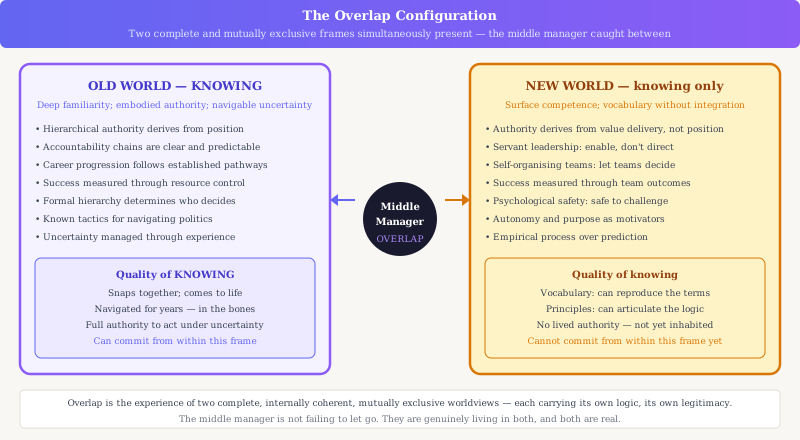
For a middle manager in an Agile transformation, the two frames are not difficult to identify. On one side: the world of hierarchical management, clear accountability chains, predictable career progression, authority derived from position, success measured through resource control. On the other: the world of servant leadership, emergent authority, self-organising teams, flat hierarchies, success measured through team outcomes rather than personal control. These are not merely different approaches. They rest on different assumptions about what organisations are for, how people are motivated, and what management means.
KNOWING the old world, knowing the new one
Sedgwick draws on a distinction, developed in detail elsewhere in his work, between two qualitatively different relationships to knowledge. KNOWING (upper case) is deep familiarity — the embodied authority that comes from having navigated a world long enough for it to snap together and come to life, for its logic to become natural rather than learned. Knowing (lower case) is surface competence — the ability to recognise, articulate, and work with information about a domain without the lived integration that produces genuine authority.
Most middle managers, in a transformation of any depth, KNOW the old world. They have spent years, sometimes decades, in hierarchical management. They know its rhythms, its politics, its informal rules, its hidden leverage points. They can navigate its uncertainties from within because they have the accumulated authority of experience. When something goes wrong, they know — not just intellectually but in their bones — what to do.
The new world they only know. They have attended the workshops. They have read the books. They can reproduce the vocabulary: servant leadership, psychological safety, autonomous teams, empirical process control. They can articulate the principles. But they do not yet KNOW the new world — they have not yet inhabited it long enough for it to become natural, for its logic to become instinctive, for its uncertainties to be navigable from within.
This asymmetry is the structural reality of Overlap. The person is being asked to act from KNOWING in a world they only know — to commit, with authority, to a frame of reference they have not yet developed the authority to inhabit. The request is not unreasonable as a long-term aspiration. As an immediate demand, it is asking for something the person cannot yet provide: not because they are resistant, but because KNOWING cannot be willed or trained into existence. It can only be developed through experience.
Why "embrace the mindset" is asking for cognitive poverty
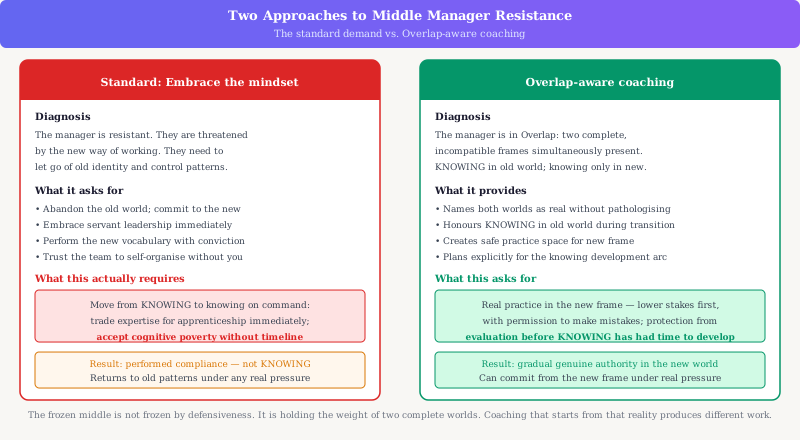
The standard transformation ask — embrace the new mindset, let go of the old ways, trust the team — is asking the middle manager to move from KNOWING to knowing. To abandon their deeply-held, experientially-grounded authority in the old world in exchange for surface-level competence in the new one. To trade expertise for apprenticeship.
Sedgwick calls this cognitive poverty: the experience of being placed in a situation where one's genuine knowledge and competence are delegitimised and one is expected to function effectively from a position of having none. This is not a description of weakness. It is a description of what any capable person experiences when asked to perform at the level of mastery in a domain where they only have the resources of a beginner.
The "resistance" that coaches and transformation leaders observe is often, at root, the reasonable reluctance of a competent person to be made incompetent on command. The middle manager who returns to hierarchical patterns is not clinging to power for its own sake. They are returning to the territory where they have KNOWING — where they can function with genuine authority — because the new territory does not yet offer them that. Given a genuinely uncertain situation, people navigate from their most solid ground.
What Overlap-aware coaching provides
The coaching response to Overlap is fundamentally different from the coaching response to resistance. Resistance asks for confrontation, safety-building, or identity work. Overlap asks for something prior: acknowledgement of the structural reality, and engagement with both frames as genuinely present rather than one being the problem and the other the solution.
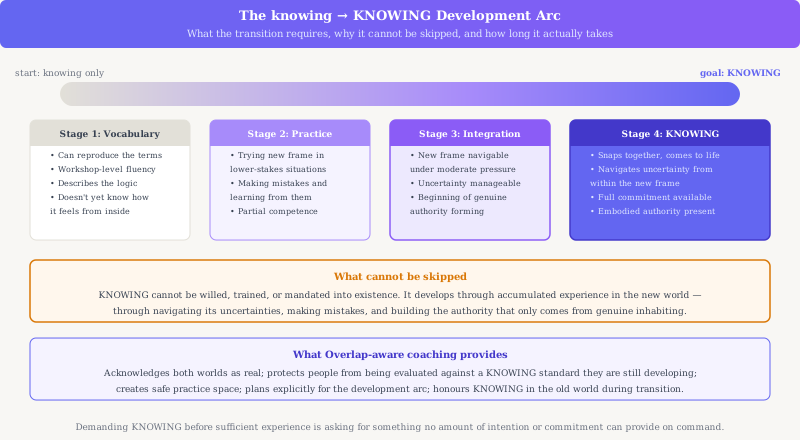
The first move is to name the Overlap without pathologising it. The middle manager is not failing to let go. They are genuinely living in two worlds, and both worlds are real. The old world carries their competence, their identity, their earned authority. The new world carries the organisation's future direction. Neither can simply be discarded.
The second move is to work with the transition rather than demanding its completion. KNOWING in the new world develops through experience — through being in situations where the new frame is navigated, including navigating it poorly, and building the accumulated authority that comes from genuine encounter. Coaching that creates safe enough spaces for middle managers to practise the new frame — to try servant leadership in lower-stakes situations, to make mistakes without those mistakes becoming evidence of fundamental unfitness — is creating the conditions for KNOWING to develop.
The third move is to be honest about timing. Demanding that middle managers KNOW the new world before they have had enough experience to develop that KNOWING is asking for something the timeline of a transformation cannot provide. The organisations that navigate this most successfully are the ones that plan for the transition explicitly — that acknowledge that developing KNOWING in a new management paradigm takes time, that protect people from being evaluated against a standard they are still in the process of building, and that create conditions for genuine practice rather than performed compliance.
The frozen middle, thawed
The "frozen middle" is not frozen by defensiveness. It is caught between two complete worlds, holding the weight of both, functioning in neither with the authority it needs. The most capable middle managers — the ones most deeply invested in doing their job well — often experience the most acute form of Overlap, because they have the most to lose from the move from KNOWING to knowing.
Coaching that misdiagnoses this as resistance will spend its energy on the wrong intervention: working with defensiveness that is actually structural reality, building safety that is not the missing ingredient, celebrating compliance that is not the same as KNOWING. The result is managed performance rather than genuine development.
Coaching that starts from the Overlap diagnosis has a different quality. It meets middle managers in the actual situation they are in — complex, costly, genuinely difficult — and works from there. That meeting, in Sedgwick's framework, is not a therapeutic act. It is a diagnostic one. The situation is what it is. Working with it accurately is the beginning of the work that can actually help.
Continue Exploring
Go deeper into the work
The Book
The Art of Creating Self-Organizing Teams
The full framework behind this article — contracting, team dynamics, and practical coaching tools for every stage of the journey.
Companion Toolkit
Resistance Radar & Resilience Scorecard
Practical tools for mapping resistance patterns and measuring whether interventions increased capacity — not just compliance.
TA for Agile
Co-creative TA in Agile Contexts
Ego states, psychological contracts, group imago, and the relational concepts that underpin this article — applied to real teams.