When the Mirror Speaks: Parallel Process and What Your Feelings Are Telling You About the Team
Carolyn had been working with the top team for nine months. The coaching was grinding to a halt. She felt increasingly bored, increasingly avoidant, and increasingly tempted to end the contract. In supervision, it took about fifteen minutes to see that her boredom was not her own. It was the team's — mirrored in her. This is parallel process. Most Agile coaches have never heard of it.
Carolyn, nine months in
Carolyn had been working with the top team of a financial services company for nine months. The focus was a five-year strategic plan. At first they had responded well — engaged, energised, willing to examine their assumptions. But as time went on, agreed work wasn't done. Sessions that had felt purposeful began to feel like going through motions. The process was grinding to a halt.
Carolyn noticed that she felt less and less interested in the work. She had to force herself to make contact with the team between sessions. In the sessions themselves she felt anxious in a way she couldn't account for, and she had a recurring, strong impulse to end the contract — to simply stop working with this team and move on.
In supervision, something shifted. Under the boredom, there was frustration. Under the frustration, something closer to anger. As Carolyn explored this, it became clear: her emotional state in the work was not simply a reaction to a difficult client. It was a mirror. The team was stuck, frustrated, and quietly furious about a situation they could not name. And Carolyn, fully inside the field they had created together, was feeling exactly what they were carrying.
What just happened to Carolyn
What Carolyn experienced has a name: parallel process, sometimes called the reflection process. The coach's emotional state — in a session, or in supervision — often mirrors what is happening in the team or client system unconsciously. The dynamics of the system reproduce themselves in the coaching relationship and, from there, into supervision.
This happens because the coach is not a neutral observer of the team. They are a participant in the relational field that the team generates. Everything the team is carrying — its anxiety, its defensiveness, its unspoken conflict — is present in the field, and the field speaks through the coach whether the coach is aware of it or not. Carolyn did not choose to feel bored and avoidant. She was drawn into the team's own experience of stasis and unexpressed anger.
The critical insight is this: the coach's feelings during or about a piece of work are not simply personal reactions. They are data about the system. Learning to read them as such is one of the most important capabilities in the team coaching repertoire — and one of the least trained.
How parallel process works
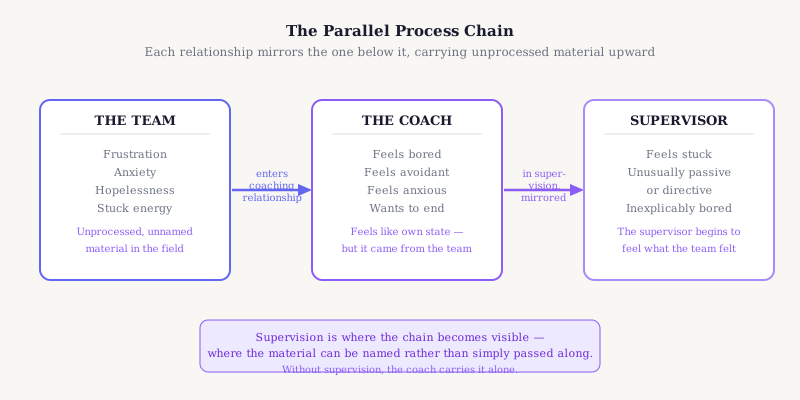
The mechanism operates through the relational field. The team's unprocessed material — the anxiety it cannot contain, the frustration it cannot acknowledge, the anger it cannot name — enters the coaching relationship and is experienced by the coach. The coach does not know, in the moment, that they are receiving it from the team. It feels like their own state.
In supervision, the same dynamic can repeat one level up. The supervisee brings material from the team. In describing it, they reproduce the relational field — and the supervisor begins to feel what the team feels. The supervisor might find themselves becoming unusually passive, or uncharacteristically directive, or oddly bored, without a clear reason. Each relationship mirrors the one it is supervising.
This is why supervision is not simply a place to discuss technique. It is a place where the mirroring chain becomes visible — where the material that has been travelling through the system can be named and examined rather than simply passed along. Without supervision, the chain has no ending point. The coach absorbs the material and carries it alone, or acts on it in ways they cannot account for.
This is different from enactment
Readers who are familiar with the dynamics of projective identification and role enactment will want a clear distinction here. Enactment is when the coach is drawn into acting out the team's pattern — taking on a role in the dynamic, behaving in ways they later recognise as the team's own characteristic behaviour. The coach who finds themselves becoming increasingly directive with a team that has an avoidant relationship to authority, or increasingly passive with a team that is over-dependent, is enacting something the team has placed in them.
Parallel process is specifically about the mirroring of the team's emotional state in the coach's own experience — not necessarily through action, but through feeling. Carolyn was not acting like the stuck team. She was feeling what the stuck team felt: bored, avoidant, quietly furious, wanting out.
The two phenomena are related — both involve the coach as a receiver of material from the system — but the distinction matters for how the coach responds. Enactment is recognised retrospectively in one's own behaviour. Parallel process is accessible through attentiveness to one's own feeling state, particularly feelings that are difficult to account for in purely personal terms, and particularly across the boundary of the session — in the hours after, in supervision, in private reflection.
What the coach's feelings are telling them
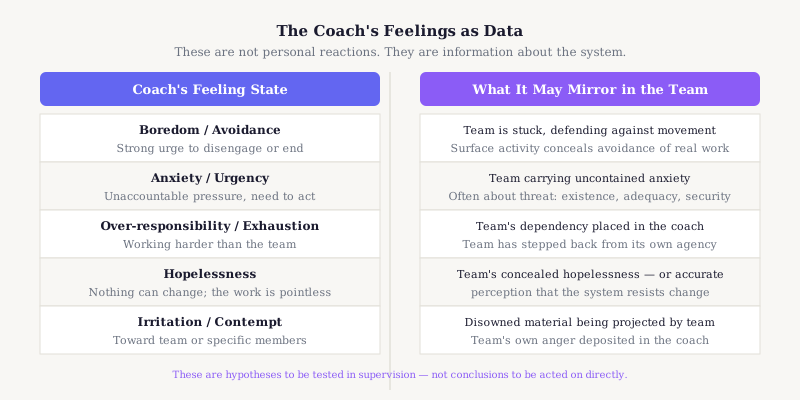
The following is not a diagnostic instrument. It is a set of hypotheses — starting points for reflection rather than conclusions. But the patterns are consistent enough to be useful.
Boredom and avoidance in the coach often mirror a team that is stuck and defending against movement. The team's surface may be busy and productive-seeming. What is being defended against is usually an acknowledgement that the real work — the conflict, the decision, the change — is not happening.
Anxiety and urgency that the coach cannot locate in any specific concern about the work often mirror uncontained anxiety in the team. The team is carrying something it cannot name — usually about threat: to its existence, to its relationships, to its adequacy — and the anxiety has entered the coaching relationship.
Over-responsibility and exhaustion — the coach working harder than the team, feeling they are the only one who cares about outcomes — often mirror a team that has placed its dependency in the coach and stepped back from its own agency. The coach is carrying the team's motivation as well as their own.
Hopelessness — a sense that nothing can change here, that the work is pointless — is perhaps the most important to examine carefully. It may mirror the team's own concealed hopelessness. But it may also be accurately perceiving something real: that the system the team operates within is genuinely resistant to change, and the team has learned this, and the learning is correct.
Irritation or contempt toward the team, or toward specific members, often mirrors something the team is disowning and projecting. The team that cannot own its own contempt for its management, or its irritation at its own avoidance, may deposit it in the coach. The coach feels it, and may even act on it, without knowing it came from the team.
The risk of getting it wrong
Parallel process is a hypothesis, not a fact. The discipline is not to interpret one's feelings as transparent windows onto the team's inner life. It is to treat them as material to be investigated.
The coach who assumes their irritation is always the team's disowned anger is using the concept to avoid self-examination. Sometimes the irritation is theirs. Sometimes the hopelessness reflects something in the coach's own history with stuck systems. Sometimes the boredom is about this particular piece of work being genuinely boring. The framework is only useful when it is held with enough uncertainty to be tested rather than simply applied.
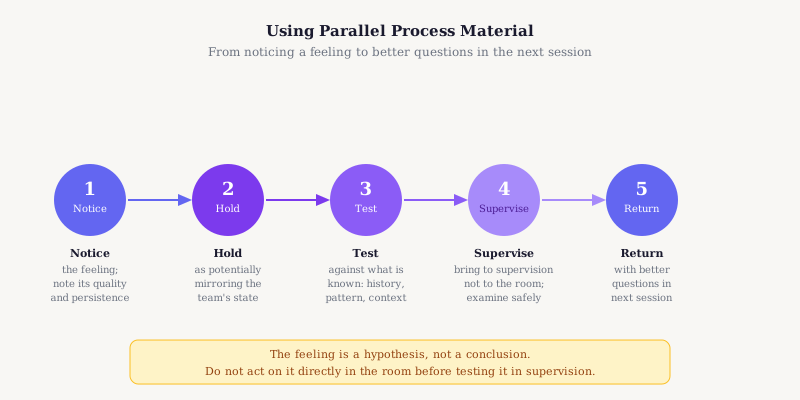
The discipline is four steps. First, notice the feeling, and note its quality and persistence. Second, hold it as potentially mirroring something in the team. Third, test it against what else is known: the team's recent history, the pattern of previous sessions, the context the team is operating in. Fourth, bring it to supervision rather than acting on it directly in the room. It is in supervision that the hypothesis can be examined safely enough to become either useful or discarded.
Why Agile coaches need supervision for this
Supervision is the container in which parallel process material can be examined rather than simply carried. Without it, coaches face a binary: absorb the team's feelings and carry them unexamined, or act them out. Carolyn's impulse to end the contract was the beginning of acting out: the team wanted to escape its stuck state, and Carolyn was about to do it for them.
The Agile coaching field has developed substantial practice around facilitation technique, retrospective design, organisational change, and systems thinking. It has largely ignored supervision. Coaches are expected to manage the relational and emotional dimensions of their work through personal reflection and peer consultation — neither of which provides the structured container that supervision offers.
The cost of this gap is paid quietly, in coaches who are carrying material they cannot name, making interventions they cannot fully account for, and ending engagements for reasons that belong to the team rather than to themselves. The parallel process, without supervision, is simply absorbed into the coach's own system and attributed to personal response.
Using parallel process as a coaching move
Once the coach has identified the parallel — in supervision, not in the room — they can return to the team with better questions. Not better in the sense of cleverer, but better in the sense of addressing what is actually happening rather than what appears to be happening.
In Carolyn's case, the question she had been asking — "why aren't you making progress on the strategic plan?" — was a process question addressed to a surface problem. The parallel process suggested a different question: what is the team's actual relationship to this plan? What are they frustrated about? What has the organisation done that the team cannot directly address, and is the strategic plan carrying that displaced anger?
This is not about disclosing the parallel process to the team — "I've been feeling angry about our sessions and I think it's your anger I'm carrying." That kind of disclosure usually generates confusion and defensiveness. It is about using what the parallel process has revealed to ask questions that get closer to what is actually present. The coach is not transparent about the instrument. They are transparent about the curiosity.
The coach's internal experience is not noise
The dominant training model in coaching treats the coach's internal experience as something to be managed: noticed, bracketed, set aside, kept from interfering with the work. This is not wrong — the coach who acts on every feeling without examination is not useful. But the management model misses what the internal experience is for.
The coach's feelings during and after a piece of work are a receiving instrument for what the team is carrying and cannot process alone. They are not interference to be filtered. They are signal about the system. The boredom, the anxiety, the over-responsibility, the inexplicable hopelessness — these are not personal failures of the coach's emotional regulation. They are the system speaking through the most available channel.
Learning to read that signal — with the rigour, humility, and supervision that the reading requires — is one of the most important developmental edges in team coaching. And it is, still, one of the least trained.
Continue Exploring
Go deeper into the work
The Book
The Art of Creating Self-Organizing Teams
The full framework behind this article — contracting, team dynamics, and practical coaching tools for every stage of the journey.
Companion Toolkit
Resistance Radar & Resilience Scorecard
Practical tools for mapping resistance patterns and measuring whether interventions increased capacity — not just compliance.
TA for Agile
Co-creative TA in Agile Contexts
Ego states, psychological contracts, group imago, and the relational concepts that underpin this article — applied to real teams.