Primary Task: The One Question That Cuts Through Everything
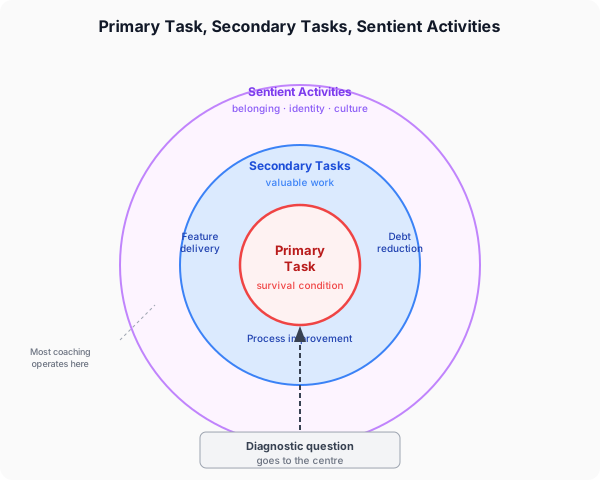
Eric Miller and Ken Rice at the Tavistock Institute proposed that every organisation and every team has a primary task: the task it must perform to survive. Not the most visible task, not the most valued task, not the task described in the team charter — but the one that, if not performed, means the team ceases to exist. When a team cannot answer this question clearly and consistently, all coaching operates on the symptoms of that confusion. Primary task clarity is not a values exercise. It is a boundary condition for effective work.
Three people, three answers, three months of drift
The coach asked the question in a discovery conversation with three people who worked closely together: "What is this team fundamentally for?" The tech lead answered without hesitation: "Maintaining the stability and performance of the platform." The product owner, equally confident: "Delivering new features that expand what users can do." The engineering manager, after a pause: "Reducing the technical debt that's holding back every other team in the organisation."
All three answers were accurate. None of them was the team's primary task. And because the three people driving the team's work had incompatible answers to the question of what the team was fundamentally for, the team had spent three months producing technically solid work in misaligned directions, satisfying nobody's definition of success, and resolving priority conflicts not through shared understanding but through whoever had the most authority in the room at the time.
Miller, Rice, and the primary task
Eric Miller and Ken Rice, working at the Tavistock Institute through the 1950s and 1960s, were interested in what makes organisational systems function effectively. Their research across manufacturing, textiles, coal mining, and aviation led them to a concept they called the primary task: the task that a system must perform in order to survive.
This is a precise and pointed formulation. Not the most important task, not the most visible task, not the task described in the team charter or the sprint goal template. The primary task is the one whose failure would, ultimately, cause the system to cease to exist. In a for-profit business, the primary task is generating revenue — not because revenue is the only thing that matters, but because a business that cannot generate revenue will not exist to do anything else. In a hospital, the primary task is patient care — not research, not training, not financial management, even though all three are genuinely important.
For an Agile team, the primary task question is: what is the one thing this team must do, for this system to have a reason to exist? The answer is often different from the team's stated mission, different from the priorities in the current backlog, and different from what any individual stakeholder would name as most important.
Why this is more pointed than BART's task dimension
The BART framework — Boundary, Authority, Role, Task — asks the team to be clear about its task, which is important and useful. But BART's task dimension asks "what is the work?" — a question that most teams can answer with reasonable agreement. It does not ask the more fundamental question that Miller and Rice identified: "what is the work that, if not done, means this team should not exist?"
The latter question is significantly more diagnostic. The tech lead, product owner, and engineering manager in the opening vignette could all answer "what is the work?" They just answered it differently. The primary task question — "what is the one thing, if not done, that would cause this team to cease to exist?" — is a different kind of question, and it has a much more convergent answer. The platform team in a SaaS business exists because the platform must remain stable and available. Feature development matters. Debt reduction matters. But if the platform goes down and stays down, the team dissolves — either because the product fails or because leadership disbands the team as a result. Platform stability is the survival condition. That is the primary task.
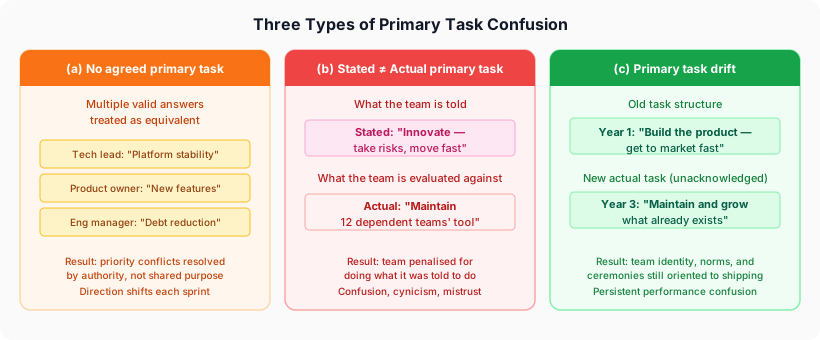
Three types of primary task confusion in Agile teams
No agreed primary task. Multiple valid answers coexist and are treated as equivalent. This is the situation in the opening vignette. The team is simultaneously trying to maintain the platform, deliver features, and reduce debt. Each of these is a legitimate secondary task. None has been designated as the survival condition. Priority conflicts are resolved by authority rather than by reference to what the team must do to survive, which means the team's direction changes with whoever is most vocal.
Stated primary task differs from actual primary task. The team is told its primary task is innovation — deliver new capabilities, take risks, move fast. The actual primary task — the one that determines whether the team survives — is maintaining the stability of an internal tool that twelve other teams depend on. Nobody says this explicitly, because the organisation's public narrative is about innovation. But when the team takes the innovation mandate seriously and stability degrades, the team gets immediately corrected. The actual primary task is maintenance, regardless of what the stated one is. The team is being asked to perform one task while being evaluated against another.
Primary task has shifted but structure has not caught up. The team was formed three years ago to build a new product. The primary task at formation was feature delivery: get to market. The product is now in market and growing. The primary task has shifted: maintain and grow what exists, balance new development against operational stability. But the team's ceremonies, norms, authority structure, and identity are still configured for the original primary task. They are still oriented toward shipping new things, even as the organisation increasingly needs them to maintain existing things. The mismatch between actual and structural primary task produces persistent performance confusion.
Four diagnostic questions
The primary task question does not need to be a workshop. It works best as a discovery probe — a series of questions asked in conversations with the team, the product owner, the engineering manager, and the sponsor, with the coach listening for convergence and divergence in the answers.
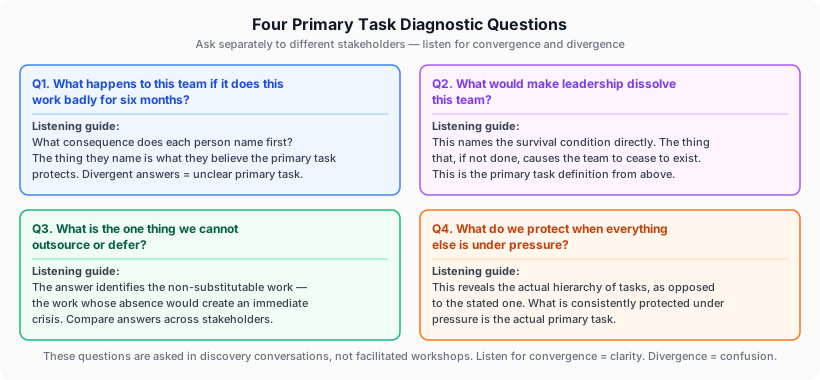
The four questions that most reliably surface primary task clarity are: "What happens to this team if it does this work badly for six months?" — which surfaces the actual consequences of primary task failure. "What would make leadership dissolve this team?" — which names the survival condition directly. "What is the one thing we cannot outsource or defer?" — which identifies the work whose absence would immediately create a crisis. "What do we protect when everything else is under pressure?" — which reveals the actual hierarchy of tasks, as opposed to the stated one.
The coach listens for convergence: do different stakeholders, asked separately, arrive at compatible answers? Divergence in the answers to these questions is the diagnostic signal for primary task confusion.
Three moves
Surface the question without rushing the answer. Primary task clarity is not a problem to be solved in one conversation. The question can be introduced early in a coaching engagement as a frame — "I'm interested in what this team must do, versus what it does" — and then tracked through subsequent conversations. Rushing to agree on an answer before the confusion is properly mapped tends to produce a politically acceptable formulation rather than an honest one.
Check for the gap between espoused and actual primary task. Ask the innovation question: "If the team prioritised innovation over stability this sprint and stability degraded as a result, what would happen?" The answer reveals the actual primary task more reliably than any mission statement.
Use primary task as a reference point in coaching conversations, not as a deliverable. Once a working hypothesis about the primary task has been established, the coach can use it as a reference point in subsequent conversations: "When we look at the current priority conflict through the lens of what this team must do to survive, which side does it come down on?" This keeps the primary task concept in use as a diagnostic tool rather than treating it as a completed exercise.
The competence trap
The team that cannot name its primary task will solve the wrong problems competently and feel confused about why the solving doesn't help. This is the competence trap: the team applies real skill and genuine effort to secondary tasks while the primary task drifts, and the confusion — why is nothing sticking, why does it feel like we're always behind, why does everyone seem slightly disappointed — is not attributable to lack of capability. It is attributable to lack of clarity about what the team actually needs to do to exist.
Miller and Rice's contribution was to show that this confusion is not accidental. Organisations routinely fail to specify primary tasks clearly, because clarity about the primary task requires authority decisions that are uncomfortable to make and commitments that are uncomfortable to keep. The team that is told to do everything — maintain, innovate, reduce debt — is a team that has been given a strategy-avoidance structure rather than a genuine task.
The coach who can name this — and use the primary task frame to help the team and its sponsor make the authority decision they have been avoiding — produces a kind of clarity that no ceremony design or psychological safety intervention can substitute for.
Continue Exploring
Go deeper into the work
The Book
The Art of Creating Self-Organizing Teams
The full framework behind this article — contracting, team dynamics, and practical coaching tools for every stage of the journey.
Companion Toolkit
Resistance Radar & Resilience Scorecard
Practical tools for mapping resistance patterns and measuring whether interventions increased capacity — not just compliance.
TA for Agile
Co-creative TA in Agile Contexts
Ego states, psychological contracts, group imago, and the relational concepts that underpin this article — applied to real teams.