What Resonates Cannot Be Planned: How Groups Learn Together Without Anyone Trying
Some moments in a team session land differently. Someone says something and the room shifts. The content wasn't exceptional. The framing wasn't clever. Something else happened — something that felt larger than the person who said it. Group analysts call this resonance. You cannot manufacture it, but you can create the conditions where it becomes possible.
Something cracked open
It was forty minutes into a team session — a working session about ways of working, nothing unusual — when a developer said something offhand. He'd been quiet most of the meeting, contributing when asked, politely not contributing when not asked. He said, without particular emphasis, that he sometimes felt invisible in architecture decisions. That he would raise something, it would go nowhere, and then three weeks later someone senior would say the same thing and it would immediately become a priority. He didn't frame it as a complaint. He said it the way people say things they've already half-decided not to say.
He didn't mean it as a disclosure. The coach could see that. But four other people shifted in their seats. Not dramatically — a slight change in posture, a fractional increase in attention. Someone else, a QA engineer who had been largely absent from the conversation, added a sentence: "Yeah, I've had that experience." Then another: "I stopped raising things in architecture review because I could see before I opened my mouth how it would go."
Something cracked open that had been closed for months. The next twenty minutes produced more genuine exchange than the preceding six retrospectives combined. Nobody had planned it. The coach had not designed an exercise to produce it. It arrived because someone said something true, and the truth was recognised.
What just happened: resonance in groups
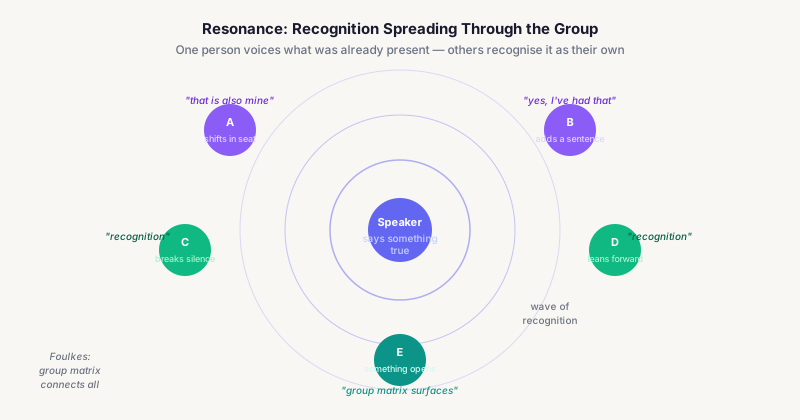
S. H. Foulkes, the founder of group analysis, described resonance as the felt sense of links between members' experiences in a group — including emotional content that has not been explicitly shared. Resonance is not agreement. It is not empathy, though empathy may accompany it. It is something more specific and more surprising: recognition. The sense that what one person has said maps onto something in one's own experience — not identically, but in a form that is close enough to produce the felt shock of being recognised in return.
"That is also mine, in some form." This is what resonance feels like from the inside. It is often slightly unexpected — the speaker did not know they were carrying what they are suddenly aware they are carrying. The recognition happens below the level of deliberate thought. And because it is not performed or planned, it carries a quality of authenticity that no facilitated sharing exercise can replicate.
Foulkes proposed that groups have their own unconscious — a group matrix of shared meanings, themes, and unspoken experience that connects members in ways they are not consciously aware of. Resonance is what happens when something in this matrix surfaces: when one person gives voice to something that was already present in the group, unnamed. The shift in the room — the changed posture, the sudden quality of attention — is the group recognising itself.
Why resonance is how groups actually learn
There is a version of team learning that is entirely cognitive: information is transferred, skills are trained, frameworks are introduced. This kind of learning has its place. But it does not change what groups fundamentally know about themselves, how they relate to each other, or what is possible between them. For that kind of change — the change that actually shifts how a team works — something different is required.
Resonance is how this deeper learning occurs. When one person's experience is recognised by others, several things happen simultaneously: bonds form, because recognition is one of the most powerful relational experiences available; communication opens, because something that was not safe to say has now been said and survived; and the group moves to a different level of work — not the surface level of process and tooling, but the level of actual experience, where the material that shapes how people relate to their work and each other can be approached.
Standard Agile ceremonies do not produce this. Training does not produce this. A well-designed team charter exercise does not produce this. What they can do, at best, is create conditions in which resonance becomes possible — in which the group has enough holding, enough familiarity, enough relational ground that when someone says something true, the room can receive it. The coach's job is not to produce resonance. It is to stop preventing it.
Condenser phenomena: when hidden material finally surfaces
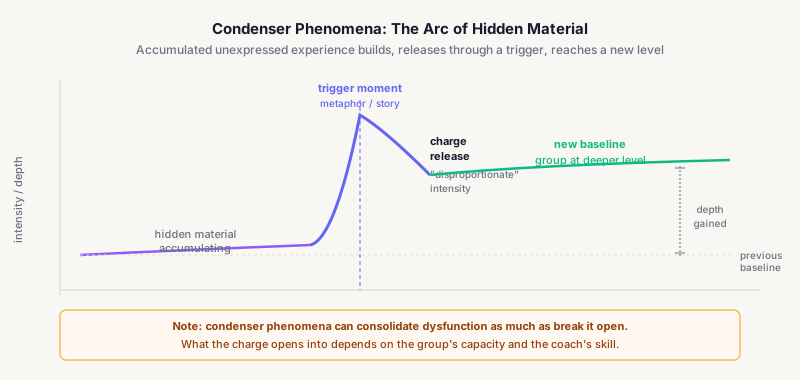
Foulkes identified a related phenomenon he called condenser phenomena: the intensification that occurs when material that has been present in the group matrix — unnamed, accumulated, building — finally surfaces, often through metaphor, symbol, or story. The release, when it comes, feels disproportionate to the trigger. The charge that discharges is greater than the immediate content warrants. This is because it has been accumulating for much longer than the current conversation.
Thornton draws on a vivid example from group analytic practice: a group of managers complaining about "being done over by HQ." The metaphor — crude, visceral, carrying a quality of violation and powerlessness — condenses months of unexpressed grievance into a shared release. The energy in the room changes. Something that had no words suddenly has words, and the words are recognisable across the group. The condenser moment is not a planned disclosure. It is the group finding, through an image or phrase, the container for what it has been unable to say directly.
Condenser phenomena are not always positive. They can consolidate dysfunction as much as break it open. A group that condenses around a shared narrative of victimhood — "we're always the last to know, we're never consulted, management doesn't care" — may experience a powerful moment of recognition that deepens its basic assumption rather than releasing it. The charge is real. What it opens into depends on whether the group has the capacity, and whether the coach has the skill, to work with what has emerged rather than simply riding the release.
What coaches do that prevents resonance
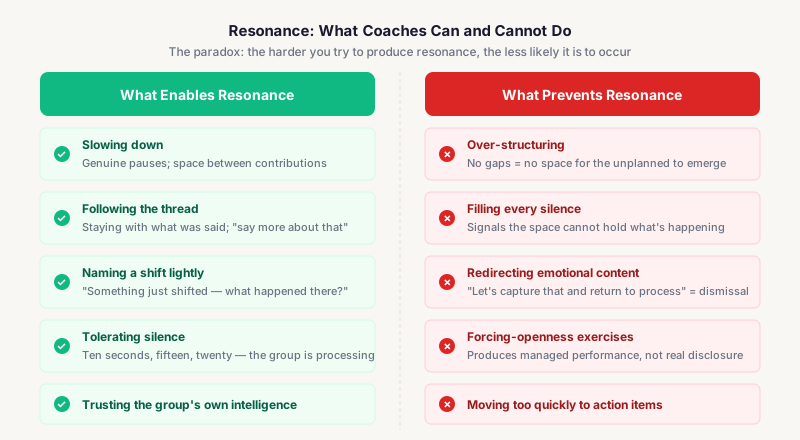
The paradox of resonance is that the harder you try to produce it, the less likely it is to occur. This is not a minor theoretical point. It has direct practical implications for how coaches structure their interventions, design their exercises, and manage their own anxiety about whether the session is "working."
Over-structuring: the coach who fills every minute with designed activity leaves no space for anything unplanned to emerge. Resonance typically occurs in the gaps — in the transition between agenda items, in the moment after something has been said when the room has not yet moved on. A session with no gaps is a session with no resonance.
Filling silences: the most common and most damaging intervention in this context. Silence after something genuine has been said is not a problem. It is the group processing. The coach who speaks into that silence — to summarise, to reflect back, to introduce the next question — interrupts the processing and signals that the space cannot hold whatever just happened. Groups learn this quickly and stop saying things that produce silences.
Redirecting when emotional content emerges: "That's important — let's make sure we capture it and come back to the process piece." This intervention, which is intended to be containing, is experienced as dismissive. It signals that the emotional content is a detour from the real work rather than the real work itself. The person who said something true learns that the true thing was out of place, and calibrates accordingly.
Exercises designed to force openness: the check-in that requires everyone to share "one word to describe how you're feeling," the retrospective format that invites "something you haven't said before," the trust exercise borrowed from a team-building workshop. These interventions have their place in the right context. In a group that is not yet held enough to support genuine exchange, they produce managed performance — people saying the words that satisfy the exercise without any real self-disclosure occurring. The coach gets compliance. The group learns that this space requires performance, not presence.
What coaches can do instead
The alternative is not passivity. It is a different quality of active attention — one that follows the group's own intelligence rather than substituting the coach's agenda for it.
Slow down: the single most powerful structural change available to most coaches. Sessions that move more slowly — with genuine pauses, with space between contributions — create the conditions in which something can arrive that was not invited. Speed signals that the primary value is efficiency. Slowness signals that the primary value is what is actually happening.
Follow the thread rather than steering: when something genuine is said, stay with it. Resist the pull toward the next agenda item. Ask a question that deepens rather than redirects: "Say more about that" or simply waiting to see what comes next. The group's spontaneous development of a theme — the way one contribution opens into another, and that into another — is the actual learning. The coach's role is to protect this development, not to manage it toward a predetermined output.
Notice when the room shifts and name it lightly: "Something just shifted — what happened there?" This intervention is simple and surprisingly powerful. It names the resonance without explaining it, inviting the group to attend to its own process without the coach's interpretation foreclosing what the group might find. The lightness matters: the coach is not making a claim about what the shift meant, only registering that it occurred and that it might be worth attending to.
Trust the group's own intelligence: perhaps the most fundamental reorientation. The group knows more than any individual in it, including the coach. It carries material that no survey or diagnostic tool will surface. Given enough holding, enough space, enough consistent presence from a coach who is not rushing to produce an outcome, that material will find its way into the room. The coach who trusts this — who can sit in apparent unproductivity without anxiety — is the coach in whose sessions resonance eventually occurs.
You cannot plan the moments that matter most
The developer who said he felt invisible in architecture decisions did not plan to say it. The QA engineer who confirmed it did not plan to confirm it. Nobody in that room had put "surface unspoken experience of marginalisation" on the agenda. It arrived because the conditions allowed it to arrive: enough holding had accumulated over enough sessions that when something true presented itself at the edge of expression, the room could receive it.
Creating those conditions is most of what group coaching means, understood from the inside rather than from the outside. Not designing the content. Not engineering the outcome. Not measuring the psychological safety score and planning the intervention. Being present, being regulated, tolerating the uncertainty of not knowing what will happen next, and trusting that when something real is ready to emerge, it will — if the container is strong enough to hold it. That is not a passive role. It is possibly the most demanding active practice available to a coach. And the moments it makes possible cannot be planned, only received.
Continue Exploring
Go deeper into the work
The Book
The Art of Creating Self-Organizing Teams
The full framework behind this article — contracting, team dynamics, and practical coaching tools for every stage of the journey.
Companion Toolkit
Resistance Radar & Resilience Scorecard
Practical tools for mapping resistance patterns and measuring whether interventions increased capacity — not just compliance.
TA for Agile
Co-creative TA in Agile Contexts
Ego states, psychological contracts, group imago, and the relational concepts that underpin this article — applied to real teams.