Speed as Social Defence: How Delivery Culture Closes the Space Coaching Needs
James Krantz observed that new information technologies function as social defences when they enable the speed of work to undermine organisational capacity for reflective thought. The observation was made in 2010. It describes the entire delivery culture of Agile in 2026. Continuous deployment, sprint velocity metrics, and cycle time dashboards are not neutral efficiency tools. When used without counterbalance, they function as a collectively maintained defence against the kind of slow, uncomfortable attention that real team development requires.
The session that dissolved by Wednesday
The coach had been working with the team for four months when the budget freeze hit. The quarterly team development day — six hours, off-site, properly facilitated — was cut to three hours, held in a meeting room between two sprint ceremonies. The team arrived with their laptops. The session produced genuine insights, moments of honest conversation, a handful of commitments that felt different from the usual retrospective action items.
By Wednesday, the commitments had not been revisited. By the following Monday, two of the three people who had made them were carrying a sprint's worth of urgent delivery work. By the end of the sprint, the insights were not gone — they were simply not available in the rhythm the team was operating at. The team could remember the conversation. They could not act from it. The sprint cycle had already moved on.
Krantz's observation
James Krantz, writing about the social and psychological effects of digital technology on organisational life, made an observation in 2010 that has only become more precise with time. New information technologies, he argued, enable a speed of work that can function as a social defence — not because anyone intends it to, but because extreme speed forecloses the capacity for reflective thought in exactly the way that Menzies Lyth showed institutional procedures forecloses the capacity for relational care.
Krantz's concern was with financial institutions: traders operating at the speed of algorithmic execution, fund managers managing portfolios across time zones, executives receiving information at a rate that made considered response structurally impossible. His argument was that speed at this level did not merely accelerate work. It changed the nature of the cognitive and moral engagement possible with that work. When decisions must be made faster than reflection can catch up, reflection ceases to be a functional part of the decision-making process. The speed is not incidentally preventing reflection — it is structurally preventing it, which means the speed is functioning as a defence against whatever reflection might produce.
Krantz was describing financial institutions in 2010. He was also describing Agile delivery culture in 2026.
How Agile velocity culture became a defence system
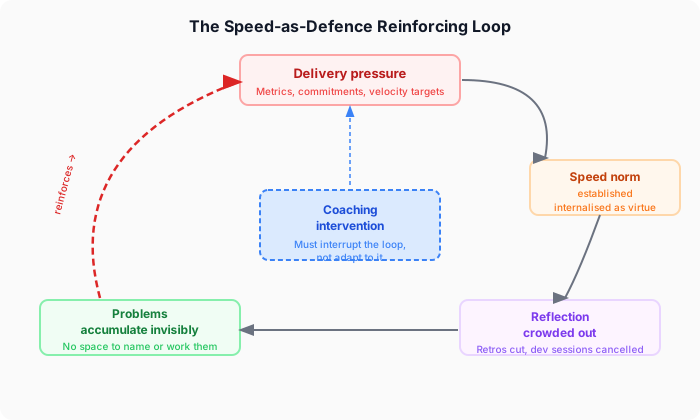
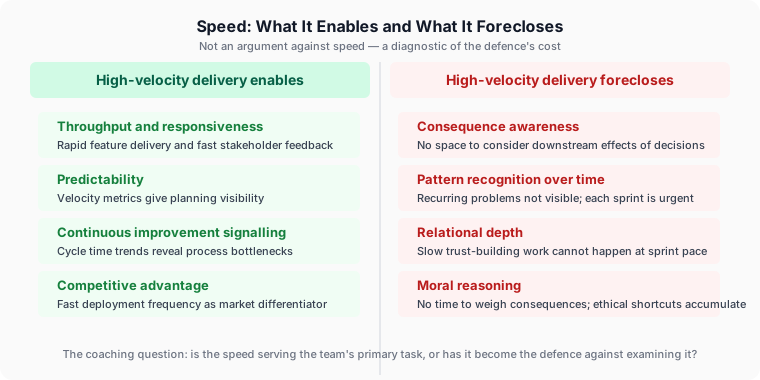
Cycle time, throughput, story point velocity, deployment frequency, lead time from commit to production — each of these is a legitimate operational metric. Each makes visible something that matters. Together, they create a normative pressure that is difficult to distinguish from genuine priority: the team that is measuring throughput and deployment frequency is implicitly valuing speed over other things, and "other things" includes the slow, uncomfortable attention that team development requires.
The defence is not cynical. That is the most important thing to understand about it. Nobody in leadership says "we will use velocity metrics to prevent the team from examining itself." The team members who deprioritise the development session to deliver the sprint commitment are not being resistant or avoidant — they are doing what the normative culture of their organisation rewards and what every signal in their environment tells them is the right priority. The defence is internalised. It has become indistinguishable from professionalism.
This is precisely what makes it a defence system rather than a mere efficiency preference. A preference can be surfaced and debated. A system that has been internalised as professional virtue is much harder to examine, because examining it feels like questioning whether work matters.
What this means for coaching interventions
The coach who works in a high-velocity team encounters a specific structural problem: the interventions their work requires — reflective conversation, pattern recognition over time, honest examination of what is and isn't working — all require a quality of attention that the delivery culture has been configured to prevent. This is not coincidental. It is the defence operating exactly as designed.
The retrospective is booked last and cancelled first, because it is the ceremony with the least visible output and the greatest reflective demand. The team development session is treated as optional because it has no sprint artifact. The coach's observation that the team needs to slow down is heard as a request to be less professional, less committed, less serious about delivery — which is how the defence reframes any challenge to the speed norm.
The coach who does not name this is working in a system designed to make their most important work invisible. They may continue producing useful insights that dissolve by Wednesday, running valuable retrospectives that get cut short or cancelled, facilitating development conversations that cannot be consolidated because the rhythm the system operates at makes consolidation impossible.
The coach's collusion
Coaches working in high-velocity environments frequently collude with the speed defence without intending to. The collusion takes several forms. The coach accelerates their own pace to match the team — producing faster frameworks, shorter interventions, more immediately actionable tools — and in doing so reinforces the message that reflection should be convertible to action before the next standup. The coach replaces open-ended inquiry with structured exercises that produce outputs, because outputs feel like work and open inquiry feels like indulgence. The coach reduces the retrospective to thirty minutes to show they understand delivery pressure, which is the correct political read and the worst developmental move.
Each of these is individually understandable. Collectively, they add up to a coach who has been absorbed into the defence system and is now helping the team manage the anxiety of not examining itself, rather than helping the team develop the capacity to examine itself.
Three moves
Name the speed as a cultural norm before proposing reflection. This is the move that most coaches skip, because it feels confrontational. It is actually the most respectful intervention available. Naming the speed culture makes it available for examination. "I notice that in this team, slowing down to examine how we're working feels professionally risky — is that accurate?" This question names the defence without attacking it, and invites the team to confirm or correct the observation. It also positions what follows — a reflective intervention — as something that has been chosen deliberately, not something that has crept in through the coach's calendar.
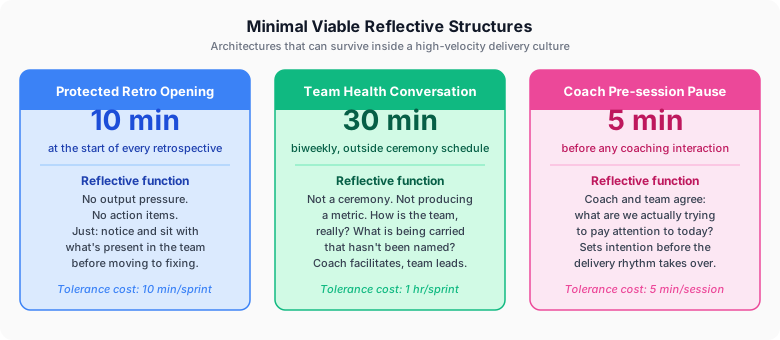
Create minimal viable reflective structures that fit within the sprint rhythm. The development day that gets cut is not the right architecture for a team operating at sprint velocity. The right architecture is smaller, more frequent, and woven into the existing rhythm rather than scheduled alongside it. Ten protected minutes at the start of the retrospective with no output pressure — no action items, no voting, just notice and sit with it. A biweekly thirty-minute team health conversation outside the ceremony structure, explicitly not a ceremony and explicitly not producing a metric. A coach's pre-session pause — five minutes before any coaching interaction where the coach and team agree on what they are actually trying to pay attention to. These are not lesser versions of proper development work. They are architectures that can survive in the speed culture the others cannot.
Contract explicitly with the sponsor about what the delivery culture costs. Coaches working without a sponsor conversation about the speed defence are working without the authority they need. The sponsor needs to understand that the interventions the team requires are structurally incompatible with unlimited delivery pressure — not as a preference, but as a property of reflective development work. This conversation is uncomfortable. It is also the conversation that determines whether the coaching engagement is structurally set up to succeed or structurally set up to produce insights that dissolve by Wednesday.
The system designed to prevent what coaching requires
The team that cannot slow down long enough to examine itself is not resistant to coaching. It is operating in a system that has been designed — with the best of intentions, by people who genuinely believe in delivery and performance — to prevent the kind of examination that coaching requires. The speed culture was not constructed as a defence. It became one, through the accumulated logic of velocity metrics, sprint commitments, and the professional identity that forms around consistent delivery.
Krantz's contribution was to show that speed itself — not the content of the work, not the difficulty of the problems, but the sheer velocity of the operational rhythm — can be a defence system. This is not an argument against speed. High-velocity delivery teams produce real value, and the metrics that drive them are not fabricated. It is an argument for the coach to understand that when speed is functioning as a defence, interventions that require reflection will be structurally resisted regardless of how well they are designed.
The coaching agenda in a speed culture is not to slow the team down. It is to find the minimum viable reflective architecture that the team can maintain within the speed it is committed to — and then to expand that architecture, carefully and incrementally, as the team's capacity for examination develops.
Continue Exploring
Go deeper into the work
The Book
The Art of Creating Self-Organizing Teams
The full framework behind this article — contracting, team dynamics, and practical coaching tools for every stage of the journey.
Companion Toolkit
Resistance Radar & Resilience Scorecard
Practical tools for mapping resistance patterns and measuring whether interventions increased capacity — not just compliance.
TA for Agile
Co-creative TA in Agile Contexts
Ego states, psychological contracts, group imago, and the relational concepts that underpin this article — applied to real teams.