The Team Is Not the Patient: Why 'Dysfunctional' Is a Frame the Coach Should Resist
The coach is hired to fix a dysfunctional team. Six months later, the team is functioning. The coach is then challenged — not on their work with the team, but on something else entirely. The organisation that commissioned the work has begun to resist what it asked for. This is not betrayal. It is the system behaving exactly as systems do when the dysfunction they housed gets disturbed.
When the system resists what it commissioned
A coach is hired to work with a branch management team. The label in the commissioning conversation is "dysfunctional" — the team has communication problems, low trust, and a pattern of blame that the HR Director describes as undermining the whole regional structure. The coach agrees to work with them for six months.
The work goes well. By month four, something real has shifted. Managers who spent the first sessions attributing every problem to head office have started owning their own contribution. The conversations in the room are different. The coach sees the change in the quality of disagreement — less defended, more curious. It is careful work and it is working.
Then the HR Director calls. Not about the work with the team — that, they say, seems fine. The challenge is about something peripheral: an administrative detail, a scheduling request the coach handled in a way that apparently caused friction in the regional centre. It is a small thing, stated with unusual force. Something feels off. The system is resisting what it commissioned, and the resistance is arriving via a different door.
The label is a location, not a diagnosis
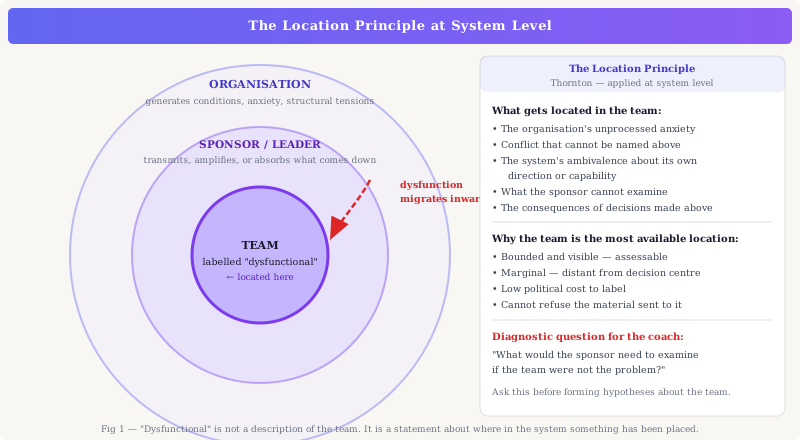
"Dysfunctional" is a word that deserves scrutiny whenever a coach hears it applied to a team. It presents as a diagnosis — a description of something intrinsic to the team, a quality the team possesses. But it is better understood as a location: a statement about where in the system a particular difficulty has been placed, not where it originated.
Dysfunction does not originate in teams. It migrates. It moves toward wherever the system can most conveniently place it without having to examine itself. Teams are often the most convenient location: they are bounded, visible, assessable, and far enough from the organisation's decision-making centre that labelling them carries limited political risk for those doing the labelling.
When a sponsor describes a team as dysfunctional, the coach's first internal question should not be "what is wrong with this team?" but "what is the system unable to hold about itself, and has located here instead?" This is not a cynical question. It is a diagnostic one. It opens the possibility that the team is doing something useful for the wider system — carrying something the system needs carried — and that fixing the team without attending to the system function will either fail or produce a new carrier somewhere else.
The location principle at system level
Christine Thornton describes the location principle in the context of individuals within teams: a quality or characteristic that the group cannot hold collectively gets located in the most marginal, most expressive, or most available member. The individual carries it on behalf of the group, and the group relates to the individual as if the quality belongs to them rather than to the system as a whole.
The same principle applies at the level of teams within organisations. A team that "has communication problems" may be communicating exactly what the organisation cannot say at a higher level. The inability to move forward, the conflict, the blame — these may not be generated by the team at all. They may be transmitted to the team from conditions above it, and the team is expressing what those conditions produce.
The team that is marginal — geographically distant, structurally peripheral, recently assembled from people nobody else wanted, or representing a function the organisation ambivalently values — is the most available location for what the system cannot own. The branch management team in a regional centre is a classic location. Far from headquarters. Accountable for outcomes they do not entirely control. The ideal container for whatever the centre cannot acknowledge about itself.
What happens when the coaching works
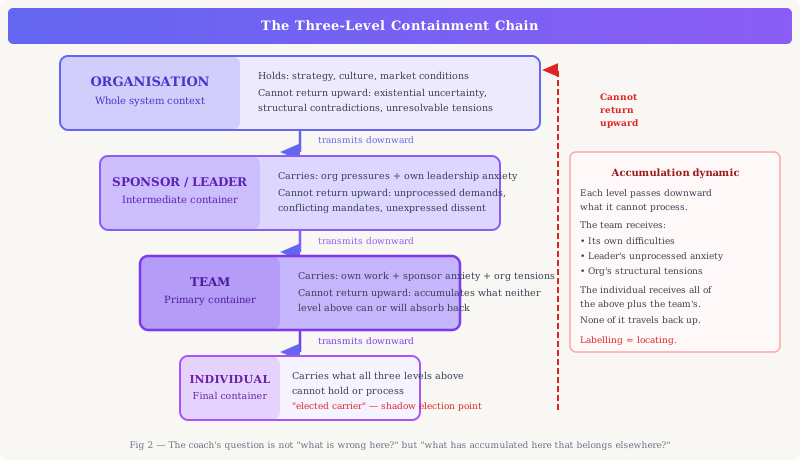
When a team stops carrying the dysfunction, the system has a problem. The material that was being held by the team — the blame, the communication failure, the sense of irresolvable conflict — has to go somewhere. If the team is no longer available as a container, the material returns to the levels that were generating it.
This is experienced at the higher levels of the system not as "the work is succeeding" but as a new pressure, a new anxiety, a new difficulty that was not there before. The regional centre that commissioned the coaching begins to notice its own tensions more acutely — because the team is no longer absorbing them. This is discomforting, and the system's response is often to locate the disturbance in the nearest available new container: the coach.
The HR Director's challenge — technically about an administrative matter, arriving with disproportionate force — is the system's attempt to locate in the coach what the team is no longer holding. The coach who receives this and interprets it as a complaint about their work is being invited into a new location role. The coach who recognises it as systemic communication has important information: the coaching has reached the right level.
The coach's diagnostic questions
Before accepting the "dysfunctional team" frame — before beginning the work, and periodically throughout it — the coach should be asking a set of systemic questions. These are not questions to ask the sponsor directly, at least not initially. They are diagnostic questions the coach needs to hold internally as they form their understanding of the system.
Who benefits from this team carrying this label? What would the sponsor organisation need to examine if the team were not the problem? What is the team carrying that belongs elsewhere in the system — what is it expressing that cannot be expressed from above? What would happen to the system if the team were suddenly "well": where would the difficulty go, and who would have to hold it?
These questions do not lead to a different intervention with the team, necessarily. But they change the coach's understanding of what the work is for. A coach who knows they are working at the boundary between a team and its system — rather than simply fixing a broken team — will attend differently to what arises, will notice the moments when the system pushes back, and will be less likely to be unconsciously drawn into confirming the dysfunctional framing.
What to do instead of accepting the label
Refusing the "dysfunctional team" frame does not mean refusing the commission. It means insisting on a different scope. The coach can accept the work while naming, clearly and early, that team behaviour cannot be understood in isolation from the system that surrounds the team. This is not a hedge or a diplomatic softening. It is a factual statement about how systems work, and sponsors who understand it will be better positioned to support the coaching. Sponsors who resist it are communicating something important about where the defence is located.
Practically: name the frame explicitly in the contracting conversation. Map the system before forming hypotheses about the team. Build sponsor accountability into the design — the sponsor is part of the system being coached, even if they are not in the room. And when the sponsor's behaviour changes in response to the team's improvement, name that change as part of the work, not as interference with it.
The coach who takes the label at face value and works only with the team has an easier engagement. The sponsor is satisfied, the team works hard, some things improve. But the systemic conditions that produced the dysfunction remain in place. A year after the coaching ends, a different team in the same position will be labelled in the same way, and the cycle will begin again. The location principle will find a new container.
The drama triangle in the system
The commissioning dynamic for team coaching often replicates the drama triangle at system level. The sponsor occupies the persecutor position: the team is the problem, something must be done, the coach is being brought in to fix it. The team occupies the victim position: we are doing our best, the system makes this impossible, we are not heard. The coach is invited into the rescuer position: hired to fix the victim, satisfying the persecutor.
Every move the coach makes from the rescuer position reinforces the triangle. If the coach works to fix the team, they confirm that the team needs fixing — confirming the persecutor's frame and the victim's self-understanding. The more effectively the coach rescues, the more dependent the team becomes on the coach's presence, and the more the sponsor is confirmed in their view that outside intervention was required.
The alternative is to hold what transactional analysis calls the Adult position: to operate from a clear-eyed assessment of what is actually happening rather than from the role the system is offering. The Adult coach refuses the persecutor/victim framing as accurate. They hold the systemic view — that the team is expressing something the system is generating — while also holding accountability: the team is not absolved by systemic analysis. Both are true. The drama triangle requires one to be false.
The team is the location, not the source
Dysfunction in a team must always be understood as an expression of dysfunction in the team's broader organisational context. This does not mean the team is without agency or that individual behaviour is irrelevant. It means that the level of analysis the "dysfunctional team" label implies is almost always insufficient.
Accepting the label is risky for the coach, because the dysfunction may not all be where it is currently located. If the coach works as though the team is the patient and the team alone requires treatment, they are likely to find that the system resists improvement, or that improvement in the team is absorbed by the system without changing anything structural, or — most uncomfortably — that when the coaching succeeds, the system finds a new way to locate what the team was holding.
The coach's task is not to fix the team. It is to work at the boundary between the team and its context, to hold the systemic question alongside the team question, and to resist — from the beginning and consistently — the invitation to treat the location as the source.
Continue Exploring
Go deeper into the work
The Book
The Art of Creating Self-Organizing Teams
The full framework behind this article — contracting, team dynamics, and practical coaching tools for every stage of the journey.
Companion Toolkit
Resistance Radar & Resilience Scorecard
Practical tools for mapping resistance patterns and measuring whether interventions increased capacity — not just compliance.
TA for Agile
Co-creative TA in Agile Contexts
Ego states, psychological contracts, group imago, and the relational concepts that underpin this article — applied to real teams.