Why Some Voices Don't Carry: Testimonial Injustice in Self-Organising Teams
Self-organisation promises that hierarchical position no longer determines whose voice carries weight. In practice this promise is incompletely kept — and the reasons are often structural, not psychological. Testimonial injustice is the condition in which a speaker is assigned reduced credibility not because of what they say but because of who they are perceived to be.
The retrospective that didn't change
The team had high safety scores. The retrospectives were well-run. The coach had worked carefully to create conditions where all voices could be heard, and by most measures, the work had succeeded: people spoke, the conversation was lively, and there were no obvious silences.
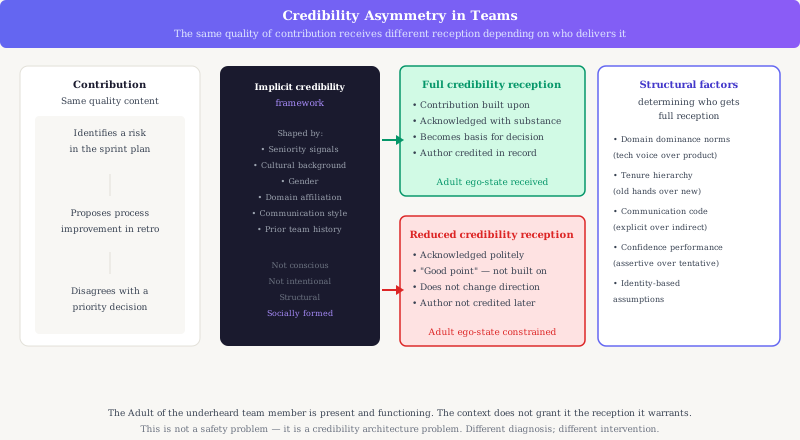
What the coach noticed, over several months, was something more subtle. Certain team members spoke and were heard. Their ideas were taken up, built on, and often became the basis of team decisions. Other team members spoke with equal frequency and equal preparation — and what they said landed differently. It was acknowledged. It was thanked. It did not quite change anything. The same person could make the same point as a colleague who had made it the week before, and this time it would be received with polite engagement rather than genuine uptake.
This was not a safety problem. No one was afraid to speak. The issue was not that voices were suppressed — it was that certain voices were systematically discounted once they had spoken. The team was, in a precise sense, not listening to everyone equally. And the pattern of whose voice carried and whose did not was not random.
Testimonial injustice: a structural account
Miranda Fricker, the philosopher from whom Sedgwick draws this concept, defines testimonial injustice as the structural condition in which a speaker is assigned reduced credibility by listeners not because of what they say but because of who they are perceived to be. The injustice operates through a credibility deficit: the listener's implicit assessment of the speaker's reliability, competence, or authority is lower than is warranted by the evidence.
This is a different phenomenon from deliberate exclusion, conscious prejudice, or the individual psychological defensiveness that coaching typically addresses. Testimonial injustice is structural in Sedgwick's sense: it operates through the shared implicit frameworks that a group uses to evaluate who deserves to be heard, and these frameworks are shaped by social context rather than individual intention. The team member whose voice does not carry is not being actively silenced. They are experiencing the accumulated weight of a context that has formed credibility hierarchies that do not include them fully.
Sedgwick's contribution is to connect this to the Adult ego-state concept from TA. When testimonial injustice operates in a team, certain members' Adult ego-state — their capacity to think, assess, and contribute from a position of competence — is placed under a credibility constraint by the group's implicit framework. Their Adult is present and functioning. The context does not grant it the reception it warrants.
Why facilitation cannot resolve what it cannot see
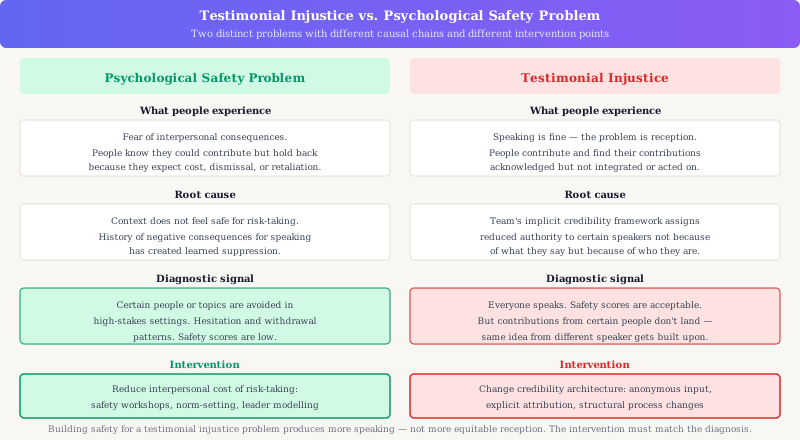
The standard toolkit for voice equity in teams is built around psychological safety: create the conditions in which people feel comfortable speaking, and the diversity of voice will follow. Testimonial injustice is a different problem with a different structure, and the safety toolkit does not reach it.
The team members experiencing testimonial injustice may already feel safe enough to speak. The problem is not that they are afraid to contribute — it is that their contributions are not received with the weight they warrant. More facilitation for safety produces more speaking from people who were already speaking. It does not change the implicit credibility framework that determines whose speaking matters.
Coaches who miss this distinction try to solve a reception problem by addressing a transmission problem. They create more opportunities for underheard voices to speak. The voices speak more. The reception is unchanged. The coach experiences this as a puzzle: more safety, more speaking, and yet the same pattern of whose ideas count and whose are noted but not integrated.
The diagnostic shift that Sedgwick's framework enables is from transmission to reception. The question is not "do people feel safe enough to speak?" but "does the group's implicit credibility framework grant equal weight to what different people say?" These are different questions with different answers, and the second one requires attending to different data.
Identifying testimonial injustice in a team
The diagnostic signal for testimonial injustice is the gap between contribution quality and contribution reception. A coach looking for this pattern attends to a specific set of observations: Who speaks? How does what they say land? Who builds on whose ideas? When the same point is made by different people, whose version gets taken up? Whose contributions are acknowledged with "good point" and whose become the basis for the next decision?
The pattern is usually not uniform across all topics or all interactions. Testimonial injustice tends to be domain-specific and context-sensitive: a team member may have full credibility in one area (technical implementation, say) and systematically reduced credibility in another (strategic direction, or the framing of team relationships). The structural factors shaping the credibility deficit — gender, seniority, cultural background, domain of expertise — will determine which domains are affected.
A useful diagnostic question for coaches: if I removed the identity of the speaker from this contribution and evaluated only the content, how would the team assess it? If the content assessment would be higher than the actual reception, testimonial injustice is likely operating. The difficulty is that this question cannot always be asked directly without the inquiry itself creating defensiveness.
Interventions that address the structural rather than the psychological
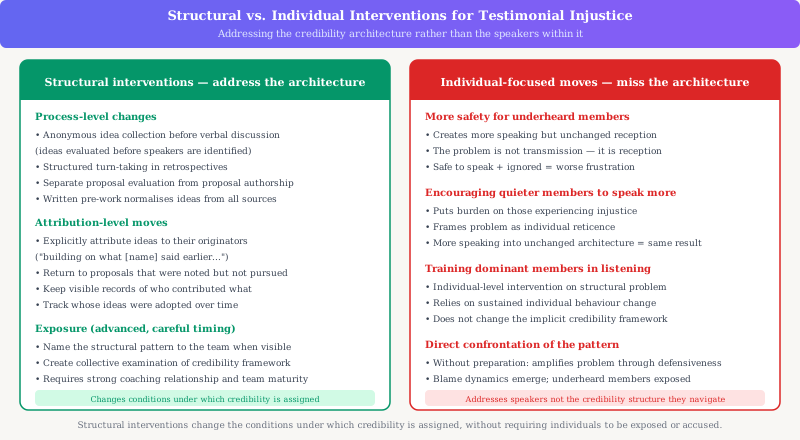
Because testimonial injustice is structural rather than psychological, the interventions that address it are structural rather than psychological. The goal is not to change how individuals in the team feel about each other — it is to change the implicit processes by which credibility is assigned in the group's collective practices.
Process-level interventions change the decision-making architecture without requiring the team to explicitly confront its credibility dynamics. Written idea collection before verbal discussion (so ideas are evaluated before speakers are identified), structured turn-taking in retrospectives (so the sequence of speaking does not amplify existing credibility hierarchies), separate proposal evaluation from proposal authorship — these are structural changes that redistribute credibility without requiring the team to examine its implicit frameworks directly.
Attribution-level interventions change how contributions are credited in the team's collective record. Coaches who explicitly attribute ideas to their originators ("building on what [name] said earlier"), who bring forward proposals that were made but not received ("I want to return to something raised a few minutes ago"), and who create records that make visible who contributed what, are working with the credibility structure rather than just the safety structure.
Exposure interventions — naming the pattern to the team — are the most powerful and the most risky. When testimony injustice has become visible enough to be named, and when the team has enough collective maturity to work with the naming without retreating into defensiveness or blame, making the structural pattern explicit can create genuine collective examination of the credibility framework. This is advanced work. It requires accurate diagnosis, careful timing, and a well-established coaching relationship. Done poorly, it amplifies the problem it was meant to address.
What was happening in the opening team
The pattern the coach observed in the opening team was not subtle once a structural frame was applied. Three team members — all relatively junior, two women, one man from a cultural background different from the team's majority — contributed ideas that were routinely acknowledged and not taken forward. The same ideas, when raised by more senior colleagues, were acted upon. The pattern was consistent enough to be diagnostic.
The coach shifted the retrospective process: anonymous idea cards before discussion, explicit attribution of contributions during conversation, a practice of returning to proposals that had been noted but not pursued. Within two retrospectives, the ideas from the previously underheard members were being built on as consistently as ideas from the rest of the team.
What changed was not the team's psychology but its processes — and through the processes, its implicit credibility framework. That is what structural intervention looks like. It does not ask the team to feel differently about each other. It changes the conditions under which credibility is assigned, and lets the changed conditions do the work.
Continue Exploring
Go deeper into the work
The Book
The Art of Creating Self-Organizing Teams
The full framework behind this article — contracting, team dynamics, and practical coaching tools for every stage of the journey.
Companion Toolkit
Resistance Radar & Resilience Scorecard
Practical tools for mapping resistance patterns and measuring whether interventions increased capacity — not just compliance.
TA for Agile
Co-creative TA in Agile Contexts
Ego states, psychological contracts, group imago, and the relational concepts that underpin this article — applied to real teams.