The Animus Trap: What Agile Measures and What It Silences
Agile frameworks are structurally biased toward animus-coded values: measurable output, decisive action, visible progress, rational prioritisation, speed. These are not neutral. The complementary anima-coded values — relational attunement, contextual wisdom, symbolic meaning, reflective depth, cyclical rhythm — are treated as soft, secondary, or unmeasurable. What isn't measured goes into shadow. Psychological safety initiatives fail precisely because they are launched with animus energy applied to something that is, by nature, anima-coded.
The team that's winning by the numbers
Velocity is up. Defect rate is down. Sprint predictability is the highest it has been in eighteen months. The team health survey shows green across all six dimensions. The coach reports this to the programme and genuinely believes it. Two months later, three senior engineers have handed in their notice. One of them explains: "The work is fine. The numbers are fine. I just can't remember the last time I felt like what I was doing actually mattered."
This gap — between what the metrics show and what the team experiences — is not a measurement problem. It is not solved by adding more metrics, more granular metrics, or sentiment indicators to the existing dashboard. It is a structural problem that sits beneath the measurement system itself: Agile frameworks are designed to make certain things visible and certain things invisible, and the things they make invisible are precisely the things that matter most to people who care deeply about their work.
Jung's analysis of the psyche included a fundamental polarity between two archetypal energies that he termed anima and animus. These are not simply gendered categories, though Jung's initial framing was shaped by the assumptions of his time. They are better understood as two orientations of the psyche toward the world: one directed toward the concrete, measurable, and decisive; the other directed toward the relational, symbolic, and contextual. Laurence Barrett, in his Jungian approach to coaching, describes the leadership problem as one of chronic over-privilege of animus energy at the expense of anima — and the same analysis applies with considerable precision to Agile frameworks.
What animus energy looks like in a sprint team
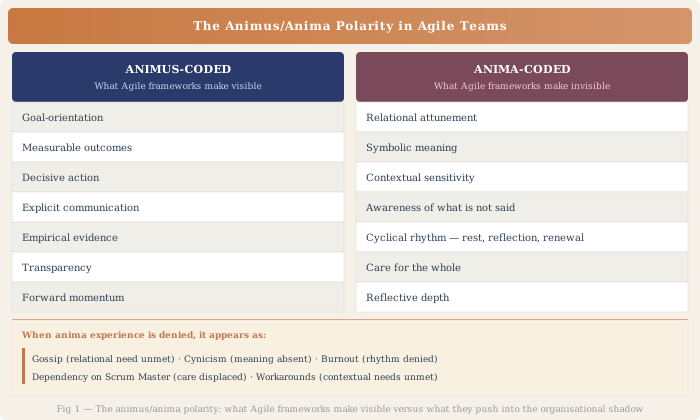
Animus-coded energy in organisations is characterised by: goal-orientation, measurable outcomes, decisive action, forward momentum, empirical evidence, explicit communication, transparency, and speed. These are not bad values. They are genuinely useful in the contexts for which they were developed. The problem arises when they are treated not as one pole of a necessary polarity but as the entirety of what matters.
Agile frameworks are structurally animus-coded. The sprint goal is explicit, measurable, and time-boxed. Progress is visible on the board. Impediments are named and tracked. Velocity is calculated. Definition of done is concrete. The retrospective produces action items. The empirical process is iterated. Each of these elements privileges the visible over the invisible, the quantifiable over the felt, the explicit over the implicit. This is by design. These frameworks emerged in software engineering contexts where the problems they addressed — unclear requirements, invisible progress, unpredictable delivery — were genuinely best approached with greater concreteness and transparency.
The trap is the assumption that what the framework makes visible is what there is to see. What it makes invisible does not therefore cease to exist. It goes into shadow.
What disappears into the shadow: the anima cost
Anima-coded experience in organisations is characterised by: relational attunement, contextual sensitivity, symbolic meaning, reflective depth, cyclical rhythm, care for the whole, and awareness of what is not said. These are not soft skills. They are the substrate on which sustainable high performance depends — and they are almost entirely absent from the Agile framework vocabulary.
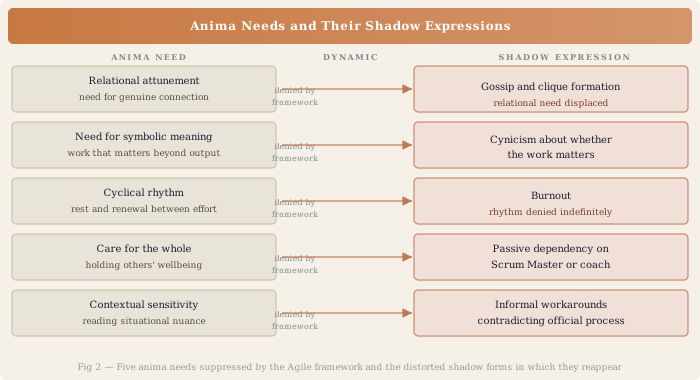
When anima-coded experience goes unacknowledged, it does not disappear. It goes into the organisational shadow and finds expression in distorted form. The team's relational need appears as gossip and clique formation. The need for symbolic meaning appears as cynicism about whether the work matters. The need for cyclical rhythm — rest, reflection, renewal — appears as burnout. The need for care appears as passive dependency on the Scrum Master or coach. The need for contextual sensitivity appears as informal workarounds that contradict the official process.
The coach who tries to address these shadow expressions within the animus framework — who adds a "team health metric," who introduces a "retrospective format for psychological safety," who creates an "impediment board for relational issues" — has applied animus energy to an anima problem. The measurement of warmth does not produce warmth. The tracking of psychological safety does not produce safety. The shadow material is simply repackaged into a form that can be made visible and managed, without being allowed to do what shadow material does when it is genuinely met: transform.
Why psychological safety can't be measured into existence
The psychological safety industry is the purest expression of animus-energy applied to an anima problem. Teams complete surveys. Scores are calculated. Dashboards are generated. Interventions are designed to move the score. And the gap between declared and experienced safety persists — because safety is not a measurement. It is an experience. It is anima-coded through and through: relational, contextual, felt rather than visible, generated through the quality of encounter rather than through the implementation of a protocol.
The Agile coach who wants to work with psychological safety must be willing to work in anima mode: to attend to the quality of encounter in the room before and instead of attending to the agenda; to notice what is being not said and find oblique ways of creating space for it; to trust the slow work of relational repair over the fast work of protocol implementation; to hold ambiguity without resolving it prematurely into an action item.
This is not a renunciation of structure. Anima energy without animus grounding is as dysfunctional as the reverse: teams that process endlessly without deciding, that attend to relationship at the cost of delivery, that mistake warmth for trust. The target is integration — the creative tension between both poles — not the substitution of one for the other. But the field's problem is not a surfeit of anima. It is the near-complete dominance of animus, with anima experience relegated to the unofficial, the informal, and the dismissed.
Recognising animus inflation in coaching practice
Animus inflation in a coaching engagement looks like: over-reliance on frameworks to diagnose situations that require felt sense; rushing toward action items before the team has had time to actually sit with what they discovered; measuring outcomes before the work has had time to land; treating every problem as solvable by the right process if only the team would implement it correctly; and a particular discomfort with sessions where nothing concrete was produced but something significant shifted.
The animus-inflated coach cannot tolerate ambiguity, uncertainty, or the unresolved. They will experience a retrospective that produced insight but no action items as a failure. They will experience a quiet session where a team simply sat with something difficult as wasted time. They will reach for a framework at the moment when the right move is to stay with the experience the team is having.
The coaching culture has its own animus inflation: the relentless production of new frameworks, competency models, assessment tools, and certification structures. Each of these is an attempt to make visible and manageable the work of coaching — to subject it to the same empirical-process treatment that Agile frameworks apply to software delivery. The work of coaching, like the experience of psychological safety, is resistant to this treatment. It happens in the space between the frameworks.
Restoring balance: what it means in practice
Restoring the anima dimension to an animus-inflated team system is not a matter of adding more "soft" elements to the existing structure. It requires a change of register — a willingness to work in a mode that the Agile framework does not naturally support.
In practice this might look like: making space in a retrospective for the team to say what the sprint felt like before asking what went well and what could improve; treating a pattern of informal conversations as data about what the official structure isn't holding, rather than as scope creep to be redirected; noticing when the team's energy shifts and treating that shift as information rather than noise; asking what the work means to people rather than only what it requires of them.
It also means developing a coaching practice that is genuinely comfortable with not knowing — with staying in the question rather than reaching for the answer, with letting the team's process unfold rather than directing it toward a predetermined outcome. This is anima mode. It produces different things than animus mode produces. Sometimes it produces nothing visible at all — and something important has shifted underneath.
The three engineers who resigned were not telling the team that velocity was wrong as a metric. They were telling it that velocity was not enough as a reason to come to work. That gap — between what the framework tracks and what people need from their work — is the space the anima dimension inhabits. Ignoring it does not make it go away. It makes it walk out the door.
Continue Exploring
Go deeper into the work
The Book
The Art of Creating Self-Organizing Teams
The full framework behind this article — contracting, team dynamics, and practical coaching tools for every stage of the journey.
Companion Toolkit
Resistance Radar & Resilience Scorecard
Practical tools for mapping resistance patterns and measuring whether interventions increased capacity — not just compliance.
TA for Agile
Co-creative TA in Agile Contexts
Ego states, psychological contracts, group imago, and the relational concepts that underpin this article — applied to real teams.