The Coach Who Became the Secure Base
Long-tenured coaches and Scrum Masters become psychological leaders without noticing it happen. The team forms an attachment bond: the coach becomes the secure base from which the team explores. This sounds like trust. It is, in part. But securely attached teams ask the coach before deciding, escalate conflict to the coach, and lose capacity when the coach is absent. The coach has become the single point of failure for the autonomy they're trying to build.
The team that couldn't decide without asking
A product team at an e-commerce company. Eighteen months into a coaching engagement. The coach is embedded, trusted, genuinely valued by the team, the Scrum Master, and the sponsoring director. Sprint retrospectives are among the best the coach has run. The SM has grown significantly — more confident, clearer in facilitation, genuinely present with difficult conversations. The coaching sponsor describes the engagement as transformative.
Then the coach takes two weeks' planned leave. On return, the debrief: the sprint was the worst in twelve months. A significant infrastructure decision — well within the team's technical competence and formally within the SM's authority — had been deferred. The retrospective had run for thirty-five minutes and produced two action items, both assigned to the coach. Three team members, independently, had sent the coach messages during the leave asking for guidance on decisions the team had collectively resolved in previous sprints without difficulty.
The coach's first thought: something went wrong while I was away. The second thought, slower and harder to reach: this is what I built.
Trust and dependency are not opposites. They are, in long-tenured coaching engagements, often the same relationship at different stages of its development. The mechanism through which excellent coaching produces coach-dependent teams is not a failure of skill or attentiveness. It is a structural property of the attachment dynamic that relational coaching is designed to create — and that the standard engagement model has no mechanism for interrupting.
This is the seventh article in a series examining the structural layers that coaching must learn to read. The previous six addressed the leadership structure a team is embedded in, the unwritten canon governing its behaviour, the private mental pictures driving its self-organisation, the coach's own power, the foundational survival conclusions teams carry from their formation, and the structural displacement of middle management. This article adds the seventh reading: the coach's own attachment relationship with the team — and whether it is serving the team's autonomy or installing a dependency that will outlast the engagement.
The argument is not that excellent coaching produces bad outcomes. The argument is that excellent coaching, combined with an engagement model that has no exit built into it, produces excellent coaching relationships and structurally dependent teams. These two results coexist. Understanding why requires a framework the coaching literature has not made central enough: attachment theory.
What attachment theory has to do with coaching
Every team that works with a coach long enough develops a psychological relationship with that coach that is qualitatively different from a professional-services relationship. The team has learned — through repeated experience — that this person is reliable, non-judgmental, genuinely curious about the team's experience, and capable of holding difficulty without collapsing or escalating. This learning changes something in the team's private structure: in its sense of what is safe to bring into the open, what is available to it when things get hard, and where it can go when the normal channels fail.
This is precisely what relational coaching is supposed to produce. The problem is not the trust itself — it is what happens when trust becomes structural. When the team's capacity to navigate uncertainty, conflict, and decision-making depends on the coach's presence as a fixed point, the trust has become the mechanism of the dependency. The two are made of the same material. They are distinguished only by what happens when the coach is removed.
John Bowlby described the secure base as the trusted figure from whom exploration becomes safe — the person whose availability transforms what the attached individual is willing to attempt. The developmental logic is clear: the secure base enables growth. The child explores, returns, is received, and explores again. Each cycle of return and departure builds the capacity for greater independence. The limitation of this model, applied to adult teams, is directional. The exploration is supposed to transfer. The team is supposed to become capable of holding its own security, not remain perpetually oriented toward an external anchor. When the secure base remains external indefinitely, the exploration never internalises. The team is learning in the coach's presence. It is not learning to learn.
Hehenkamp and van Geffen (2024) document how the attachment patterns established in primary caregiving relationships are replicated in organisational leadership relationships — and by extension in the relationships coaches form with their teams. The same four patterns that describe adult attachment appear consistently in how teams relate to the trusted figures they work with most closely. Long tenure amplifies the pattern: the longer the relationship, the more fully the team's attachment style is expressed, and the more structurally significant the coach's presence becomes.
Colhizer (2006) offers a useful distinction here. Goal-bonding holds the team's attention on its purpose — on the work, the outcome, the team's own developing capacity. People-bonding attaches the team to the specific individuals through whom the goal has been pursued. A team that has become people-bonded to its coach has confused the relationship with the capability. The coach's departure doesn't simply mean losing a valued person. It means losing the mechanism through which the team has been functioning.
The four attachment patterns in the coach-team relationship
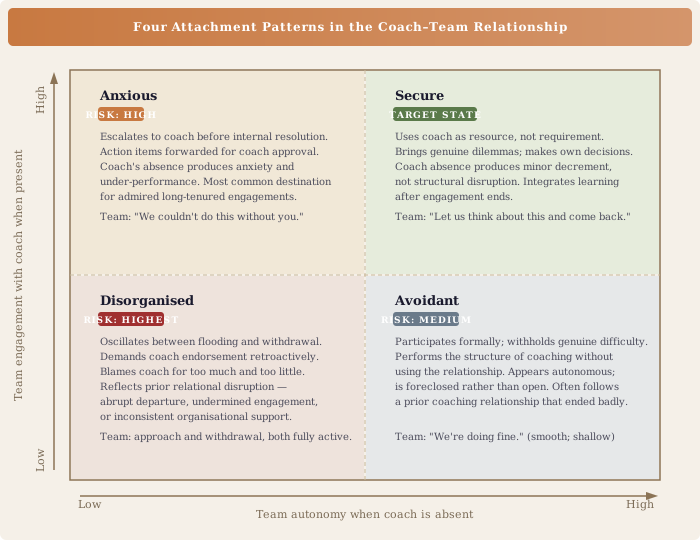
Four distinct patterns emerge in how teams attach to coaches over time. Each has specific behavioural signatures that are visible in coaching sessions, in the team's behaviour during the coach's absence, and in what happens when the coaching relationship eventually ends. Only one of the four represents the coaching goal.
Secure
A team with secure attachment uses the coach as a resource rather than a requirement. They bring genuine dilemmas — not for resolution but for thinking-with. They engage with the coach's perspective and then make their own decisions. They do not seek the coach's approval before acting, and they do not interpret the coach's silence as withholding. When the coach is absent, the team's capability decrements slightly — the resource is unavailable — but the team's process does not change structurally. When the coach eventually departs the engagement, the team integrates what it has learned rather than experiencing a capacity loss.
This is the target state of coaching. It is also not where most long-tenured engagements land, because the conditions that produce secure attachment — reliability, predictability, sustained relational availability — are identical to the conditions that produce the anxious pattern in teams that use those conditions differently.
Anxious
An anxiously attached team escalates to the coach before attempting internal resolution. Check-ins happen frequently and without a specific agenda. Action items from retrospectives are forwarded to the coach for confirmation before being implemented. The retrospective itself runs through the coach: "What do you think we should do about this?" is a question the team addresses to the coach rather than to each other. When the coach attempts to redirect — "What do you think?" — the team answers briefly and then waits for the coach's version.
The team describes the coaching relationship as essential. The coach's absence produces anxiety, under-performance, and deferred decisions. This pattern is the most common destination for admired coaching engagements. The team's description of the coach — "we couldn't have done this without them" — is both accurate and diagnostic.
Avoidant
An avoidantly attached team participates in the coaching formally without genuine engagement. Ceremonies are attended. Working agreements are produced. The coaching relationship is performed rather than used. Pressed for authentic reflection, the team finds reasons to move on. The conversations are technically smooth and substantively shallow.
This pattern presents as high autonomy. It is better understood as foreclosed intimacy — the team is protecting itself from the vulnerability that relational trust requires. This is often the initial state with teams that have had previous coaching relationships that ended badly: an abrupt departure, a coach whose recommendations were later undermined by the organisation, an engagement that produced working agreements the team watched be ignored by leadership. The avoidant team has learned that attachment to a coach produces disappointment. They have solved for this by not attaching.
Disorganised
The most complex pattern. The team oscillates: flooding the coach with escalations and then withdrawing abruptly; making a significant unilateral decision and then demanding retroactive endorsement; expressing profound gratitude for the coach in one session and bypassing the coach entirely in the next. The coach is simultaneously blamed for insufficient presence and for over-involvement.
This pattern typically reflects a prior relational disruption in the team's coaching history. A previous coach departed without adequate closure. A sponsoring manager sent inconsistent signals about whether the coaching was supported. An organisational restructuring interrupted an engagement mid-flow. The disorganised team wants the secure base and has evidence from prior experience that it will be removed. They cycle between approach and withdrawal because both the need and the fear are fully active.
The psychological leader function and how it enters the coach
Berne (1963) identified three distinct leadership types operating simultaneously in any organised group. The responsible leader holds the formal title and is accountable to higher authority. The effective leader makes the real decisions under stress. The psychological leader lives in the team's private structure — in the permission field, the shared sense of what is possible here, the group's collective read of what risks can be taken and what failures will be survived. The psychological leader may never be identified as a leader. They are visible primarily in what the team permits itself to do in their presence and withholds in their absence.
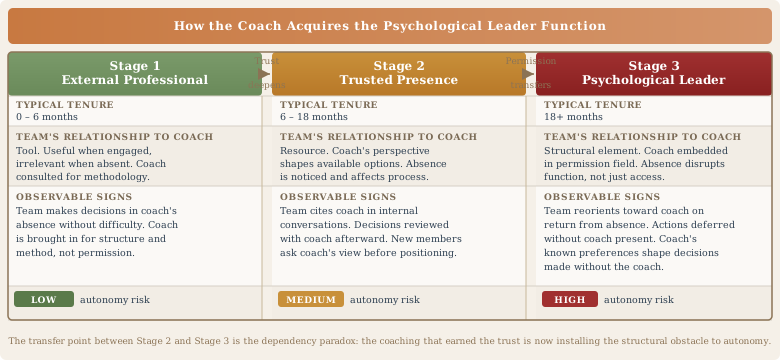
Long-tenured coaches often acquire the psychological leader function without noticing it happen. The process is gradual and has no single visible moment of transfer. The coach is reliable and non-judgmental. The team learns that the coach can be trusted with genuine difficulty. The coach's perspective begins to shape what the team believes is available to it — not through instruction but through consistent modelling and sustained presence. Over time, the coach's view of the team's capability becomes part of the team's view of its own capability. That is the function transferring.
The signs that the transfer has occurred are specific. Team members cite the coach in internal conversations the coach is not party to: "I was thinking about what [coach] said about how we handle decisions like this." A new team member asks "what does [coach] think?" before taking a position in a retrospective. Decisions made in the coach's absence are reviewed with the coach afterward — not to pass on information but to receive a form of validation that functions like ratification.
The structural problem this creates is precise. When the coach holds the psychological leader function, they hold the team's permission structure. A team developing genuine autonomy must build its own permission structure — its own collective sense of what it is allowed to attempt. If that permission structure includes the coach as an implicit authority, the team cannot be fully autonomous, because the coach will eventually leave. The team's autonomy is real within the coaching relationship and contingent on it.
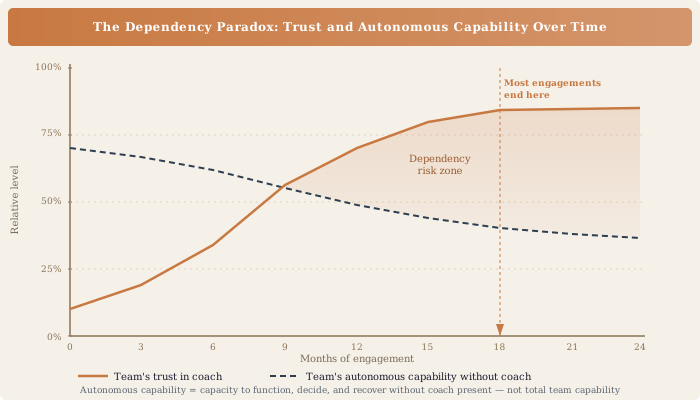
This is the dependency paradox fully stated. The most trusted coaches, in long-tenured engagements, become the psychological leaders of the teams they are trying to make autonomous. The trust that earns the psychological leader function is the same trust that makes the dependency structural. The more thoroughly the coach is trusted, the more completely the dependency is installed. The coach who has done the deepest relational work has, by that fact alone, created the deepest structural obstacle to the team's genuine independence.
The diagnostic that distinguishes structural dependency from appropriate reliance is not the team's behaviour when the coach is present — it is the team's behaviour in the moments after the coach returns from an absence. Does the team's energy reorient toward the coach? Do decisions that were in progress shift in the direction of the coach's known preferences once the coach is back? Is there a perceptible quality of relief at the return — not just at the person's return but at the return of the permission structure? These are the signs that the psychological leader function has been fully acquired.
The structural contradiction: coaching is paid by duration
Coaches are paid by hour, day, or month. Engagements continue as long as there is a perceived coaching need. Duration is the commercial signal of value being delivered. The coach who is trusted, relied upon, deeply embedded in the team's process, and considered essential to the team's functioning has done exactly what the engagement's commercial model rewards.
The dependency that results from this is not a side-effect of poor coaching. It is the natural output of excellent coaching combined with an engagement model that has no built-in mechanism for distinguishing trust from structural dependency. The incentive structure rewards the behaviour — sustained relational availability, consistent presence, deep embeddedness — that produces the outcome the engagement is supposed to eliminate: the team's need for external support.
Organisations that have worked with multiple Agile coaches over several years often notice the same cycle without naming it. Each coach builds a trusted relationship and improves the team's performance in measurable ways. After the departure, performance decrements. A new coach is engaged. The relationship builds. Performance improves. The coach departs. The cycle repeats. Each engagement is successful by the criteria available — improved facilitation, growing SM capability, better ceremonies. Each engagement leaves the team no more capable of sustaining its own functioning without external support than when it began. The problem is not the coaches. They were doing precisely what they were engaged to do, as well as they knew how. The problem is what was not built into the engagement: the goal of the coach's own irrelevance.
A coaching engagement that ends because the budget ran out has ended. A coaching engagement that ends because the team has acquired the capacity to function without external support has succeeded. These are not the same termination condition. The distinction is rarely specified in a coaching contract, and almost never built into the engagement's design.
Designing for your own irrelevance
An experienced SM-coach hybrid. Two years into the engagement with a scaled engineering team. The dependency has been building quietly — visible in retrospect, invisible in the day-to-day. In a retrospective, the team votes on a format for the following sprint. Four of seven members glance at the coach before raising their hand.
The coach notices. In the SM development session that follows, the coach names what they saw: "I noticed that when the team voted, several people checked my reaction first. I'm not sure that's what we're aiming for. I want to think with you about whether that's something you've noticed too." The SM is quiet for a moment. Then: "But isn't that what you're here for?"
The coach's response is not a correction. It is a question: "If I weren't here, what would you do?" The SM is quiet for longer this time. Then: "I don't actually know."
That conversation was the beginning of a different kind of coaching relationship. Not a worse one — a different one. The coach was still present, still trusted. What changed was what the presence was for.
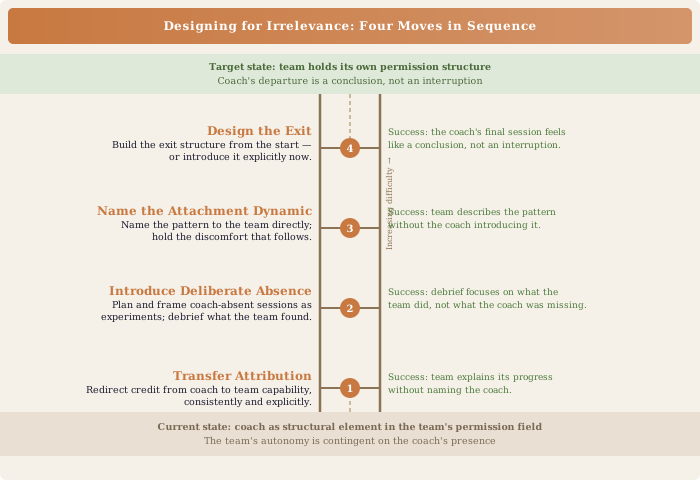
Four moves address the attachment dynamic directly, in order of difficulty and depth. They do not happen by default. Each requires the coach to act against some of the behaviours that produced the trust in the first place.
Transfer attribution before accepting credit
The coach who is doing good work is frequently the person to whom the team's progress is attributed — by the team, by the sponsor, and often by the coach's own internal account of the engagement. Every attribution to the coach is a subtraction from the team's developing sense of its own agency. The first discipline of designing for irrelevance is making attribution visible and then actively redirecting it: "What did you do in that retrospective that made it work differently?" This is not modesty. It is methodology. The team needs to own the capability, not recognise it as the coach's gift, because ownership is what survives the engagement.
A coach who consistently redirects attribution is building the team's internal account of its own competence — the account it will draw on after the coaching ends. Success: the team, unprompted, describes its progress in terms of what it did. The coach's name does not appear in the team's explanation of why something worked.
Introduce deliberate absence
The coach who is present at every ceremony, every difficult conversation, every significant decision is installing themselves as a structural element of the team's process. Deliberate absence — planned, framed, and debriefed — creates conditions in which the team must exercise its own capability without the permission structure the coach provides. The framing is everything. Unannounced absence produces anxiety. Framed absence produces an experiment: "I won't be at next sprint planning. I'm genuinely curious what you'll notice about how it goes differently — or doesn't."
The debrief afterward is not the coach reassuring the team that it performed well. It is the team examining what it found when the fixed point was removed — what decisions were made without asking, where the reaching for the coach happened and turned out to be unnecessary, what the team discovered it already knew. This is the data of autonomy developing. Success: the team's debrief after a coach-absent session focuses on what it did, not on what the coach was missing.
Name the attachment dynamic explicitly
The hardest move, and the one most coaches avoid: naming the attachment pattern to the team directly. Not as a clinical observation but as a genuine reflection: "I've been noticing that when something's uncertain, the first move is often to bring it to me. I'm not sure that's what we're aiming for. I'm wondering whether you've noticed it too." This is not a confrontation. It is an honest account of what the coach can see from their position in the system.
The conversation can produce temporary rupture. The team may respond with defensiveness — "but you're here for this, that's the point" — or with confusion, or with the specific discomfort of having something useful taken away before a replacement is ready. That discomfort is the move. The dynamic cannot be changed until it is seen, and it cannot be seen until someone in the relationship names it. The coach is the only person with both the visibility into the pattern and the relational standing to name it without the team experiencing it as an attack. Success: the team can describe the pattern without the coach having to introduce it.
Design the exit before the end
Most coaching engagements end when the budget is exhausted or the sponsor declares completion. This is exit by attrition. A coach designing for irrelevance builds the exit structure into the engagement from the beginning — or, in a long-tenured engagement where this was not done, introduces the exit conversation explicitly now.
The exit structure specifies what the team will be capable of without the coach, and stages the transfer of each function the coach currently holds. The psychological leader function is the last to transfer and the most difficult. It requires the team to develop an internal permission structure that no longer includes the coach as a structural element. This is work at the level of the team's private structure, not its ceremonies. It takes time, and it requires the coach to be willing to be less central than they have been — to hold the team's discomfort at that reduction, and to name it when the team attempts to restore the previous arrangement. Success: the coach's final session feels like a conclusion. Not an interruption.
The coach who remains relevant by becoming unnecessary
The most skillful coach is the one who has built themselves out of the team's system. Not by withdrawing prematurely — the avoidant pattern demonstrates what happens when the coach was never genuinely present. Not by maintaining indefinite distance — the disorganised pattern demonstrates what happens when relational safety is offered and then removed unpredictably. By working so thoroughly, and with such deliberate attention to what the team needs to be capable of without the coach, that the team's capacity to learn, explore, and recover from setbacks no longer requires an external secure base.
This series has examined seven structural layers the coach must learn to read: the three leadership types operating simultaneously in any team; the unwritten canon governing what is actually permitted; the private mental pictures that either align or fracture self-organisation; the coach's own power and the sources they use without noticing; the foundational survival conclusions teams carry from their formation; the structural displacement of the management layer that sits above the team; and now the attachment relationship the coach has built, and whether it is building toward autonomy or consolidating dependency. Each layer is a place where coaching floats if the coach cannot read it. Reading all seven does not guarantee that the work goes well. It guarantees that the coach knows where they are in the system — what they are actually doing, and what they may be installing without intending to.
The engagement model does not reward this kind of coaching. It rewards continued presence. That tension is not resolvable within a single engagement — it requires a different kind of contract, a different success criterion, and a willingness to name the goal of irrelevance to the sponsor at the beginning rather than hoping the team develops autonomy by accident. Most coaching engagements do not have that conversation. They could.
The coach who has become the secure base has done something real and something incomplete. The real part is the trust. The incomplete part is what happens to the team when the base is no longer there.
Continue Exploring
Go deeper into the work
The Book
The Art of Creating Self-Organizing Teams
The full framework behind this article — contracting, team dynamics, and practical coaching tools for every stage of the journey.
Companion Toolkit
Resistance Radar & Resilience Scorecard
Practical tools for mapping resistance patterns and measuring whether interventions increased capacity — not just compliance.
TA for Agile
Co-creative TA in Agile Contexts
Ego states, psychological contracts, group imago, and the relational concepts that underpin this article — applied to real teams.