The Company You're Still Carrying: Organisational Phantom Narratives
Every organisation carries cultural complexes formed by significant historical events — a founder's controlling mythology, a public failure, a traumatic acquisition. These form 'phantom narratives': unconscious stories that silently choreograph present behaviour long after the original event. Why some organisations treat every impediment like an existential threat. Why post-merger teams still behave as if the merger is happening now. The phantom narrative is not visible on the culture deck.
The organisation that survived
The company nearly collapsed fifteen years ago. It survived — narrowly, and because of decisions that a small group of senior leaders made under severe pressure. Those leaders are largely gone. The company has grown, hired, restructured, and rebranded. But in every significant meeting, at every moment of real decision, there is still a particular quality of hesitation. Proposals circulate longer than they should. Sign-off is sought from one level above what the decision formally requires. Risk is named early and managed visibly, sometimes at the cost of moving at all.
No one is making a conscious choice to behave this way. Ask any member of the leadership team and they will describe it as bureaucracy, risk aversion, or "the culture." They will express frustration with it. They will have been expressing that frustration for years. It continues because the source is not in the current behaviour of current people. It is in the organisation's history, which is not past.
This is what organisational psychologists working in the Jungian tradition call a phantom narrative. It is not a metaphor. It is a description of how cultural complexes formed by significant historical experience continue to choreograph present behaviour — silently, pervasively, and almost entirely below the level of conscious acknowledgement.
What a phantom narrative is — and what it isn't
The psychologist Samuel Kimbles, developing the work of Thomas Singer on cultural complexes, describes phantom narratives as "pervasive threads that bring together the images of a culture to form a coherent but unconscious order, silently structuring and altering perceptions, behaviour, images, and effective responses of groups and individuals in groups." They are not stories that people tell — they are stories that people enact without knowing they are doing so.
The cultural complex that generates a phantom narrative forms in the same way as a personal complex: through significant, emotionally charged experience — often involving suffering, threat, shame, or loss — that leaves an organising imprint on the group psyche. In an organisation, this might be a near-collapse, a public scandal, a traumatic merger, the loss of a founding leader, or a period of sustained failure. The experience is encoded not simply as a memory but as a pattern of feeling, image, and response that shapes how the group perceives and acts in analogous situations long afterward.
What makes it a "phantom" is that it operates below conscious acknowledgement. The organisation may have a story it tells about the founding crisis — perhaps even a narrative of resilience and survival — but the phantom narrative is not that story. It is the emotional pattern beneath the story: the conviction that similar crises are always possible, that authority cannot ultimately be trusted, that the ground can give way. This pattern governs behaviour in ways that the official story does not.
It is distinct from an organisational culture in the conventional sense. Culture can be described, debated, and intentionally changed through values work, leadership modelling, and structural redesign. A phantom narrative resists these interventions precisely because it operates at a deeper level — it shapes how the culture interprets and enacts those very interventions.
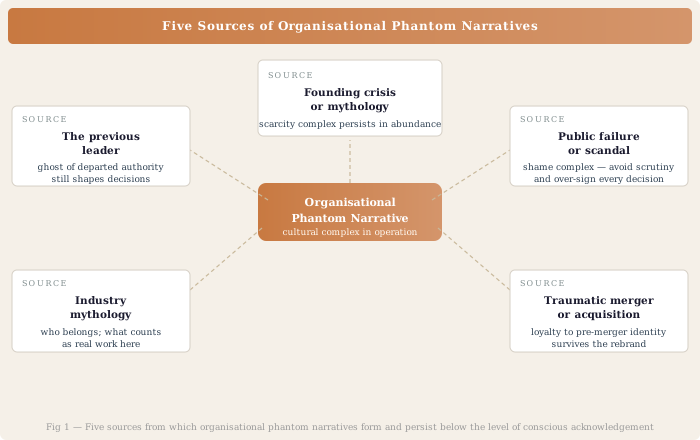
Five sources of organisational phantom narratives
1. Founding crisis or mythology
The conditions under which an organisation was founded leave a lasting imprint. A company founded in scarcity will often carry a scarcity complex even in abundance — an inability to invest, to trust resource availability, to plan beyond the immediate horizon. A company founded by a commanding visionary will often struggle to distribute authority even decades after that person is gone, because the organisational unconscious has encoded the pattern that legitimate decisions come from one source.
2. Public failure or scandal
When an organisation is publicly shamed — through financial failure, regulatory sanction, reputational crisis, or the exposure of misconduct — the shame does not depart when the immediate crisis passes. It becomes a complex of invisibility: an organisational imperative to not be seen, to not invite scrutiny, to avoid accountability in ways that risk further exposure. In the organisation from the opening scene, the pattern of over-signing and hesitation is not incompetence. It is a fifteen-year-old shame response still running.
3. Traumatic merger or acquisition
When two organisations merge — particularly when one acquires the other under difficult conditions — a phantom narrative of the merger often persists in the merged entity for years. Teams still identify with "the old company." Sub-groups carry the sense of having been invaded or diminished. Collaboration between divisions is complicated by a loyalty structure that no longer maps onto the current organisational chart. Rebranding and restructuring do not dissolve these complexes. They go underground.
4. Industry mythology
Every industry carries its own cultural complex — shared images and assumptions about what this kind of work is, who does it, what it demands, and what success looks like. A professional services firm carries the mythology of the partnership and the billable hour. A technology company carries the mythology of the exceptional individual contributor and the meritocratic hierarchy of technical skill. These phantoms shape who feels like they belong, what gets counted as real work, and which voices carry authority in ambiguous situations.
5. The previous leader
Leaders who held power for extended periods, particularly those who were charismatic or controlling, often leave a phantom narrative in their wake. The organisation continues to behave as if that person is still present — avoiding decisions they would have disapproved of, reproducing patterns they established, experiencing their shadow in current leaders who activate the same projections. The complex organises around the ghost of the departed authority, not around any individual currently in the room.
How phantom narratives appear in Agile transformation work
The characteristic signs of a phantom narrative in an Agile context are not dramatic. They manifest as patterns of inexplicable resistance, recurring conversations that go nowhere, and a quality of heaviness in certain topics that exceeds what the surface content would warrant.
Psychological safety work that never holds. The organisation invests seriously in psychological safety — training, facilitated retrospectives, leadership modelling. Surveys improve briefly, then revert. The phantom narrative may be a complex around visibility and punishment formed during a period when transparency actually was dangerous. No amount of declared safety will overwrite that complex until it is surfaced and examined.
Decision-making paralysis that survives restructuring. Authority is redistributed on paper. Teams are declared self-organising. And yet every significant decision still travels upward before it can proceed. The phantom narrative of centralised authority is stronger than the current org chart.
Post-merger team dysfunction that persists for years. Two years after the merger, the teams still sit separately in the open-plan office. Cross-team collaboration requires deliberate facilitation that should be unnecessary given the formal integration. The phantom of the acquisition is still dividing people who are now legally one organisation.
Ceremonies that cannot achieve genuine candour. Retrospectives are facilitated well, questions are open, the environment appears safe. But certain topics are never raised, and the coach cannot explain why. The organisation may carry a complex around criticism — formed during a period in which speaking critically was genuinely risky — that continues to govern what can be said even when no current threat exists.
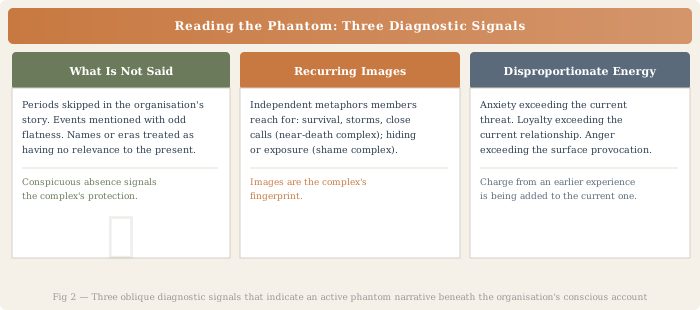
Diagnostic: reading the phantom
Phantom narratives are not accessible through direct questioning. Asking "what is your organisation's historical trauma?" produces intellectual speculation that stays safely above the complex. The diagnostic approach is oblique and imagistic.
Listen for what is not said — the conspicuous absence in a conversation about the organisation's story. What periods are skipped over? What events are mentioned only in passing or with an odd flatness? What names or eras are treated as having no relevance to the present?
Listen for recurring images — the metaphors people reach for independently when describing the organisation. An organisation carrying a near-death complex may consistently use images of survival, storms, or close calls. An organisation carrying a shame complex may consistently generate images of hiding or exposure.
Notice what produces disproportionate energy — anxiety that exceeds the current threat, loyalty that exceeds what the current relationship would warrant, anger that exceeds the surface provocation. Disproportionate reactions are the fingerprint of a complex: an emotional charge that belongs to an earlier experience is being added to the current one.
Working with the phantom: the organisational reverie
The approach Barrett describes as an organisational reverie — a series of structured but open conversations that invite the unconscious to surface — is the most effective method for bringing a phantom narrative toward consciousness. It does not confront the phantom directly. It creates conditions in which the phantom can make itself visible, at a pace the organisation can tolerate.
The method uses simple, open questions that invite associative rather than analytical responses: "Why does this organisation matter?" "How have we experienced this organisation over the last year?" "What does working here feel like right now?" These questions are not surveys. They are invitations to reverie — to allow images, feelings, and half-formed thoughts to surface without the immediate pressure of rational interpretation.
Active imagination exercises — drawing, collage from magazines, simple embodied responses — are often more productive than verbal discussion, because they bypass the organisation's defences. A management team that cannot discuss its relationship to the founding crisis may produce telling images when asked to represent "this organisation" in a collage without analytical framing.
The conversations are not designed to reach a predetermined conclusion. They are designed to make visible what the organisation is carrying — and, slowly, to allow a new story to form around that material. The psychoanalyst Christopher Bollas: "by making past events meaningful, the historian exercises an important psychic capacity, that of reflection: this does not confer retrospective truth on the past — but creates a new meaning that did not exist before."
What the coach must not do
The temptation when a phantom narrative becomes visible is to name it, frame it, and move the organisation toward a resolution. This impulse belongs to the coach's own need for closure and should be treated as countertransference. The organisation's unconscious cannot be interpreted into resolution. It can only be gradually brought into a relationship with consciousness through the patient work of reverie, naming, and meaning-making.
The coach must also resist the pull to take sides in the phantom narrative. Every complex has a structure that includes both what is preserved and what is split off. An organisation carrying a shame complex will have individuals who embody the shame and individuals who embody the defiance against it. The coach who aligns too closely with either group has been absorbed into the complex and loses the capacity to work with it.
Finally: this work is slow. The cultural complex that drives a phantom narrative was formed over years and is maintained by structures, relationships, and unspoken agreements that extend far beyond any coaching engagement. The goal is not to dissolve the complex — complexes do not dissolve — but to bring it into sufficient consciousness that it no longer runs the organisation without the organisation's knowledge. When the phantom can be named, even partially, it begins to lose its grip on the room.
Continue Exploring
Go deeper into the work
The Book
The Art of Creating Self-Organizing Teams
The full framework behind this article — contracting, team dynamics, and practical coaching tools for every stage of the journey.
Companion Toolkit
Resistance Radar & Resilience Scorecard
Practical tools for mapping resistance patterns and measuring whether interventions increased capacity — not just compliance.
TA for Agile
Co-creative TA in Agile Contexts
Ego states, psychological contracts, group imago, and the relational concepts that underpin this article — applied to real teams.