The Containing Organisation: Why Some Teams Can Do Depth Work and Others Cannot
Coaching literature uses containment to describe the practitioner's stance — the ability to hold a team's anxiety without being overwhelmed by it. Systems psychodynamics extends this: the organisation itself must be structured to provide containment for its teams. An organisation that eliminates slack, punishes ambiguity, distributes accountability without authority, and changes direction faster than teams can orient has created an uncontaining environment. In such an environment, no amount of coach skill will produce lasting depth work — because the organisation is continuously doing to the team what the coach is trying to undo.
Same coach, same method, different outcomes
The coach worked with two teams simultaneously. Both were in the same organisation, both had comparable starting points — moderate psychological safety, some unresolved conflict, unclear authority on several recurring decisions. The coaching methodology was identical. The engagement length was the same.
After eight months, one team could manage its own conflict, raise difficult topics in sprint ceremonies, and act without checking in with the coach at each decision point. The other had improved and regressed and improved again in a pattern the coach could not break. The difference was not in the teams. The first team's leadership was stable, its mandate was clear, its priorities had not changed in eight months, and it was protected from most of the political noise in the organisation. The second team had had three acting sponsors, two strategy pivots, and weekly interventions from a stakeholder who was technically outside the team's line of authority. The coach had been doing depth work in a container that could not hold it.
Containment as a coaching concept
Containment, in coaching and psychodynamic practice, describes the practitioner's capacity to receive the team's anxiety, distress, and difficult material without being overwhelmed by it, and to return something more manageable to the team. The coach who can sit with what is being brought — the conflicts, the fears, the things that cannot be named directly — and remain stable and thoughtful is providing containment. The team can approach more difficult material because the container holds.
This is a practitioner stance, and it is the dominant use of containment in coaching literature. But it is an incomplete account. Bion's container/contained, from which this usage derives, was not only a description of a therapeutic stance. It was a description of a structural relationship. The contained — the emotional material, the thinking — requires an adequate container to be processed rather than evacuated or defended against. When the container is weak, the contained is not processed. It is acted out.
Winnicott's holding environment extends this: the developmental quality of an environment — whether it is good enough — is a function of whether it provides the conditions in which the person (or team, or group) can develop without being overwhelmed by environmental impingement. A holding environment is not one without challenge. It is one in which the challenges are appropriately paced, the boundaries are stable, and the person is not asked to manage more impingement than they have the capacity for at their current developmental stage.
Containment as an organisational property
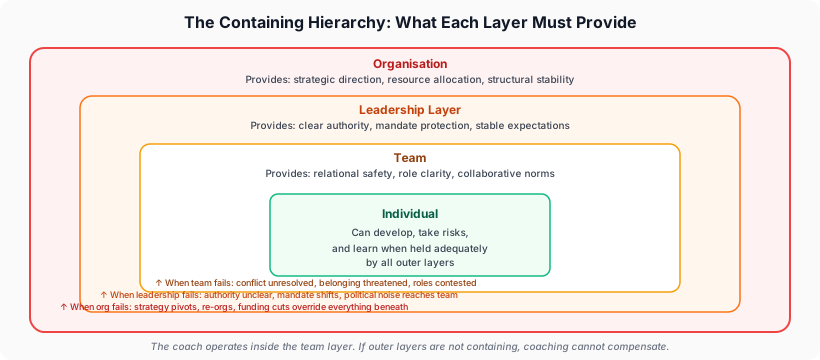
These concepts, applied at the organisational level, produce a different and more demanding account of what coaching depends on. The coach can provide a containing stance in the coaching session. But the coach is present for a small fraction of the team's working life. The organisation — its leadership, its structure, its culture — is present all the time. If the organisation is not providing containment, the coach's containing work is being continuously undone between sessions.
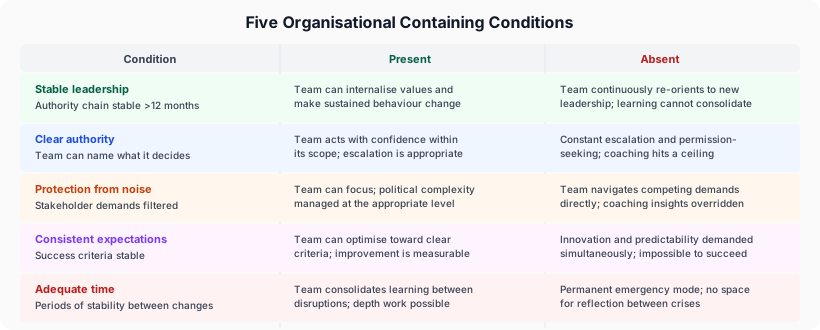
An organisation that provides containing conditions for its teams does specific structural things. It provides stable leadership: the team is not re-organised or re-prioritised every quarter, and the people with authority over the team's mandate do not change faster than the team can orient to them. It provides clear authority: the team knows what it has the right to decide and what it does not. It provides protection from political noise: the team is not exposed to every stakeholder conflict simultaneously or asked to navigate competing demands that its authority structure cannot adjudicate. It provides consistent expectations: the team is not asked to be both innovative and predictable simultaneously, or to meet incompatible criteria for success. And it provides adequate time: the team is not in a state of permanent emergency where the next release or the next reorganisation crowds out any capacity for reflection.
How to assess whether an organisation is containing its teams
A coach can make a preliminary assessment of organisational containing capacity within the first week of observation. Five diagnostic questions:
How many leadership changes has the team's direct authority chain experienced in the last twelve months? More than one is a signal. Three or more is a containing capacity problem. Teams cannot develop when the authority structure above them is continuously changing, because the implicit terms of the work keep shifting.
How many strategic pivots or priority changes has the team navigated in the last two quarters? More than two significant changes in a six-month period is a signal that the organisation is not providing the stable directional container that allows teams to develop. Teams cannot internalise values, practices, or ways of working that keep being overridden.
Can the team name clearly what they have the authority to decide without checking upward? Teams that cannot answer this question are not under-bounded in Hirschhorn's sense (their boundaries have dissolved in transition) — they may simply be in an organisation that has never clearly delegated authority to them. The coaching work hits a ceiling when teams cannot act on their own authority.
How many stakeholders have direct access to the team outside the team's normal governance structure? Any significant number signals that the team is not being protected from the field's full complexity. The coach working with such a team will find that insights from coaching sessions are overridden by noise from stakeholders the team cannot integrate into a coherent authority structure.
When was the last time the team had three consecutive months without a significant structural change? Teams need periods of stability in which to consolidate what they are learning. Organisations that reorganise faster than teams can consolidate create a chronic learning deficit that coaching cannot overcome.
The coach's dilemma when containment is absent
The coach who recognises that the organisation is not providing adequate containment faces a specific dilemma. The instinct is to compensate — to provide more sessions, more structure, more frameworks, more support. This instinct is understandable and unhelpful. It increases the coach's workload, increases the team's dependency on coaching, and does not address the structural deficit that is producing the problem.
The analogy: a patient whose housing conditions are chronically unhealthy — damp, overcrowded, under-heated — cannot be treated effectively through medication alone. The medication addresses the symptoms. The housing conditions produce more symptoms faster than the medication can manage. Increasing the medication dose makes the prescriber feel more effective and changes nothing fundamental. The housing is the intervention. A coach who increases the coaching dose when the organisation is not containing its teams is in the same position as the prescriber.
This is not a comfortable diagnosis. It requires the coach to move upstream — to work not on the team's dynamics but on the conditions in which the team is operating. It requires the coach to have a conversation with the sponsor that most coaching contracts do not anticipate: "the conditions you are asking me to work in are insufficient to support the outcomes you have contracted me to produce."
What coaches can and cannot provide
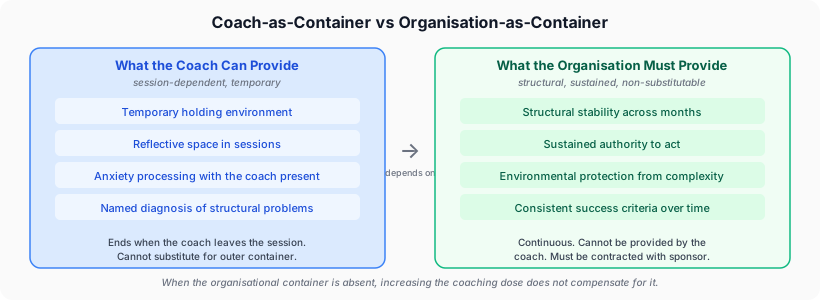
The coach-as-container can provide specific things: a temporary holding environment in which difficult material can be approached without overwhelming the team; a reflective space that the team's daily rhythm does not provide; the processing of anxiety that the team cannot yet process for itself. These are real contributions and they are coach-dependent by nature.
What only the organisation can provide: structural stability — the team's mandate, leadership, and expectations hold long enough for them to build on; sustained authority — the team's right to act is continuously backed by the people with the power to back it; environmental protection — the team is not exposed to more complexity than its current capacity can manage. These are not coaching outputs. They are preconditions for coaching to work.
The organisation as the actual client
Depth work is not possible in an uncontaining organisation, regardless of the coach's skill. The team that improves in sessions and regresses between them is not failing to apply the coaching. It is showing the coach where the containing deficit lives — not in the team, but in the conditions in which the team operates.
The coach who understands this stops over-functioning at the team level and starts attending to the organisation as the actual client. The sponsor conversation becomes not "how is the team progressing?" but "what are you providing the team that will hold what the coaching is building?" This is a different contract, a more difficult conversation, and the only one that addresses what is actually limiting the work.
Continue Exploring
Go deeper into the work
The Book
The Art of Creating Self-Organizing Teams
The full framework behind this article — contracting, team dynamics, and practical coaching tools for every stage of the journey.
Companion Toolkit
Resistance Radar & Resilience Scorecard
Practical tools for mapping resistance patterns and measuring whether interventions increased capacity — not just compliance.
TA for Agile
Co-creative TA in Agile Contexts
Ego states, psychological contracts, group imago, and the relational concepts that underpin this article — applied to real teams.