The Dissolution Before the Transformation: Why Agile Change Needs a Threshold
Most Agile transformation programmes attempt to move people from State A to State B while leaving their identity, role, and status intact. Genuine transformation requires a period of dissolution: a liminal threshold where old identity is temporarily surrendered before new identity can form. Without this threshold, what looks like transformation is persona-thickening. People learn the new language while carrying the old script.
The bilingual cynic
Two years into the transformation, there is a category of person the coach encounters everywhere: someone who speaks Agile fluently but has not changed how they actually think. They use the right words. They attend the ceremonies with adequate participation. They can describe the principles. They have not, in any meaningful sense, crossed over.
This is not hypocrisy. It is the predictable outcome of a transformation programme that attempted to move people from one state to another while leaving their identity, status, and fundamental self-understanding intact. The programme taught people a new language. It did not require them to become new people. And becoming genuinely new — in the sense that matters for how teams actually work together — requires something the programme did not provide: a period of dissolution.
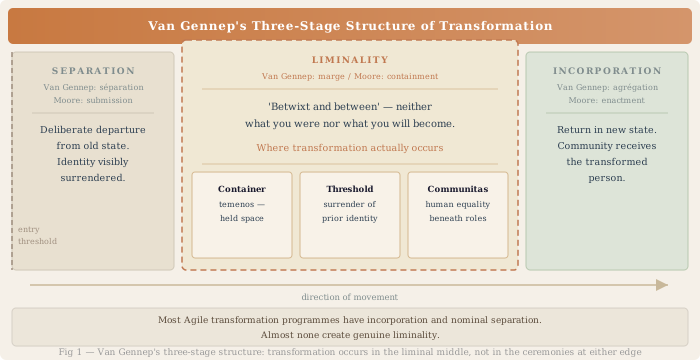
The ethnologist Arnold van Gennep, in his 1909 study of rituals across traditional societies, identified that every significant social transition is structured around three phases: separation, liminality, and incorporation. Victor Turner, developing van Gennep's work half a century later, showed that the middle phase — liminality — is where transformation actually occurs, and that it has a specific character: the dissolution of existing identity, the suspension of social status, and the emergence into a state of "betwixt and between" that makes new identity possible. Without the middle phase, there is no transformation. There is only change of address.
The three stages every genuine transformation moves through
Van Gennep called the three stages séparation, marge, and agrégation. Turner's translation: separation, liminality, incorporation. More recently, the analyst Robert Moore, extending the framework to contemporary developmental programmes, has used the terms submission, containment, and enactment — describing the experience from the inside.
Separation is the first crossing: the deliberate marking of departure from the old state. In traditional rites of passage, this often involved elaborate rituals of symbolic death — the initiate was buried, stained, marked, or removed from their ordinary community. The social status of the previous role was visibly surrendered. The function of separation is to make the individual genuinely available for what comes next. Without it, people carry their previous identity into the liminal space and protect it there.
Liminality is the threshold state: Turner's "betwixt and between." In this phase, the initiate holds no fixed social identity. They are neither what they were nor what they will become. The rules that governed the previous state do not yet apply; the rules of the new state have not yet been established. Turner describes this state as one of deliberate ambiguity — and it is in this ambiguity that genuine transformation becomes possible. The old certainties are unavailable. The initiate must find their way without them.
Incorporation is the return: the re-entry into society in a new state, with a new identity, recognised by the community as having crossed over. The incorporation phase is not simply personal. It is social: the community receives the newly transformed person and confers on them their new standing. Without this reception, the transformation remains incomplete.
Most Agile transformation programmes have a version of incorporation — the launch, the certificate, the new job title. Many have a nominal separation — a kickoff event, a training programme, a workshop series. Almost none create genuine liminality. The middle phase — the dissolution, the genuine holding of uncertainty, the suspension of previous identity — is precisely what they skip. It is uncomfortable, ungovernable, and cannot be put on a Gantt chart.
What liminal space actually requires
Liminal space has specific structural requirements. Without them, what appears to be liminality is something else — something Turner called limonoid, which we will return to. The requirements are three.
A container — the temenos. The alchemical image is the sealed vessel: the space that is set apart from ordinary social life, that holds the energy of transformation without allowing it to dissipate or to overwhelm those within it. In the language of contemporary organisational development, this is the developmental programme's structural container — its physical space, its consistent rhythm, its clear boundaries around who is in and who is out, and the ritual elements that signal that something different is happening here. The container must be strong enough to hold what emerges. An insufficiently bounded container does not produce liminality; it produces fragmentation.
A threshold — the genuine surrender of previous identity. The surrender cannot be symbolic only. In traditional rites, it was enforced by the structure of the ritual: the initiate was physically removed from their community, stripped of their markers of status, and immersed in experiences that made their old identity unavailable. In a contemporary leadership programme, this might mean that participants genuinely cannot access the protections of their organisational role — that seniority does not purchase safety in the room, that the usual moves of authority and expertise are temporarily suspended. This is among the most difficult things for organisations to allow. They routinely breach this requirement by allowing participants to maintain their organisational identity even within the programme — by permitting status hierarchies to operate, by inviting senior leaders to observe, by treating the programme as an extension of work rather than a departure from it.
Communitas — the relational field that sustains the threshold. Turner identified that genuine liminality is almost always a shared experience. Initiates cross thresholds together. As they shed their social identities, they encounter each other as what Turner calls "human totals" — human beings without the mediating structure of role and status. This quality of encounter, which Turner named communitas, is the relational foundation that makes the dissolution of individual identity bearable. People can endure the loss of their old certainties because they are not alone in the space. The group becomes its own container.
Liminal vs. limonoid: the crucial difference
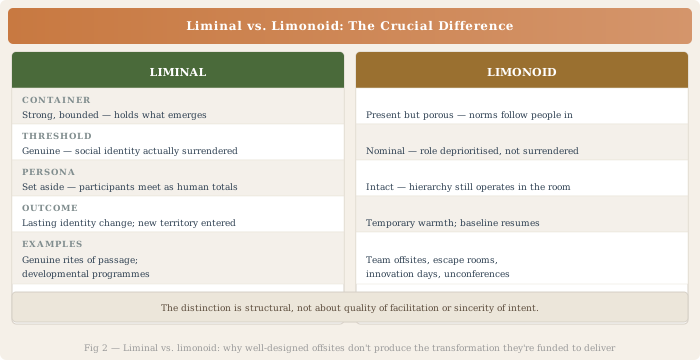
Turner introduced the term limonoid to describe experiences that share some qualities of liminality — a sense of departure from the ordinary, an intensified energy, a feeling of possibility — without the structural conditions that make genuine transformation possible. They are exciting but not transformative. They leave people stimulated and unchanged.
Most team retreats, innovation days, unconferences, and off-site workshops are limonoid. They feel different from ordinary work. They may produce genuine enthusiasm. But because participants do not actually surrender their social identity — because seniority still operates, because the norms of the workplace follow them into the room, because there is no genuine container and no genuine threshold — the experiences remain pleasurable rather than transformative. The team returns energised and slightly closer. A week later, the patterns are the same.
The distinction matters for programme design. A limonoid experience is not a failed liminal experience — it is a different kind of experience entirely. It can have value: it can build rapport, generate ideas, restore energy. But it should not be confused with transformation and should not be funded as such. When organisations discover that the off-site "didn't stick," the temptation is to conclude that the format was wrong or the facilitation insufficient. The actual explanation is structural: no threshold was crossed, so no new territory was entered.
What communitas feels like — and why it can't be manufactured
Communitas is recognisable as an experience. It is the quality of connection that sometimes emerges in a group when the usual social armour has been set aside — when people are talking to each other as people rather than as their roles, when status has genuinely, not performatively, been suspended. It has an immediacy and an intimacy that is qualitatively different from good team dynamics or productive collaboration.
Turner is emphatic: communitas cannot be manufactured. It can only emerge under conditions that are created for it. Attempting to produce it through team-building exercises, trust falls, or sharing circles is analogous to trying to force an alchemical reaction by describing what the product should look like. The conditions must be right — the container must be strong enough, the threshold must be genuine, the social identity must actually have been surrendered — and then communitas may emerge. Or it may not. Its arrival is not guaranteed.
What the coach or programme designer can do is create the conditions and resist the temptation to substitute a performance of communitas for the real thing. Groups that have not yet reached communitas will often produce something that resembles it — an agreed warmth, a declared trust, a performed openness. This is not communitas. It is the persona of communitas, which is almost the opposite of the thing itself.
Designing transformation that crosses the threshold
The practical implication is not that transformation programmes need to be more dramatic or more intense. It is that they need to take the threshold seriously — to design for the structural conditions of liminality rather than the aesthetics of it.
This begins with the separation event. Something must mark the genuine departure from the previous state. Barrett's account of a multi-year leadership programme illustrates this: the opening event is held in the organisation's own space, with the formality of the existing hierarchy still present. This is the separation phase — participants formally leave their previous standing. Subsequent modules are held in a consistent residential space with a consistent rhythm, and participants are required to introduce themselves through drawings rather than roles, and to commit to full physical and mental presence throughout. The container is constructed deliberately, and the threshold — setting aside organisational credential — is structural, not merely aspirational.
The hardest design question is what genuinely prevents participants from holding onto their previous identity within the programme. Seniority hierarchies must not be permitted to operate. Observers must not be admitted. Work must not be allowed to interrupt. Each of these boundaries is routinely breached in corporate development programmes — and each breach signals to participants that the organisation's existing social order is more real than the developmental space, which prevents the threshold from being crossed.
The sponsor's role — and why they usually don't hold it
The most consistent source of boundary failure in transformation programmes is the organisational sponsor. The sponsor funds the programme and therefore feels some ownership over it. They want visibility into what is happening. They want assurance that the investment is productive. These are not unreasonable desires. They are, however, incompatible with the structural requirements of liminal space.
An organisation that sends a manager to observe a development programme — or that requests reporting on participant progress — signals to participants that the organisation is watching. The watching is enough. If the organisation is watching, participants cannot genuinely surrender their organisational identity in the space. They continue to perform for the audience that is present even if it is not visible. The space cannot become liminal. The investment produces bilingual cynics.
The sponsor's role, properly understood, is to hold the boundary of the programme against the organisation's entirely predictable anxiety about what is happening inside it. This requires the sponsor to tolerate not knowing, to resist the organisation's requests for progress updates, and to sponsor the programme's independence from the organisation while the programme is in progress. It is among the most difficult things that transformation sponsors are asked to do, and among the most rarely done.
The transformation programmes that produce genuine change share one characteristic: at some point in the design conversation, the sponsor agreed to relinquish control of the space. They may not have fully understood what they were agreeing to. But the relinquishment was real enough to create the conditions for liminality — and in that space, something happened that could not have been planned.
Continue Exploring
Go deeper into the work
The Book
The Art of Creating Self-Organizing Teams
The full framework behind this article — contracting, team dynamics, and practical coaching tools for every stage of the journey.
Companion Toolkit
Resistance Radar & Resilience Scorecard
Practical tools for mapping resistance patterns and measuring whether interventions increased capacity — not just compliance.
TA for Agile
Co-creative TA in Agile Contexts
Ego states, psychological contracts, group imago, and the relational concepts that underpin this article — applied to real teams.