The Double Task: What Coaches Are Always Working On (Whether or Not They Name It)
Harold Bridger, working at the Tavistock Institute, proposed that any working group is always simultaneously engaged in two tasks: the stated task (the work) and an implicit relational task (the management of the group's own emotional life, power dynamics, and sense of who belongs and who doesn't). Every Agile ceremony has both. Coaches who attend only to the stated task miss half the available data. Coaches who attend only to the relational task lose the authority that comes from being useful to the work. The double task is not an optional layer — it is always present.
The planning session that was never only about planning
The coach observes a sprint planning session. On the surface: the team is sizing stories for the next two weeks. The product owner is walking through the backlog. The team is asking questions, estimating, committing.
Also present, if the coach is paying attention: a simmering disagreement about database architecture that keeps surfacing as over-estimates for any story that touches the data layer. A new team member who has been with the team for three weeks and has not yet spoken freely — she raises her hand once, is talked over, and does not raise it again. A pattern in which the senior engineer's view on technical approach, once stated, ends discussion — not because it is challenged and prevails, but because it is not challenged at all. Three conversations happening simultaneously with the one that is being minuted.
Bridger and the double task
Harold Bridger was a British psychologist who worked at the Tavistock Institute for several decades, conducting action research with organisations across manufacturing, healthcare, and social services. His most durable contribution to the field was an observation so simple it is easy to underestimate: any working group is always simultaneously engaged in two tasks.
The first is the business task — the explicit, stated, minuted purpose of the meeting or the ceremony: planning the sprint, reviewing the increment, identifying improvements. This is the task that most practitioners attend to and that most methodologies are designed around.
The second is what Bridger called the relational task — the implicit, ongoing, un-minuted work that every group is simultaneously doing: managing its anxiety, negotiating power and status, maintaining belonging, processing conflict that cannot be named directly. This task is never announced. It has no agenda item. It is, however, frequently more alive and more consequential than the business task it runs alongside.
Bridger's observation was not that the relational task is a distraction from or corruption of the business task. It is a structural feature of group life that is always present and always influencing what happens in the business task. The effectiveness of any intervention — any facilitation move, coaching question, or process adjustment — depends on whether the practitioner has both tasks in their awareness simultaneously.
Why the double task is practically important
The data from the relational task tells you why the business task is not working. This is the most direct practical application of Bridger's framework, and the most frequently missed.
The team that cannot agree on story sizing is often enacting, through the sizing conversation, a disagreement that has no other venue. The architecture disagreement surfaces as over-estimates because there is no established process for raising architectural disagreement directly. The relational task — managing the anxiety of a conflict that hasn't been named — is being conducted through the business task of planning. The coach who attends only to the business task will try to improve the estimation process. The underlying disagreement will surface again in the following sprint, in a different form.
The retrospective that produces safe action items is managing a relational tension that the stated format cannot hold. The team produces "we need better communication" rather than "Amir consistently takes over the technical direction of the feature before the rest of us have had time to think about it" because the relational task in the room is: maintain the relationship with Amir at the cost of an honest retrospective. The safe action item is not a facilitation failure. It is the product of a relational task that the business task format was not designed to surface.
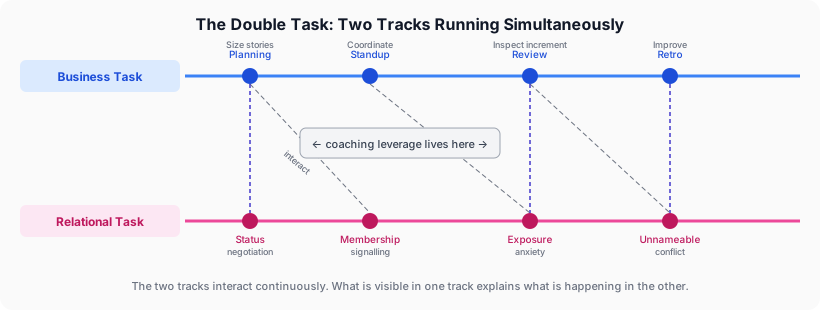
Five double-task moments in Agile ceremonies
Each ceremony has its characteristic business task and its most common concurrent relational task. The coach who knows the pattern can enter the ceremony with both tracks already in awareness.
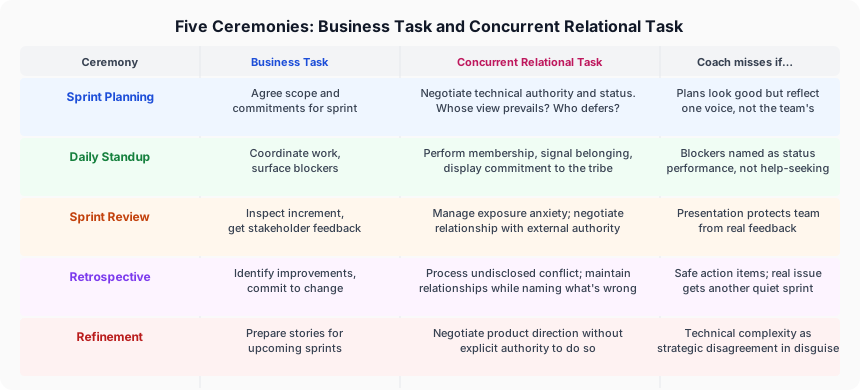
Sprint planning: Business task — agree what will be built. Relational task — negotiate status through technical authority. The most technically confident voice often determines the sprint scope, not through overt authority but through the relational dynamic that has been established over time. The coach who is tracking only the planning task will not notice when a planning decision is actually a status negotiation.
Sprint review: Business task — inspect the increment and adapt. Relational task — manage the anxiety of exposure and manage the relationship between the team and stakeholders. The team that presents rather than demonstrates is managing exposure anxiety through a format that limits direct stakeholder feedback.
Retrospective: Business task — identify and commit to improvements. Relational task — manage conflict that cannot be named directly, process emotion from the previous sprint, maintain relationships while identifying what is not working. The team that identifies external causes for every problem is using the retrospective's business task format to avoid the relational task of internal accountability.
Daily standup: Business task — coordinate work for the day. Relational task — perform membership and signal status. Who speaks confidently and who hedges, who is heard and who is talked over, whose blockers are responded to and whose are noted — these are relational signals that carry more information about team power dynamics than any org chart.
Backlog refinement: Business task — prepare stories for upcoming sprints. Relational task — negotiate about the product's direction without having explicit authority to do so. Engineers who disagree with the product direction will surface their disagreement as technical complexity estimates. The refinement session where every story gets complicated by technical concerns is often one where the team and product owner have an unresolved strategic disagreement that refinement is not designed to address.
The coach's dual-track attention
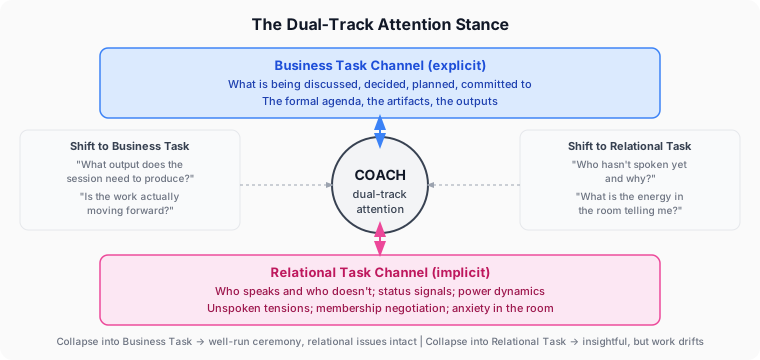
The coach who can hold both tracks simultaneously without losing either is operating at what Bridger called the double-task stance. This is not the same as attending to the task, then attending to the relationship — sequential awareness that leaves the practitioner perpetually one step behind. It is a quality of sustained, simultaneous attention to what is explicitly happening and what is implicitly happening, as two layers of the same moment.
In practice, this feels like a specific kind of peripheral vision: the planning session is in the foreground of the coach's attention, and the relational field — who is speaking and who isn't, what happens when a particular person raises a concern, what the room's energy shifts when a specific topic is approached — is maintained in a kind of continuous background awareness that occasionally comes forward when it becomes more diagnostic than the foreground.
The coach knows that one track has collapsed when they are fully absorbed in either the business task (running the ceremony efficiently, tracking commitments, managing time) or the relational task (attending so fully to dynamics that the work slips away). Both collapses produce characteristic errors: the efficiency-focused coach produces well-run ceremonies that leave the relational issues intact; the dynamics-focused coach produces insightful observations that the team cannot translate into work because the business task has not been held.
Three moves
Before intervening, ask which task is speaking. This is a one-second internal question before any coaching move: is what I am about to address in service of the business task, the relational task, or both? The question prevents the most common coaching error — responding to the content of what is being said when the real material is in the dynamics of who is saying it and who is not.
Use the relational task as diagnostic without making it the subject. The coach who names the relational dynamic directly — "I notice that when Ahmed raises a technical concern, the discussion stops" — in the middle of a planning session creates a therapeutic moment in what is supposed to be a work session, and risks losing the authority that comes from being useful to the work. The more effective move is to use the relational observation as a diagnostic that informs the next business-task intervention: "I want to make sure we've heard from everyone before we commit to this estimate — Priya, what's your sense?" This addresses the relational dynamic (Priya has not been heard) through the business task format (getting her estimate), which maintains the session's task orientation while addressing the relational issue.
Create space for the relational task to be addressed without abandoning the business task. Some relational issues cannot be addressed adequately through business-task format moves. When this is the case — when the relational task has accumulated enough charge that it is actively preventing the business task from functioning — the coach needs to create explicit space: a brief pause, a check-in question, a temporary suspension of the agenda. The key is that this space is named and boundaried: "I want to step back from the backlog for five minutes because I think there's something we need to name about how we're working together before we can plan well." This names the shift, addresses the relational need, and returns to the business task — maintaining both tracks rather than abandoning one for the other.
Every ceremony is always two conversations
Every ceremony is always two conversations. The explicit one is the one that gets minuted and produces artifacts. The implicit one is the one that determines whether the team is actually doing the work, whether commitments made in the explicit conversation will be honoured, whether the team's capacity to engage honestly is developing or shrinking.
The coach who attends to both is not doing something more complicated than the coach who attends to one. They are doing something more complete. Bridger's contribution was to make visible that the choice between task and relationship is a false one — not because the two are the same thing, but because they are always both present, always influencing each other, and always requiring simultaneous attention from anyone who wants to be genuinely useful to the work.
Continue Exploring
Go deeper into the work
The Book
The Art of Creating Self-Organizing Teams
The full framework behind this article — contracting, team dynamics, and practical coaching tools for every stage of the journey.
Companion Toolkit
Resistance Radar & Resilience Scorecard
Practical tools for mapping resistance patterns and measuring whether interventions increased capacity — not just compliance.
TA for Agile
Co-creative TA in Agile Contexts
Ego states, psychological contracts, group imago, and the relational concepts that underpin this article — applied to real teams.