The Elected Carrier: How Agile Teams Create Scapegoats
Every team under sustained pressure unconsciously elects one person, role, or sub-group to carry the shadow material it cannot own collectively — the failure, the conflict, the anxiety. In Agile contexts this appears as 'QA is always the bottleneck,' 'the architect doesn't get Agile,' 'the legacy team is the reason we can't move.' Removing the scapegoat does not dissolve the pattern. The next carrier is already waiting.
The QA lead is the bottleneck. Again.
The sprint doesn't close, and everyone in the room already knows how the post-mortem will go. The QA lead will be mentioned. Not directly — there will be talk of "process gaps" and "earlier visibility" — but the direction of travel will be clear. This has happened in some version three sprints running. The coach has watched it and attributed it to workload imbalance or unclear definition of done. Both are true. Neither explains why the same person keeps ending up in the same position.
The QA lead is not incompetent. The coach has watched them work. They are methodical, ask good questions, and consistently surface issues that would have reached production otherwise. But they have become the team's explanation for its own underperformance. The category "QA" has stopped being a function and has become a verdict.
This is the scapegoat mechanism. It is one of the most common patterns in teams under sustained pressure, one of the least named in Agile coaching literature, and one of the most important to understand — because every intervention that addresses the symptom rather than the mechanism will make it slightly worse.
What shadow election is — and what it isn't
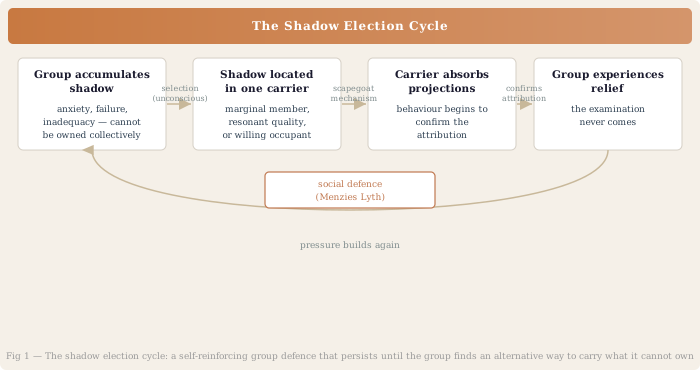
Every team carries material it cannot acknowledge about itself: its actual relationship to failure, its complicity in the problems it attributes to others, its anxiety about its own adequacy. In Jungian terms this is the organisational shadow — everything that is inconsistent with the team's preferred self-image and has therefore been denied, repressed, or split off. The shadow does not disappear when it is denied. It accumulates, and it needs somewhere to go.
What groups do — often without any individual making a conscious choice — is locate this shadow material in one person, role, or sub-group, and then relate to that person as if the shadow qualities genuinely live there and only there. The person who is elected does not volunteer. They are chosen because they are slightly marginal (not fully inside the group's identity), because they carry some quality the group is disowning, or because they have been willing — consciously or not — to occupy the position. Once elected, they begin to absorb the group's projections. They may even start to behave in ways that confirm the attribution: the QA lead who, under the weight of being "the bottleneck," becomes more anxious and less decisive.
The organisational psychologist Isabel Menzies Lyth described how institutions develop social defences — structured patterns of behaviour that protect members from the anxiety of their work. The scapegoat is one such defence. By locating the team's failure in one place, the rest of the team is temporarily relieved of having to examine its own contribution. The relief is real. The examination never comes.
This is distinct from a personality conflict, a performance problem, or a drama triangle game. Those are dyadic or small-group patterns. The scapegoat mechanism is systemic: the whole group participates in it, usually unconsciously, and the carrier's individual behaviour is almost irrelevant to the selection.
Five forms it takes in Agile teams
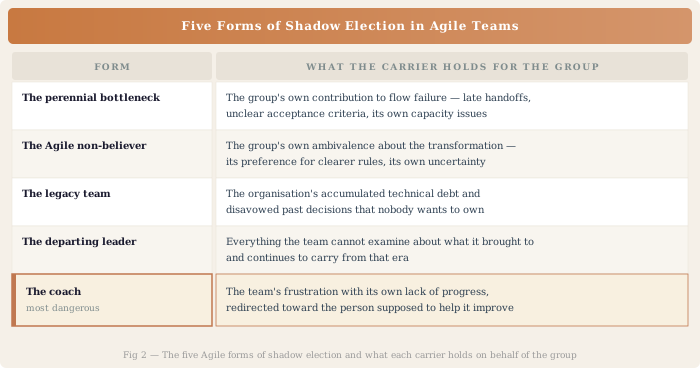
The mechanism takes recognisable shapes in Agile contexts, even though the surface presentation varies.
The perennial bottleneck
One role — often QA, architecture, or a shared platform team — is consistently identified as the reason work cannot flow. The rest of the team may be genuinely frustrated, and there may be genuine capacity issues. But the energy directed at the bottleneck is disproportionate to the actual constraint, and the team's own contribution to the bottleneck (unclear acceptance criteria, late handoffs, rework) goes unexamined.
The Agile non-believer
One member of the team "doesn't really get Agile." They ask the wrong questions in refinement, they want more process than the team likes, or they advocate for practices that were officially abandoned. The team's frustration with them carries a quality that exceeds the actual impact of their behaviour. The non-believer is carrying the team's own ambivalence about the transformation — the part that also finds self-organisation uncomfortable, that also prefers clearer rules, that is also not entirely convinced.
The legacy team
At the organisational level, a team or system — often the oldest, most technically indebted component — becomes the reason nothing can move forward. "We can't do X until the legacy team sorts out Y." The legacy team carries the organisation's anxiety about its own technical debt, its own accumulated bad decisions, its own difficulty with change. The anxiety is real. The attribution is partial.
The departing leader
After a change of leadership, the previous leader becomes the explanation for all current difficulties. "That was the old way of thinking." The team's relief at being able to locate dysfunction in the past can be genuine, but it forecloses the examination of what the team itself brought to and continues to carry from that era.
The coach
Less commonly but importantly: in some teams, the coach becomes the carrier. The team's frustration with its own lack of progress is redirected toward the person who was supposed to help it improve. This is among the most important to recognise, because the coach's own discomfort with the projection may lead them to work harder — becoming more present, more directive, more anxious — which deepens the pattern rather than resolving it.
Why removing the scapegoat makes things worse
The instinct — managerial, coaching, and the team's own — is to address the symptom. Move the person to a different team. Restructure the role. Bring in a replacement. Resolve the "performance issue."
What happens is predictable: for a period, the team's dynamics improve. The identified problem is gone. Then, over weeks or months, a new carrier emerges. Someone else begins to accumulate the projections that were previously held by the person who left. The team has not addressed its shadow; it has relocated the container.
This is not a failure of management or of the new person. It is a failure of the level of analysis. The shadow election is a group process. It will continue to operate until the group has an alternative way of carrying what it cannot acknowledge — and that alternative requires the group to do work that is more uncomfortable than relocating the container.
What the elected carrier reveals about the team
The scapegoat is diagnostically rich precisely because they are not chosen arbitrarily. The qualities that are projected onto them are the qualities the team most needs to disown. The bottleneck carrier holds the team's own anxiety about flow. The non-believer carries the team's ambivalence about transformation. The legacy team carries the organisation's disavowed relationship to its own past.
The first diagnostic question when a scapegoat emerges is not "what is wrong with this person?" but "what is the group unable to own about itself?" The carrier is a mirror. The qualities that appear most threatening, most irritating, most inexplicable in their behaviour are the qualities to examine in the system as a whole.
A second question concerns the carrier's willingness to occupy the position. Some people repeatedly find themselves in the scapegoat role across different teams and organisations. This suggests that their own history has made the position familiar — that they have learned, at some earlier point, that carrying the group's shadow is the price of belonging. Working with this in a team context requires care. The coach is not equipped to do the individual therapeutic work that the full picture would require. But they can notice it, and can work at the group level without exposing the carrier further.
Three moves for working with the shadow election
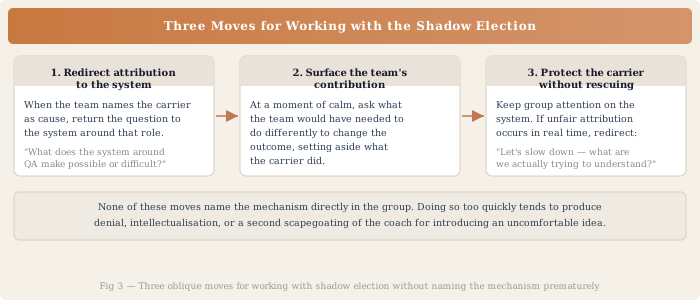
None of these moves name the mechanism directly in the group. Doing so too quickly tends to produce denial, intellectualisation, or a second scapegoating — of the coach for introducing an uncomfortable idea. The work is oblique and patient.
1. Redirect attribution to the system
When the team attributes a problem to the carrier, return the question to the system. "You're right that QA is a constraint here — help me understand what the system around QA makes possible or difficult." This is not a defence of the carrier. It is a shift in the unit of analysis. Practiced consistently, it begins to make visible that the system is not simply the carrier's problem to solve.
2. Surface the team's contribution without accusation
At a moment of relative calm — not during the heat of attribution — ask the team to examine its own role in the pattern. "When we look at the last three sprints, what would we have needed to do differently to change the outcome, setting aside what the QA lead did?" This question is genuinely difficult. It requires the coach to hold a position of curiosity rather than challenge, and to stay with the discomfort if the team initially deflects.
3. Protect the carrier without rescuing them
The carrier needs to not be further exposed by the coach's intervention. This means avoiding the temptation to visibly defend them — which marks them as the coach's protégé and may deepen their marginalisation — and instead working at the group level. The coach's protective move is to keep the group's attention on the system. If a moment arises in which the carrier is being addressed unfairly in real time, the coach can redirect: "Let's slow down here — what are we actually trying to understand?"
The deeper work — helping the carrier examine why they repeatedly occupy this position across different contexts — is individual work. If the coach has a one-to-one relationship with the carrier, that conversation can happen separately. It should not be visible to the team.
The shadow election does not resolve quickly. The group has learned to use it as a relief valve, and that learning is durable. The coach's task is to make the valve slightly less available at each iteration, while the group slowly builds its capacity to hold its own complexity without needing a carrier for the parts it cannot yet own.
Continue Exploring
Go deeper into the work
The Book
The Art of Creating Self-Organizing Teams
The full framework behind this article — contracting, team dynamics, and practical coaching tools for every stage of the journey.
Companion Toolkit
Resistance Radar & Resilience Scorecard
Practical tools for mapping resistance patterns and measuring whether interventions increased capacity — not just compliance.
TA for Agile
Co-creative TA in Agile Contexts
Ego states, psychological contracts, group imago, and the relational concepts that underpin this article — applied to real teams.