The Inside-Out Coach: What Internal Agile Coaches Can't See and Why
Internal Agile coaches are embedded in the organisation's cultural complex — they have absorbed its phantom narratives, its persona and shadow, its language for what can and cannot be said — usually without awareness. This gives them genuine advantages and a specific blind spot: they cannot easily see what has become invisible through familiarity. External coaches have more distance and can see what insiders have stopped noticing — but miss the embedded context. Neither position is superior. Each requires a different discipline.
The knowledge only an insider has
The internal Agile coach knows the organisation in ways no external practitioner can replicate. They know where the bodies are buried — the decisions that were made and never discussed, the reorganisation that nobody has recovered from, the executive who still carries enormous informal authority two years after leaving the company. They know which teams are performing and which are managing impressions. They know who trusts whom and who doesn't, and why the why matters. They can read a meeting in thirty seconds because they have been reading this organisation's meetings for three years.
This is genuine and valuable. It is also the source of their primary structural problem.
The same immersion that generates the internal coach's knowledge makes them invisible to a specific category of information: the things that have become invisible through familiarity. They have absorbed the organisation's cultural complex — its phantom narratives, its institutional persona and shadow, its language for what can and cannot be discussed — usually without awareness. The water they swim in has become the water they cannot see.
What immersion costs
Every organisation has a cultural complex: a network of shared assumptions, images, and feeling-toned patterns that organise how its members perceive and respond to the world. This complex operates largely below conscious awareness. It is not the stated values or the culture deck. It is the unspoken knowledge about what can be said, who has real power, what topics are dangerous, and what the organisation is actually for — as distinct from what it says it is for.
When someone works inside an organisation for long enough, they internalise this complex. They take it in not through deliberate learning but through the daily experience of what works and what doesn't, what is rewarded and what is quietly punished, who gets promoted and who gets marginalised. The cultural complex becomes part of their professional identity. They can no longer easily distinguish between their own perspective and the organisation's view of itself.
This is what Jung and his followers called participation mystique: the state in which the boundary between the individual and the collective is blurred, in which the individual can no longer clearly distinguish what belongs to them and what belongs to the group they are embedded in. The internal coach who has participated in the organisation's life for years may be in a state of participation mystique with its cultural complex without knowing it. Their judgements about what is possible, what is safe to say, and what the organisation will tolerate are not independent assessments. They are assessments shaped by the complex they have absorbed.
The specific cost is this: the internal coach cannot easily see the phantom narratives that an external practitioner sees immediately. They have adapted to them. What to the outside eye looks like a striking pattern — every decision escalated to a level above what it formally requires; a culture of public optimism and private pessimism; the conspicuous absence of a certain category of conversation across every team — to the internal coach looks like "how things are here." They have stopped registering it as unusual because it is not unusual. It is the norm.
What the internal coach can do that no external practitioner can
The internal coach's advantages are not incidental. They are structural and significant.
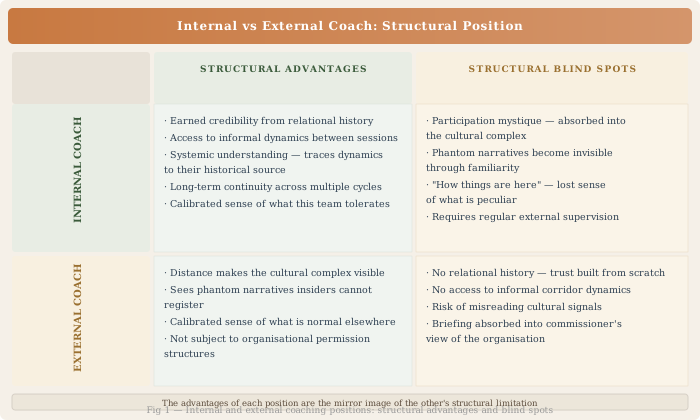
Earned credibility. An external coach must establish trust from scratch with each engagement. An internal coach has a relational history with the organisation — people know how they work, what they have done before, whether they can be trusted with difficult material. This history is not always positive, but it is real, and it removes the investment required to establish the working alliance that external engagements begin with.
Access to informal dynamics. The internal coach is present in the organisation continuously, not intermittently. They see what happens in the corridor before the meeting, how the team responds to news they receive between sessions, what changes between one coaching conversation and the next. This access to the organisation's informal life is not available to external practitioners who arrive for the session and leave.
Systemic understanding. The internal coach understands how the parts of the organisation connect. When a team is experiencing a particular dynamic, the internal coach can often trace it to its systemic source — the restructuring two years ago, the change in incentive structure, the exodus of a particular leader — in ways that an external practitioner would need to investigate through interview and inference.
Long-term continuity. External engagements end. Internal coaches can stay with a team through multiple cycles, tracking what holds and what reverts, building on previous work rather than starting each engagement from scratch. For developmental work that requires years rather than months, this continuity is irreplaceable.
What the external coach misses
The external practitioner's disadvantage is the mirror image of the internal coach's advantage. They lack the relational history, the access to informal dynamics, the systemic understanding that comes only from sustained immersion. They will make errors of interpretation that the internal coach would not make, because they do not know what the internal coach knows.
They will sometimes misread cultural signals, attribute relational patterns to individual psychology rather than systemic history, or propose interventions that fail because they do not account for dynamics that are invisible from outside. In complex, politically layered organisations, the external coach's disadvantage can be significant.
These are real costs. They do not outweigh the external coach's primary advantage — which is precisely the distance that makes the cultural complex visible — but they must be accounted for in how external engagements are structured. The external coach who does not invest significantly in understanding the organisation's history and informal dynamics before attempting to change anything is working with insufficient information.
What each position demands differently
For the internal coach: Regular supervision with someone completely outside the organisation is not optional. It is the primary mechanism for accessing the perspective that the internal coach's immersion has made unavailable to them. The supervisor's function is to see the water the internal coach is swimming in. Without this external perspective, the internal coach is limited to working within the cultural complex rather than with it.
The internal coach also benefits from periodic contact with practitioners in different organisational contexts — not to import their practices wholesale, but to recalibrate what is normal. The internal coach who has not spoken with practitioners from other contexts in six months may have lost the reference point that allows them to register their own organisation's peculiarities as peculiar.
For the external coach: The investment in understanding the organisation's history before working within it is not background reading. It is a technical requirement. The external practitioner who arrives without this understanding is likely to misread significant dynamics and to propose interventions that the organisation's cultural complex will quietly neutralise.
The external coach also needs to account for the countertransference generated by the briefing they receive. The person who commissions external coaching holds a view of the organisation that may itself be shaped by the cultural complex — and the external coach who absorbs this view without examining it has been absorbed into the complex through a different route than the internal coach, but absorbed nonetheless.
The contracting implication: how clients should choose
The choice between internal and external coaching is not a quality question. It is a structural question about what the work requires.
Work that requires sustained relational continuity, systemic understanding, and access to informal dynamics — the kind of long developmental arc that produces genuine team maturation — is well suited to internal coaching, provided the internal coach has robust supervisory support.
Work that requires seeing what has become invisible — surfacing phantom narratives, naming cultural patterns, challenging assumptions that the organisation cannot challenge from inside — is well suited to external coaching, provided the external practitioner invests seriously in understanding the system before attempting to change it.
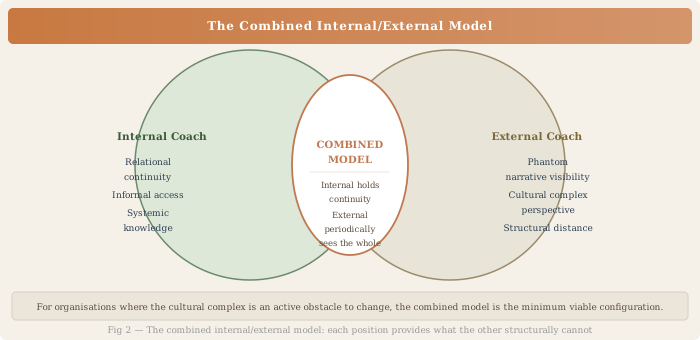
The most effective arrangements often combine both: an internal coach who holds the continuity and the relational infrastructure, and an external practitioner who periodically sees the whole from outside. This is not a luxury. For organisations navigating significant transformation — where the cultural complex is an active obstacle to change — it is the configuration that gives both perspectives what they structurally need.
Continue Exploring
Go deeper into the work
The Book
The Art of Creating Self-Organizing Teams
The full framework behind this article — contracting, team dynamics, and practical coaching tools for every stage of the journey.
Companion Toolkit
Resistance Radar & Resilience Scorecard
Practical tools for mapping resistance patterns and measuring whether interventions increased capacity — not just compliance.
TA for Agile
Co-creative TA in Agile Contexts
Ego states, psychological contracts, group imago, and the relational concepts that underpin this article — applied to real teams.