The Manager Agile Forgot
The most consistent failure point in Agile transformations is not team performance — it is the structural displacement of middle management. Middle managers are not exhibiting a mindset problem. They are experiencing a structural threat: their legitimate power sources are being systematically removed, and the replacement structure has not assigned them a clear function. Coaching for mindset is applying the wrong framework to a power problem.
The consultation that worked on the wrong problem
A Head of Engineering at a mid-size financial services company. Twelve years in the organisation, two direct reporting lines removed from the CTO. The Agile transformation arrived eighteen months earlier: SAFe at the programme level, Scrum at the team level, a dedicated Agile coach for each tribe. The Head of Engineering's role was reframed accordingly — no longer responsible for delivery commitments (moved to the Release Train Engineer), no longer the escalation point for technical decisions (moved to principal engineers embedded in teams), no longer the conduit for reporting to senior leadership (now handled through PI planning artefacts and automated dashboards). The new job description used phrases like "empowering servant leader," "talent developer," and "culture champion."
The coach arrived in month seven. The brief: change coaching to support the Head of Engineering in adapting to the new model. Eight weekly sessions. The manager was articulate, asked good questions, engaged thoughtfully with the material, and described their situation with more clarity than most coaching clients manage in the first three sessions. The coach did careful work. The engagement was well-structured, the manager participated fully, and the final session closed with a genuine sense of progress.
Four months later, the Head of Engineering was made redundant. The coach worked on mindset. The manager was working on survival. The gap between those two framings is the subject of this article.
The most consistent failure point in Agile transformations is not team performance. It is the structural displacement of middle management. The people in that layer are not exhibiting a mindset problem. They are experiencing a structural threat — and coaching interventions that frame the problem as mindset work are applying the wrong diagnosis to a structural condition.
This is the sixth article in a series examining the structural layers a coach must learn to read. The previous five articles addressed the leadership structure the team is embedded in, the unwritten rulebook governing its behaviour, the private mental pictures driving its self-organisation, the coach's own power, and the foundational survival conclusions teams carry from their formation. The final piece in that argument was that a team's survival conclusion is often authored or reinforced by the way the organisation assembled it and continues to treat it. Working with the team alone, in that case, is a partial intervention. This article opens the territory above the team.
The manager Agile forgot is not a character type. They are a structural position — and the coaching they need is not different in degree from standard change coaching. It is different in kind.
The frozen middle: a structural phenomenon
Coaches who work at the team level often encounter the frozen middle as an obstacle. The team is making genuine progress — ceremonies are working, collaboration is improving, the Scrum Master is growing into the role. And then something above the team slows everything down. Approvals that used to take a day now take two weeks. Decisions that the team nominally owns keep surfacing in the manager's weekly report. Initiatives that the retrospective produced never quite get implemented because the manager's involvement introduces a delay that nobody formally authorised but nobody can remove. The team is moving. The middle isn't.
The standard read is cultural. The manager hasn't shifted yet. They still reach for the information flow that Agile has redistributed. They still grasp for the decision authority that has been delegated to the team. They exhibit behaviours that look like resistance — because, from a behavioural frame, that is what they are. But behaviour is not explanation. The question underneath the behaviour is: what is being protected, and from what structural threat?
A well-implemented Agile transformation does the following to the middle management layer, systematically and by design. It moves delivery accountability to the team and to programme-level constructs. It moves technical decision authority into the team through self-organisation and embedded expertise. It moves information flow out of the management layer through dashboards, PI planning artefacts, and transparent backlogs. It moves stakeholder relationships to the product owner. It moves escalation paths to Agile coaches and release managers. And it describes the manager's remaining function in terms of cultural ownership — "servant leader," "people coach," "chapter champion" — that are almost never specified clearly enough to produce a deliverable.
This is not a failed transformation. In most cases it is a successful one. But it produces, as a structural byproduct, a person whose previous role has been disaggregated and who has been given a new role description that does not specify what organisational value they are now supposed to produce. The frozen middle is not a collection of resistant individuals. It is a structural position without a structural function.
The coach who reads resistance-as-character will work on growth mindset, change readiness, and personal development. These are real coaching conversations. They are not the coaching conversation this situation requires. Three theoretical lenses — Berne's leadership typology, Krausz's power sources, and van Poelje's developmental stages — make the structural threat legible in ways that the mindset frame cannot.
Which of Berne's three leaders is being displaced?
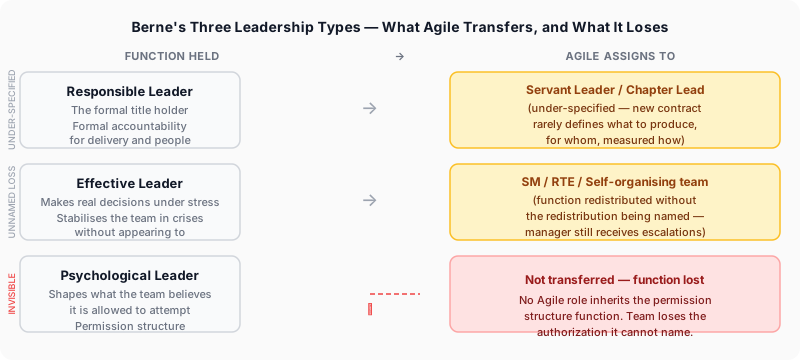
Eric Berne (1963) identified three distinct leadership types operating simultaneously in any organised group. The distinction matters here because Agile transformation does not threaten all three equally — and the intervention the coach needs to offer depends entirely on which function the manager was actually performing.
The responsible leader
The responsible leader holds the formal title. They are the person whose name appears in the org chart, who chairs the meetings that structure the management layer, and who is formally accountable for the team's delivery and conduct. The Agile transformation has a plan for the responsible leader. The plan is usually: become a servant leader, a talent developer, a chapter or community-of-practice owner, a people coach. These are real organisational functions. The problem is that they are almost never specified in terms of what the responsible leader is supposed to produce, for whom, measured how. The manager is given a new orientation without a new contract. They cannot identify what they are now accountable for — and cannot ask for help succeeding, because the question itself implies that the transformation's role design was incomplete.
The effective leader
The effective leader makes real decisions under stress. Not the decisions that appear in the formal governance model — the decisions that actually resolve things when the sprint is at risk, when two developers are in intractable conflict, when a stakeholder is demanding something the team cannot deliver in the current sprint. The Agile transformation transfers the effective leadership function deliberately: to the team through self-organisation, to the Scrum Master through ceremony facilitation, to the product owner through priority decisions, to the Release Train Engineer through cross-team coordination. The manager who was the effective leader — whose read on technical risk shaped sprint planning without appearing in it, whose intervention stabilised the team under deadline pressure — finds the function redistributed without the redistribution being named. They still receive the same escalations. They still have the same instinct to stabilise. But the structural licence to do so has been removed.
The psychological leader
The psychological leader shapes what the team believes it is allowed to attempt. This is Berne's most precise and most easily overlooked concept. The psychological leader is not the person who tells the team what to do. They are the person who holds the team's permission structure — who determines, through accumulated relationship and demonstrated authority, what risks the team believes it can take, what ambitions it believes are within reach, what failures it believes will be survived. The psychological leader's function does not appear on an org chart and is not included in a job description.
When the psychological leader is displaced — when the manager is removed from regular contact with the team, or their authority is so visibly undermined that the team no longer reads them as the person whose permission matters — the team loses something it cannot name and the organisation cannot measure. Until the team stops attempting the things the psychological leader had been, invisibly, authorising. The Agile transformation addresses the responsible and effective leadership functions explicitly, even if imperfectly. The psychological leadership function is almost never addressed. It disappears.
The power sources being removed
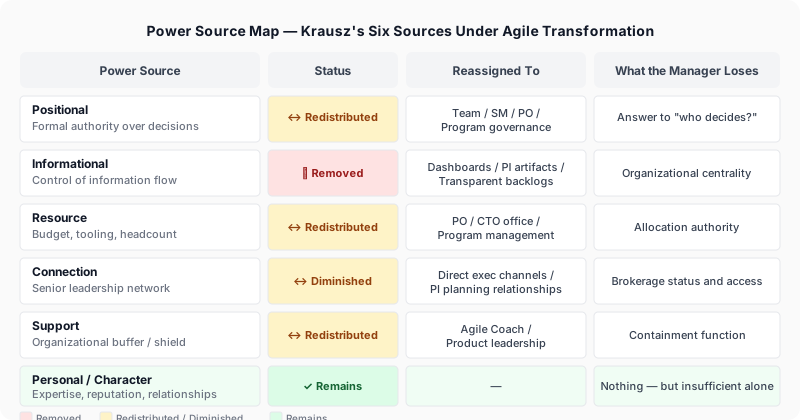
Rosa Krausz (1986) defined power as "the ability to influence the actions of others, individuals or groups" — and identified six sources through which that ability is held in organisational life. Julie Hay (2015/2018) extended this taxonomy to seven power potentials. Together, these frameworks make the structural threat to middle management legible at the level of sources rather than symptoms.
What follows is a mapping of each source against what a standard Agile transformation does to it. The manager who "resists" is typically protecting what's in the first two columns of this map — the sources that have been most thoroughly removed.
Positional power
Formal authority over assignments, decisions, and process. In a pre-Agile structure, the manager owned the answer to "who decides?" In a well-implemented Agile structure, the answer is the team for technical decisions, the product owner for product decisions, the Scrum Master for process decisions, and programme-level governance for dependency decisions. The manager is not included in this list. Their formal decision authority has been redistributed. The organisation expects them to have "stepped back" without specifying what they stepped forward into.
Informational power
The ability to control the flow of information between the team and senior leadership. Previously, information passed through the management layer: status reports, risk escalations, performance assessments, and strategic updates all arrived at senior leadership shaped by how the manager framed them. Agile transparency removes this function directly and deliberately. Dashboards, burndowns, PI planning artefacts, and direct product-owner-to-stakeholder relationships are designed to eliminate the information mediation layer. This is architecturally correct. It also removes one of the manager's most significant sources of organisational relevance — the centrality they held by being the node through which everything flowed.
Resource power
Influence over budget, tooling, and headcount. Moved to the product organisation for product spend, to the CTO office for technical tooling, and to programme management for headcount planning. The manager who once held meaningful resource influence often retains nominal input — a seat in planning conversations — without retaining meaningful authority: the ability to allocate differently from what the programme has already decided. The seat without the authority is not a partial retention of resource power. It is its removal with the appearance of inclusion.
Connection power
The relationship network with senior leadership that conferred both personal status and the ability to open doors for the team. The manager's position as connection broker — the person who could reach the CTO when a dependency was blocking delivery, who could translate a team's technical constraint into language that landed with the programme director — was organisational capital. Agile's direct stakeholder engagement model builds direct channels between product leadership and senior executives through PI planning, executive demos, and OKR reviews. The manager's brokerage function diminishes as these direct channels become institutionalised.
Support power
The organisational backing that protected the team from turbulence. A critical and underacknowledged function: the manager who absorbed pressure from above — who shielded the team from restructuring noise, budget uncertainty, and competing executive demands — provided a structural buffer that the team may not have been aware of until it was gone. Agile models tend to locate this function with the Agile coach or the product organisation. In practice, neither reliably provides the same containment that a line manager with organisational standing and a senior leadership relationship could offer. When the manager's support power is removed, the team often begins to encounter the organisational environment directly for the first time — which can produce its own defensive response.
Personal and character power
Intrinsic to the person: expertise, reputation, relationship depth, the accumulated trust of years in the organisation. The one source that cannot be removed structurally. It is also the one source that Agile transformation programmes typically address directly — through coaching, development, and growth mindset work. The irony is that personal power is the least threatened of the six. The five structural sources that have been removed receive the least attention; the one that remains receives the most. A manager coached exclusively at the personal power level is being prepared for the wrong job.
Van Poelje's stage 4: the lieutenant problem
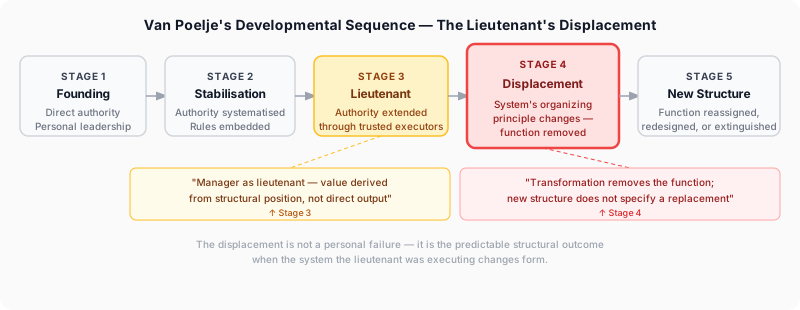
The structural displacement of middle management is not a contingent failure of a particular poorly-managed transformation. Sari van Poelje (1995) observed that autocratic organisational structures — the kind of structures most organisations operated under before Agile arrived — don't originate as fully formed hierarchies. They develop through a sequence of stages, each comprehensible in itself, whose cumulative result is visible only in retrospect.
In early organisational life, the founding leader's authority is direct and personal. They make decisions, they hold the relationships, they are visible throughout the organisation. As the organisation grows past what one person can manage directly, authority is extended through lieutenants — people who execute the leader's intent, represent the leader's position in distributed operations, and derive their organisational value from the accuracy and reliability of that representation.
The lieutenant relationship is not merely instrumental. It is constitutive. The lieutenant's organisational identity is defined substantially by their position in the authority structure. They are valuable because they are trusted to represent a power that is above them — to extend the leader's reach, to interpret the leader's intent in local conditions, and to bring the local back up accurately so the leader can decide. Remove the principal, or remove the principal's dependence on the lieutenant, and the lieutenant's structural function disappears.
"Autocratic systems do not begin autocratically. They develop through stages in which each step is comprehensible and the cumulative result is visible only in retrospect."
Sari van Poelje, Development of Autocratic Systems in Organisations (Transactional Analysis Journal, 1995)
Van Poelje's stage 4 is the displacement event. When the organising principle of the system changes — through a strategic transformation, a leadership transition, or a structural redesign — the lieutenant's function may be removed without anyone naming that this is what is happening. The new system doesn't need the function the lieutenant was performing. But it often hasn't specified this clearly. The lieutenant remains in place, executing a function the system no longer requires, unable to identify what the new system would need them to do instead.
Middle managers in traditional hierarchies were often lieutenants in the precise sense van Poelje describes: executing downward authority (delegation, direction, accountability-setting for the team) and representing upward to senior leadership (status, performance, the team's condition and needs). Both functions are explicitly removed by well-implemented Agile structures — the first by self-organisation, the second by transparency. The result is a stage-4 displacement: the lieutenant without a principal. Not a resistant individual. A structural position without a structural function.
Five moves that address the structural threat
The five moves below operate on the structural threat rather than on the behavioural symptoms it produces. They are not a programme. They are not a sequence to be completed in order. They are interventions available to the coach who has made the structural diagnosis and needs to know what working at that level actually looks like.
Name the structural threat before the mindset conversation
The coach who begins with growth mindset framing is starting one level too high. The structural diagnosis needs to happen first: what power sources has this manager lost? Which leadership function has been reassigned? What is the organisation implicitly asking them to become, and has that question been made explicit anywhere?
The naming move is precise. It is not "Agile must be hard for you." It is: "It sounds like three of the main ways you produced value here have moved — the information flow, the decision authority on technical risk, and the escalation path from the team to the programme level. What the organisation is asking you to produce instead doesn't seem to be clearly specified yet. Is that an accurate read?" The manager who is being read structurally, rather than assessed for mindset, can engage with the actual problem. The coaching can start at the right level.
Distinguish which power source the manager is actually grieving
Not all losses are equivalent in impact or in what they require from the coaching. A manager who has lost informational power — once the node through which status, risk, and team condition all flowed — is experiencing a loss of organisational centrality. The intervention is about building a new kind of relevance: a different form of connection and contribution that the new structure can accommodate.
A manager who has lost positional power — formal authority over decisions they once owned — is experiencing a legitimacy loss. The intervention is a contract renegotiation: what decisions does this person own, explicitly, in the new structure? If the answer is "none yet," the coaching cannot proceed productively until it is. A manager who held psychological leadership and has lost it is facing a different kind of displacement — one that neither they nor the organisation has language for. The work here is to name what the function was and ask whether the organisation wants it maintained in a different form, transferred intentionally to another person, or retired with acknowledgment.
Renegotiate the contract from the organisational level
A delivery manager at a large retail organisation, eighteen months into an Agile transformation. The Agile coach had been working with the team below her for six months — good velocity, improving ceremonies, a Scrum Master growing steadily into the role. The manager kept appearing at the edges: slow approvals, a tendency to reinstate decisions the team had made, visible tension in joint planning sessions. The team had started calling her a blocker. The coach had begun working around her.
The coach proposed a three-party conversation: manager, her senior leader, and the coach. Not as a conflict resolution session — as a contract-setting conversation. The question on the table: what is this manager's role supposed to produce for the organisation, specifically, and who is accountable for specifying that? The senior leader, when asked directly, acknowledged that the role redesign had not been completed. A revised contract emerged over two sessions: the manager owned cross-team dependency management, organisational relationship capital (the connection function Agile hadn't replaced), and one explicit decision domain in the technical estate.
Within a quarter, the blockage the team had been experiencing resolved — not because the manager changed their attitude, but because the structural ambiguity that had produced the blocking behaviour was resolved. The three-party renegotiation is not always available. It is almost always worth attempting before eighteen months of mindset coaching that leaves the structural problem intact.
Work with the lieutenant relationship
The senior leader whose delegated authority the manager was executing has usually not recognised that the transformation removed the lieutenant function. They continue to behave as if the manager is their primary operational extension — calling them for status, expecting them to implement direction, holding them accountable for outcomes that now belong formally to the programme level. The manager is caught between two structures: the new one they are supposed to serve and the old one that still reaches for them.
The lieutenant relationship needs to be named and renegotiated in both directions. The senior leader needs to redirect their operational expectations. The manager needs organisational permission to stop executing a function the structure no longer assigns to them. Neither can do this without the conversation being made explicit. The coach who can facilitate this conversation — and who can help the senior leader see that their own behaviour is maintaining the displacement — is working at the level where the system actually runs.
Design for the power sources that remain
Personal and character power cannot be removed structurally. But they are almost never sufficient on their own to sustain an organisational role. The manager who retains only personal power — working in a structure that has removed their positional, informational, resource, connection, and support power — is a very capable person without organisational leverage. Coaching them to show up better personally, while five of six power sources remain unaddressed, is coaching for the wrong game.
Two sources can be rebuilt in genuinely different form. Connection power — not as access to the org chart, but as a cultivated relational network across teams, functions, and organisational levels that makes things happen without formal authority. And purpose or transcendent power, Hay's seventh potential: alignment to a mission that extends beyond positional role, that gives the work meaning independently of the title. Neither is a consolation prize. Both require explicit design and organisational support to develop. The coach's role is to make the design work concrete — not to encourage the manager to feel differently about what was lost.
Contracting when the middle manager is in the room
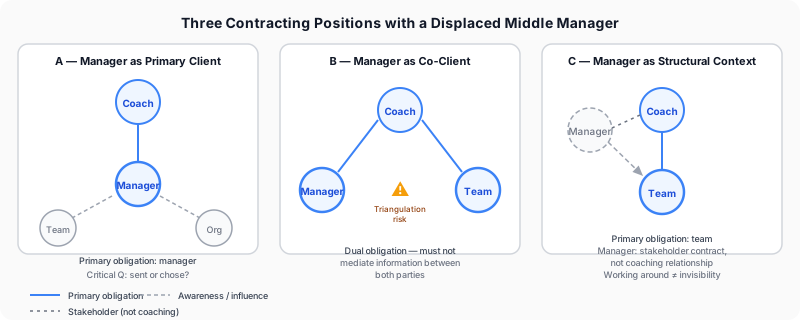
The middle manager is a different kind of coaching client from the team — not just in content, but in the contracting relationship itself. Three configurations arise commonly in Agile coaching contexts, each requiring specific moves.
Manager as primary client
The brief is explicitly about the manager's development or transition. The critical contracting question is not what the organisation needs — it is whether the organisation has commissioned this work or whether the manager has been "sent." A manager who has been directed to coaching, rather than choosing it, is often in a double bind: the organisation is sending a problem, not a client. The system expects the coaching to fix the resistance while leaving the structural source of the resistance intact.
The coach's first move is to establish what the manager's own goal is, independent of the organisational brief, and whether there is enough alignment between the two to proceed honestly. If the manager's goal is to regain the functions the transformation removed, and the organisation's goal is to help them stop reaching for those functions, the coaching is built on a contradiction. The structural reframe — acknowledging the loss, mapping what remains, designing for different sources — is what makes the contradiction resolvable.
Manager as co-client alongside the team
The coach holds active relationships with both the manager and the team. This is a structurally demanding configuration, and the most common failure is specific: the coach becomes a conduit for information between the two parties, receiving each party's private read on the other and using it to navigate the relationship from the middle. This is a triangle, not a dual-client relationship. The coach's position becomes the thing that mediates a relationship that has not been made direct.
The contracting move is to make the configuration explicit at the outset — who the coach's obligations run to, what information flows where, and what the goal of the dual relationship is. Information disclosed in individual conversations does not flow to the other party without explicit consent. The coaching is not a workaround for a conversation the manager and the team need to have directly.
Manager as structural context for team-client work
The coach's primary client is the team. The manager is not a coaching client — but they are the structural layer that determines what the team can attempt. This is the most common invisible configuration: the team is the client, the manager is the constraint, and the coach is navigating the constraint without contracting with the manager at all. The risk is specific: every time the coach works around the manager, they implicitly validate the team's reading that the manager is the obstacle rather than a structural position that has not been adequately redesigned.
The structural move is to contract with the manager explicitly — not as a coaching client, but as a structural stakeholder — about what the coaching work is doing, what it is not doing, and what the manager's role in the team's development is or isn't. Naming the configuration transparently is the move. The manager who understands that the coach is working with the team and not against the manager is in a different relationship to the coaching work than the manager who experiences it as something happening below them without their knowledge or consent.
The coach who reads structural displacement
The coach who can read structural displacement is not doing more sophisticated work than the coach who reads mindset. They are working on a different problem — the one that is actually operating. This distinction matters because mindset coaching has genuine value, and the coach who has been applying it to structural displacement is not incompetent. They are misdiagnosed. The problem isn't the coaching tool. It's the level at which the tool is being applied.
The layers connect. The three leadership types from the first article in this series identify which function the manager was actually performing — responsible, effective, or psychological — and therefore which displacement is most consequential. The group canon from the second article explains why the team doesn't automatically update its norms when the manager's structural authority changes: the canon runs independently of the org chart, and the canon the team built under the manager's authority will persist after that authority is formally removed. The collective imago from the third article explains why the team's private picture of what it is and what is possible continues to include the manager's influence long after the org chart has been redesigned. The team script from the fifth article explains why teams formed under a particular authority structure carry that formation as a survival conclusion — and why coaching the team to behave differently, without working on the layer above it, keeps producing the same result.
The coach who can read all of these layers is not doing more complex work than the coach who reads ceremonies and behaviours. They are reading the system at the level where the system actually runs — which is the level at which durable change becomes possible.
The final article in this series will address what happens when the coach itself becomes the structural layer — when the team has formed an attachment to the coach as its source of security, and the coach's continued presence is what makes the team's autonomy impossible. That is the same structural problem from the opposite direction: the coach who didn't design for their own displacement.
The manager Agile forgot is not standing in the way of the transformation. The manager is the evidence that the transformation forgot to design for the people it displaced.
Continue Exploring
Go deeper into the work
The Book
The Art of Creating Self-Organizing Teams
The full framework behind this article — contracting, team dynamics, and practical coaching tools for every stage of the journey.
Companion Toolkit
Resistance Radar & Resilience Scorecard
Practical tools for mapping resistance patterns and measuring whether interventions increased capacity — not just compliance.
TA for Agile
Co-creative TA in Agile Contexts
Ego states, psychological contracts, group imago, and the relational concepts that underpin this article — applied to real teams.