The Mourning That Organisations Skip
Every genuine transformation involves irreversible loss, but change programmes are structured to bypass grief. The team that is still attached to the way it was is not resisting the new — it is carrying unprocessed mourning that the transformation never made space for. Resistance, nostalgia, passive sabotage, and inability to commit are not communication or management failures. They are the four forms of grief that was not allowed its ending.
The team that's still attached to the way it was
Six months into the Agile transformation, the adoption metrics look good. Sprint ceremonies are running. Velocity is being tracked. The teams are showing up to planning and producing story estimates. There is one persistent problem: the work that comes out of these ceremonies is not qualitatively different from what the teams were producing before. The decisions are still made through the old channels. The same people are still being consulted. The new structures are present; the old logic is operating within them.
The change programme's assessment is that adoption has been slower than expected and that the solution is better training, clearer metrics, and stronger leadership sponsorship. The coach watching the teams carefully has noticed something different: a quality of loss in the conversations. References to "how we used to work" that carry something more than simple preference. A recurring sense in the team that something good was taken away — something that deserved acknowledgement that it never received.
The transformation programme has treated the previous way of working as a problem to be solved. It has not treated it as something that existed, that had meaning, and that ended. The team is not resisting change. It is carrying unprocessed grief — and the new structures cannot be fully inhabited until the ending of what preceded them has been genuinely acknowledged.
What mourning is — and what it is not
Mourning, in Winnicott's account, is not simply the experience of loss. It is the psyche's work of metabolising loss — the gradual, non-linear, irreducibly personal process of adjusting to a reality in which something that was present is now absent. This adjustment cannot be rushed. It cannot be bypassed by cognition alone — by understanding that the change was necessary, that the old way had limitations, that the future will be better. Knowing something intellectually does not produce the emotional relinquishment that mourning requires.
Kübler-Ross's stages model has been broadly influential and broadly misapplied. Her original research described the experiences of terminally ill patients, not organisations undergoing transformation. The stages — denial, anger, bargaining, depression, acceptance — are not sequential, universal, or predictable. Applying them to organisational change typically produces a simplified map that is more useful to the change programme's communication strategy than to the people doing the actual work of adjusting.
What is useful from the mourning literature is William Bridges' distinction between change and transition. Change is situational: the new structure, the new process, the new team configuration. Transition is psychological: the internal process of relinquishing the old and coming to inhabit the new. Change can be announced and implemented. Transition cannot be. It happens on its own timeline, which begins not with the announcement of the change but with the recognition of the ending — a recognition that most change programmes systematically avoid.
Vamik Volkan's work on large-group mourning adds a further dimension: groups — nations, organisations, teams — carry collective grief that differs from individual mourning. The group's loss of an identity, a way of working, or a founding story produces what Volkan calls a chosen trauma: a representation of the loss that is passed down through the group's culture and continues to shape behaviour long after the event that generated it. Teams that went through painful reorganisations years ago still carry those reorganisations in their norms and their defensive structures, not because the individuals are traumatised but because the group's mourning was incomplete.
Why organisations cannot grieve
Organisations are structurally unable to acknowledge loss in the way that mourning requires. The reasons are not incidental. They are built into how organisations understand their purpose and how change programmes understand their task.
Change is narrated as progress. This is not simply communication strategy — it is the frame through which organisations can justify the disruption that change produces. If the new way is better than the old, the discomfort of transition is a reasonable price. If the new way is different in ways that include genuine loss, the change becomes harder to justify and harder to sponsor. The progress narrative is not a lie. It is a selective account that emphasises what is being gained and systematically discounts what is being given up.
Attachment to the old way is diagnosed as resistance. This diagnosis is convenient because it pathologises exactly the response that mourning produces — the continued orientation toward what has been lost, the difficulty fully inhabiting what has replaced it — and replaces it with a problem that can be managed. Resistance can be addressed through communication, through stakeholder management, through training and measurement. Grief cannot be managed in this way. It has to be allowed.
The organisation's speed bias compounds this. The pressure to demonstrate adoption metrics, to show tangible progress within the transformation programme's timeline, creates a structural incentive to move faster than the psychological work of transition can proceed. Teams that are still in the process of relinquishing the old way are measured on their adoption of the new. The measurement produces performance — surface compliance — that reads as adoption while the actual transition remains incomplete.
Four forms unprocessed mourning takes in Agile contexts
Unprocessed grief does not disappear. It reappears in forms that are regularly misdiagnosed as process problems, communication failures, or individual performance issues. Recognising the underlying mourning changes the intervention entirely.
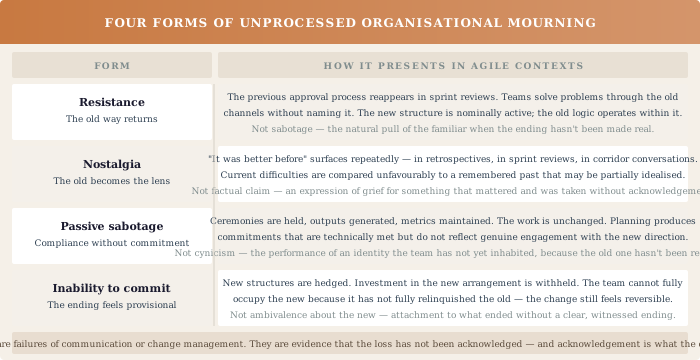
Resistance is the most commonly recognised form: the old way keeps reappearing as if the change hadn't been decided. The team reverts to previous approval processes, produces work through the old channels, frames problems in the language of the previous structure. This is not sabotage. It is the natural pull of the familiar in the absence of a genuine ending. The old way was not only a way of working — it was the environment in which competence was built, relationships were formed, and identity was grounded. Returning to it under pressure is not resistance to the new. It is the natural movement toward what was real when the new does not yet feel real.
Nostalgia is the form mourning takes when it becomes the lens through which the present is evaluated. "It was better before" — applied to team decisions, to sprint outputs, to relationships — carries a quality of comparison that is not primarily analytical. It is the expression of loss: a way of keeping alive the value of what was given up without being able to name the loss directly. The change programme that tries to counter nostalgia with data is missing the point. The person expressing nostalgia is not primarily making a factual claim. They are expressing grief.
Passive sabotage is mourning expressed through the gap between compliance and commitment. The team follows the new process technically and produces nothing different from what it produced before. Ceremonies are held, outputs are generated, the forms of Agile are performed — and the work remains unchanged. This is not cynicism about the transformation. It is the response of people who are going through the motions of a new identity that has not yet replaced the old one, because the old one has not been released.
Inability to commit is the form mourning takes when the ending is still experienced as reversible. The team cannot fully occupy the new arrangement because it has not fully relinquished the old one. The transformation is still, in some layer of the group's experience, provisional — something that might yet be undone. This prevents the investment in the new structures that would make them genuinely work, because investment in what might be undone is experienced as loss in advance.
What the coach can hold — and what they must not try to resolve
The coach's primary function in the presence of organisational grief is not to facilitate the move past it. It is to create conditions in which the grief can be acknowledged — in which loss can be named as loss and its significance can be registered by the group. This is different from managing resistance, from reframing nostalgia, from encouraging commitment. It is holding a different kind of space.
In practice, this means creating explicit opportunities for the team to acknowledge what has ended. Not to evaluate it, not to decide whether it was good or bad, not to compare it with what has replaced it — but simply to name it as something that was real and is now gone. This is often more difficult to do in organisations than it sounds, because the organisational norm is that what is gone was a problem and that what is new is better. The coach who can hold space for the team to say "this mattered, and we miss it" without immediately redirecting toward "and here is what we can build on in the new structure" is doing something genuinely different from standard facilitation.
What the coach must not try to resolve is the grief itself. The well-meaning coach who responds to a team's expression of loss by helping them see the value in what has replaced it has redirected the grief rather than allowed it. The team's experience of loss is not a misunderstanding to be corrected. It is an accurate registration of the cost of change. Allowing it means staying with the discomfort of hearing it without immediately moving to what can be built from it.
Designing the ending: ritual, witnessing, and release
Bridges argued that the psychological beginning of any genuine transition is not the adoption of the new but the completion of the ending. Organisations skip endings because they are uncomfortable and because they seem like the wrong direction — backward-looking in a context that is supposed to be moving forward. But the ending is not backward-looking. It is the precondition for genuine forward movement. Without it, the team occupies the neutral zone — neither in the old nor fully in the new — indefinitely.
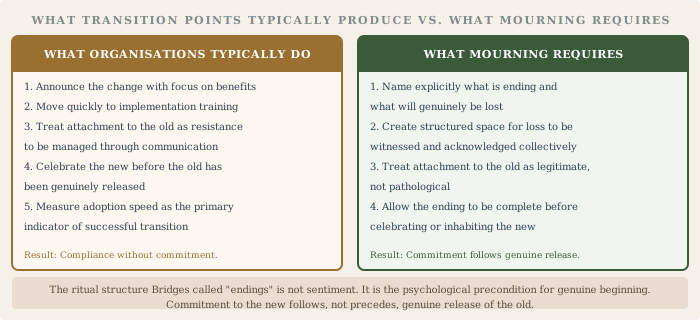
Eliade's account of ritual death and rebirth points toward what the ending requires: a deliberate structure in which what is ending is acknowledged as ending — not deprecated, not evaluated, but witnessed. Something that marks the boundary between the before and the after, that holds the loss long enough for it to be registered collectively, and that allows the group to cross into the new arrangement with the knowledge that they have done so consciously.
In team coaching, this can be as simple as a structured ending ceremony: a conversation in which the team names what the old way gave them, what they valued in it, what they will carry forward and what they are genuinely leaving behind. This is not a celebration of the old way. It is an acknowledgement of it — a witness to its ending that the team can use as a genuine marker of transition rather than a boundary that is officially declared but psychologically uncrossed.
The coach who can facilitate this kind of ending — who can hold the discomfort of a group sitting with genuine loss without moving prematurely toward the new — is providing something that no training programme, no adoption metric, and no stakeholder communication can substitute for. They are creating the condition in which the team's commitment to the new arrangement becomes possible not because it was required but because the relinquishment of the old was genuine.
Continue Exploring
Go deeper into the work
The Book
The Art of Creating Self-Organizing Teams
The full framework behind this article — contracting, team dynamics, and practical coaching tools for every stage of the journey.
Companion Toolkit
Resistance Radar & Resilience Scorecard
Practical tools for mapping resistance patterns and measuring whether interventions increased capacity — not just compliance.
TA for Agile
Co-creative TA in Agile Contexts
Ego states, psychological contracts, group imago, and the relational concepts that underpin this article — applied to real teams.