The Power You Didn't Know You Had: A Self-Audit for Coaches and Scrum Masters
The most common structural error in Agile coaching is not misreading the team — it is misreading the coach's own power. Coaches and Scrum Masters routinely describe themselves as having no authority, conflating positional power (one of seven available sources) with all power. The sources they discount most confidently — psychological, political, personal — are the ones they use most, invisibly and often at the expense of the team's autonomy.
The coach who had no power
The engagement ended without reaching its goal. The team didn't arrive at self-organisation. The sponsor is not satisfied. In the debrief, the coach says, with genuine conviction: "I didn't have the authority to make the changes that were needed. The real decisions were above me." The coach is describing the organisational structure accurately. They are not describing their power accurately.
Authority and power are not the same thing. Authority is the formal right to direct — to assign work, approve decisions, hold people accountable through the hierarchy. Power is the ability to influence outcomes. A coach has minimal authority in most Agile engagements. That says nothing about how much power they have. The two are consistently conflated in post-mortems, in contracting conversations, and in the stories coaches tell themselves about why things didn't move.
The conflation has two specific costs. The first: coaches who discount their own power use it without awareness — which is more controlling, not less, because the influence is invisible and therefore unchosen. The second: coaches who equate powerlessness with neutrality miss the power they are already using and the power they could deploy more intentionally. Both are development failures dressed as humility.
This article is a self-audit. Before coaching the team's leadership structure, its canon, or its collective imago — the work described in the first three articles of this series — the coach needs to audit what they bring into the room. Seven sources. One role. And a persistent, well-meaning script about having none of them.
What power is
Rosa Krausz (1986) defined power as "the ability to influence the actions of others, individuals or groups." Leadership, in her framework, is the way that power is used in the process of influencing. The definition matters because it locates power in capacity, not in role. Authority is a subset of power — the formalised, institutionally recognised version. But capacity to influence exists independently of whether the institution has acknowledged it.
Krausz drew a structural distinction that is the foundation of this article's argument: organisational power is formally distributed — it comes with role, status, and function, and when you lose the role, you lose the power. Personal power is not distributable — it depends on specific individual characteristics, knowledge, and relational capabilities. It cannot be assigned to someone else. It cannot be taken away by an organisational decision.
This matters for the coach immediately. When an Agile coaching engagement ends, whatever positional power the coach held within the programme structure evaporates. Their performance power, personal power, and psychological power travel with them. The coach who describes themselves as powerless because their role doesn't appear on the org chart is miscounting — they are counting one source and ignoring the others.
"Power [is] the ability to influence the actions of others, individuals or groups."
Rosa Krausz, Power and Leadership in Organisations (Transactional Analysis Journal, 1986)
Julie Hay (2015/2018) synthesised Krausz, French and Raven (1959), Steiner (1987), and others into a map of seven power potentials — the full range of influence sources available to anyone in an influence role. The coach who says "I have no authority here" is describing one of the seven. The other six are still in the room.
The seven power potentials
Hay's seven potentials — Physical, Pecuniary, Performance, Personal, Psychological, Positional, Political — map what generates influence independently of role title. Hay is explicit that coercion is a behaviour, not a source, and control is an outcome, not a source. The seven describe what the coach and SM bring into any working relationship, whether they have named it or not.
Each potential can be underused (the coach discounts or ignores it) or overused (the coach deploys it without awareness, at a scale that works against the team's autonomy). The diagnostic value of the map is not in knowing which sources you have — you have all seven — but in reading which you are actually using, how consciously, and to what end.
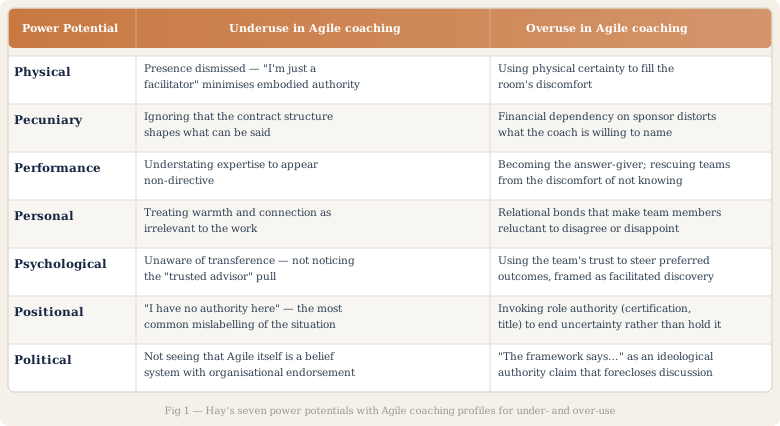
Physical
The most easily dismissed. Coaches who describe themselves as "just facilitators" are discounting the embodied presence they carry into the room: how they hold silence, how they position themselves physically, how their certainty or uncertainty signals to the group what is safe to bring. A coach who retreats to the edge of the room, minimises their spatial presence, and avoids eye contact during charged moments is not being non-directive. They are using physical power in a specific way and calling it neutrality. Physical withdrawal is itself a signal — often read by the group as the facilitator's discomfort with what is happening, which shapes what they bring next.
Pecuniary
The coach's financial relationship with the engagement shapes what they can say. A coach whose contract is held by the transformation sponsor cannot name what the sponsor is doing to undermine the team without risking the engagement. An internal SM whose performance review is managed by the manager the team is trying to become independent from has a different relationship to truth-telling than their formal facilitation role would suggest. The trap is believing that financial dependency sits outside the coaching relationship. It is inside it, shaping the edges of what can be surfaced, at every session.
Performance
Expert knowledge — Krausz's "knowledge" source — is the most frequently claimed power by coaches and the most frequently misapplied. The coach with genuine methodology expertise has real influence. The problem is that performance power is the most natural displacement for positional uncertainty: when the coach doesn't know how to hold an ambiguous space without directing it, they become the answer-giver. The team asks a question. The coach provides an answer that would have been more developmental as a discovery. The team learns that expertise lives with the coach. The appropriate response to uncertainty becomes asking the coach. This is dependency production running as facilitation.
Personal
Interpersonal competence — warmth, empathy, communication skill, the capacity for genuine connection — is the most systematically undervalued source in coaching self-assessments. Coaches who describe themselves as having "good working relationships" with the team are naming the outcome of their personal power without accounting for the influence it carries. Strong relational bonds make team members reluctant to disappoint the coach, to disagree with a direction the coach has invested in, or to grow in ways that would outgrow the relationship. The trap is building genuinely warm working relationships and not noticing that warmth is influence.
Psychological
The most consequential source and the least examined. Psychological power — the pull of the trusted advisor, what accumulates in a relationship as the team learns the coach can be relied on — builds over time and is active in proportion to how long the coaching relationship has run. The team begins to look to the coach for orientation before deciding. The coach who does not register this dynamic and continues to act "non-directively" within it is using psychological power without awareness. The facilitated discovery that consistently arrives at the coach's preferred outcome is not facilitation. It is psychological power with a facilitation wrapper. This is the most common form of invisible control in long Agile coaching engagements.
Positional
The one coaches say they don't have — and the most conflated with all power. Positional power comes from role, hierarchy, and formal context. An Agile coach in most organisations has minimal positional power relative to line managers, sponsors, and senior technical leads. This is accurate. But it describes one of seven potentials. The trap runs in both directions: treating the absence of positional power as the absence of power entirely (powerlessness as virtue), or overusing what positional legitimacy exists — invoking the certified role or the formal coach title — to close down uncertainty that would have been more developmental left open.
Political
The most systematically unacknowledged source for Agile coaches. Agile is a belief system with organisational endorsement — a set of values and practices that has been given institutional permission in many organisations. The coach who enters a team carries that endorsement. "The framework says teams should make this decision" is a political power move: it invokes ideological authority to close a conversation that the team has not yet resolved through its own judgment. Coaches who describe themselves as politically neutral while advocating for Agile adoption are using political power without naming it. The trap is treating Agile as methodology — a neutral technical choice — rather than as ideology, which cannot be deployed without consequence.
The discounting problem
The powerlessness script is recognisable in Agile coaching: the facilitator who positions themselves as purely supportive, who explicitly declines credit for outcomes, who says "the team made this decision" about processes the coach shaped. None of this is inherently wrong. It becomes a problem when the disclaimer is extended to the coach's actual influence. "I don't make decisions here" does not prevent the coach from shaping which options the team considers, whose concerns get amplified in the retrospective, what the coaching questions assume, or what direction the conversation moves toward.
The compounding problem is temporal. At month one, the team is largely indifferent to the coach's preferences. The coaching relationship has not yet accumulated the weight that produces orientation. By month twelve, the team has learned what the coach values, which of the coach's questions are genuinely open and which are rhetorical, and which directions the coach's facilitation tends to move toward. The coach's "facilitated discovery" at month twelve is happening inside a room that has been shaped by twelve months of the coach's presence, preferences, and implicit steering. The powerlessness script remains intact. The psychological power has been accumulating throughout.
A software product team at a professional services firm. An eight-month coaching engagement. Three developers, a product owner, a delivery manager, and an Agile coach with genuine facilitation skill and real methodology expertise.
Month seven. A retrospective. The team is deciding whether to adopt a new technical practice. The coach facilitates with the full toolkit: open questions, deliberate silence, paraphrasing, surfacing minority views. Two members are uncertain. One is opposed. The team arrives, through the process, at the coach's preferred outcome — try the practice for one sprint and review. The coach writes in their journal: the team made this decision themselves.
What wasn't visible: the coach had been expressing enthusiasm for this practice in corridor conversations for three weeks. The questions they asked in the retrospective were structurally open, but not neutral. "What would it mean for the team's technical capability if you didn't explore this?" is a question that assumes the practice has developmental value. The team arrived at the coach's preferred outcome through a process that looked like collective discovery. The coach's psychological power steered the room. Nobody, including the coach, could see it.
This is not manipulation in the ordinary sense. The coach was not deceiving the team. They were unaware of their own influence — which is exactly what makes psychological power the most consequential source to audit.
The over-use problem
The counterpart to discounting is over-use without awareness. Performance power and political power are the two sources most commonly over-deployed by Agile coaches without the coach registering the deployment. Both serve the same function: they fill space that would be more developmental left unfilled. Both feel, to the coach, like helping.
When a team sits in genuine ambiguity — uncertain, not yet able to decide, needing to remain in the discomfort before clarity can emerge — the coach has a choice: hold the space or fill it. Holding the space is a developmental act. It requires the coach to tolerate the team's uncertainty without resolving it on the team's behalf. Filling the space with expertise removes the team's opportunity to develop their own tolerance for not-knowing. The team learns that the appropriate response to ambiguity is to ask the coach. This is dependency production. It looks, in the moment, like support.
Political power over-use operates through a different mechanism. "The Agile framework specifies that this belongs to the development team" is an authority claim dressed as a process description. It uses the ideological endorsement Agile has received in the organisation to close a conversation that would be more developmental if the team were allowed to negotiate it from first principles. The coach who invokes framework authority when a team is struggling with a decision is not holding the space. They are using organisational legitimacy to exit the discomfort of a conversation that has not yet resolved itself.
A newly formed cross-functional team at a logistics company. A Scrum Master, certified and confident, three sprints in. The team is in sprint planning, discussing who should make a specific technical architecture decision that affects the sprint goal.
The conversation has been running for twenty minutes without resolution. Different team members are making different cases. The SM says: "In Scrum, technical decisions belong to the development team. That's what the framework specifies." The conversation ends. The team complies.
What actually happened: the team had not yet developed the shared authority structure to make that decision together. The twenty-minute conversation was the development — the moment where the team was negotiating, in real time, what "belonging to the development team" would actually mean for this team, in this situation. The SM's intervention was accurate in terms of the framework. It was not a coaching move. It terminated the development opportunity by substituting framework authority for the harder, slower work of the team finding its own answer.
Political power over-use looks like process clarity. What it forecloses is the developmental conversation that produces genuine self-organisation.
The power audit
Power literacy is not a single self-assessment exercise. It is an ongoing practice — a set of questions returned to regularly, applied to the specific coaching relationship at the specific point it is in. Three questions, applied to each of the seven potentials, constitute the audit.
The awareness question — which of the seven am I actually using?
The starting point is not "do I have power here" — you have all seven — but "which of these is active in this relationship right now?" Performance power is almost always active for coaches with methodology expertise. Psychological power accumulates over time and is active in any relationship that has run for more than a few months. Personal power is active in proportion to the warmth of the working relationship. Political power is active whenever the coach invokes Agile norms as institutional authority. The awareness question is diagnostic, not judgmental. Finding that psychological power is active is not a problem. It is information. The problem is when it is active and unrecognised — when the coach believes they are facilitating while actually steering, because the steering is invisible to them.
The intentionality question — is this use conscious or habitual?
Each power source can be used consciously or habitually. Conscious use means the coach knows they are influencing, can articulate how, and has chosen this form of influence for this moment because it serves the team's development. Habitual use means the influence is running automatically — shaped by the coach's own history, anxiety, or preference — without awareness or choice. Habitual performance power over-use is the coach who always has an answer. Habitual psychological power over-use is the coach who has learned that they are most trusted when they project calm certainty, and who provides that signal regardless of whether the team's uncertainty needs resolving. Habitual political power use is the coach who invokes the framework when the direction of the conversation makes them uncomfortable. In each case, the power is not chosen. It is reactive.
The purpose question — is this serving the team's autonomy or managing my uncertainty?
The purpose question is the hardest and the most important. It requires the coach to distinguish between interventions that create developmental space for the team and interventions that reduce the coach's own discomfort with ambiguity. An honest answer to "why did I give that answer?" or "why did I invoke the framework there?" will sometimes reveal that the intervention was primarily self-regulating. Hay (2018) frames this as the practitioner's central obligation: review how you might be unconsciously influencing clients; ask whether the use of influence is a conscious and positive choice or whether it might be undermining their autonomy. The question is not whether influence is present — it always is. The question is whether the coach is choosing it or running it without choice.
Why this is relational
Power literacy is not a management skill. It is a relational prerequisite for the kind of coaching that actually develops team autonomy. The first three articles in this series addressed maps of the team: the leadership structure that determines who actually runs the system, the canon that runs beneath the ceremonies, and the collective imago that determines whether team members are imagining the same team. This article is the first map of the coach. A coach who reads the team accurately and does not read themselves accurately is coaching with a significant blind spot.
The team's private structure is shaped, in part, by the coach's presence. How the coach's psychological power is experienced by team members determines whether the coach's slot in the team's collective imago is developmental or dependency-producing. How the coach's political power is used determines whether Agile becomes a shared set of values the team genuinely adopts or an ideological authority structure that forecloses their own thinking. The coach is not outside the system they are trying to develop. They are inside it, with seven sources of influence active, whether they acknowledge them or not.
Reading your own power is also the prerequisite for the specific coaching moves described in the earlier articles. Canon-naming — making the team's unwritten rulebook visible — requires that the coach is not using their performance power to substitute their own interpretation for the team's. Imago surfacing — helping the team see its divergent private pictures — requires that the coach is not using psychological power to steer the team toward a convergence the coach has already decided is correct. The self-audit is not preparatory work done before the real coaching. It is the same work, directed inward.
The coach who cannot audit their own power is using it — they are simply not choosing it, which is a different kind of control.
Continue Exploring
Go deeper into the work
The Book
The Art of Creating Self-Organizing Teams
The full framework behind this article — contracting, team dynamics, and practical coaching tools for every stage of the journey.
Companion Toolkit
Resistance Radar & Resilience Scorecard
Practical tools for mapping resistance patterns and measuring whether interventions increased capacity — not just compliance.
TA for Agile
Co-creative TA in Agile Contexts
Ego states, psychological contracts, group imago, and the relational concepts that underpin this article — applied to real teams.