The stage Tuckman skipped
Tuckman's model came from passive-leader therapy groups — not agile teams with active coaches. The rebellion stage he collapsed into 'storming' is where genuine ownership forms. Suppressing it produces compliance without commitment.
The team that agrees to everything and owns nothing
Every working agreement is signed. Every retro format is followed. Every sprint goal is technically accepted. And yet by the second month, the working agreements are being gently ignored, the retro format is going through the motions, and the sprint goals are being executed with the minimum of genuine investment.
The problem is not disengagement. It is that the team never reached the developmental stage where genuine commitment forms. They got to compliance — and compliance is not the same thing.
Why Tuckman doesn't fit agile teams
Tuckman's forming-storming-norming-performing model is one of the most cited frameworks in team development and one of the least examined. Tuckman's 1965 review synthesised over fifty studies — but almost all of them involved groups with passive, non-directive leaders: therapy groups, training groups, sensitivity groups where the coordinator deliberately did not intervene in the process.
In those groups, storming is unmanaged rebellion. Nobody intercepts it, reframes it, or facilitates it toward a productive outcome. It plays out, and then the group either finds its own norms or it doesn't.
Agile teams are not passive-leader groups. They have Scrum Masters, coaches, delivery leads, and a calendar full of structured ceremonies. When rebellion surfaces — when someone challenges the sprint goal framing or refuses a working agreement — it is almost always intercepted: smoothed, reframed, or quietly pressured back into compliance. The storming stage gets managed away before it can do its developmental work.
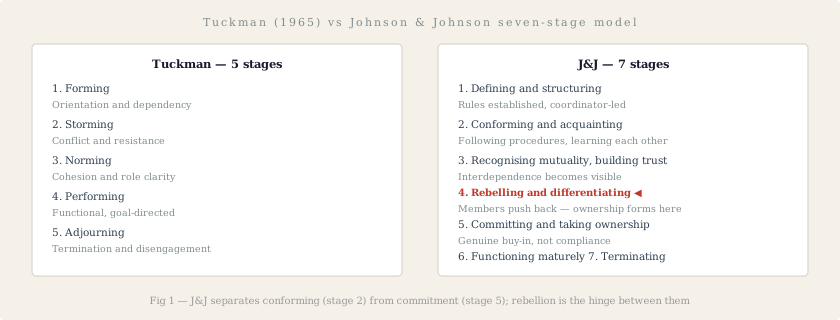
The seven-stage model
Johnson and Johnson's seven-stage model was developed specifically for task-focused groups with active coordinators — closer to the conditions of an agile team than anything Tuckman reviewed. It distinguishes two stages that Tuckman treats as continuous: conforming (stage 2) and committing (stage 5). Between them sits the stage that Tuckman merges into storming and norming — and that agile coaches most often suppress.
Stage 1 — Defining and structuring
Members establish rules and understand what is expected. Coordinator-led.
Stage 2 — Conforming and acquainting
Members follow procedures and learn each other. Dependency on the coordinator is high.
Stage 3 — Recognising mutuality and building trust
Members begin to see that they need each other. Trust begins to develop.
Stage 4 — Rebelling and differentiating(the pivotal stage)
Members assert individual preferences and challenge imposed norms. Necessary for genuine ownership.
Stage 5 — Committing and taking ownership
Members accept the goals and procedures as their own. Compliance becomes commitment.
Stage 6 — Functioning maturely and productively
Members work flexibly and effectively together toward shared goals.
Stage 7 — Terminating
The group's work concludes. Members disengage from roles and relationships within it.
What the rebellion stage looks like in agile teams
In the J&J model, stage four is described as rebelling and differentiating. Members assert their individual perspectives, challenge imposed norms, and resist the coordinator's authority — not as dysfunction, but as the developmental act through which genuine ownership becomes possible. The key word is differentiating: members cannot own something they have not first had the opportunity to push against.
In agile teams, the rebellion stage often looks like this:
Challenging the sprint goal framing after it was apparently agreed.
Questioning why this retrospective format exists when another would be better.
Asserting a personal preference about how the work should be organised.
Refusing a norm the team adopted in its first week without ever discussing it.
Naming a disagreement that has been present for weeks but stayed indirect.
Each of these can look like resistance, low engagement, or difficult personality. Most coaches respond by facilitating toward agreement. That response is understandable. It is also what prevents the team from reaching stage five.
What happens when rebellion is suppressed
When the rebellion stage is smoothed before it runs its course, teams produce pseudo-commitment: agreement that persists as long as conditions are stable and evaporates as soon as pressure rises. Working agreements are followed in the presence of the coach and gently discarded without them. Sprint goals are accepted without ever becoming genuinely wanted.
The pattern looks stable from the outside. It has no tensile strength because it was never negotiated — only accepted. The team moved from conforming (stage 2) to a permanent version of conforming that looks like the mature stage but lacks its depth.
Rebellion vs genuine dysfunction
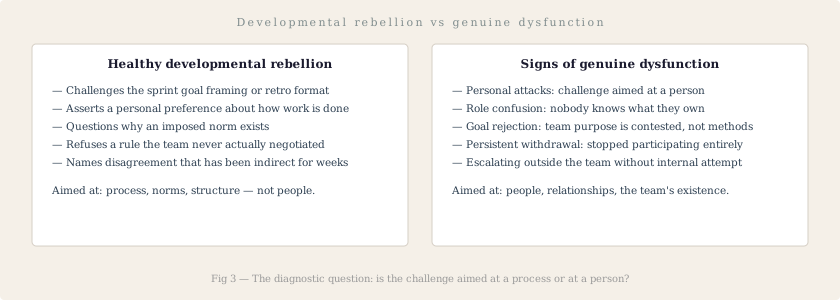
Not everything that looks like rebellion is developmental. The diagnostic question is whether the challenge is aimed at a process or a person, at an imposed norm or at the team's existence itself.
Healthy developmental rebellion
— Challenging the sprint goal framing after it was apparently agreed.
— Questioning why this retrospective format exists when another would be better.
— Asserting a personal preference about how the work should be organised.
Signs of genuine dysfunction
— Personal attacks — the challenge is aimed at a person, not a process.
— Role confusion — nobody is clear what they are responsible for.
— Goal rejection — members do not accept the team's purpose, not just its methods.
— Persistent withdrawal — the person has stopped participating rather than pushing back.
Coaching through the rebellion stage
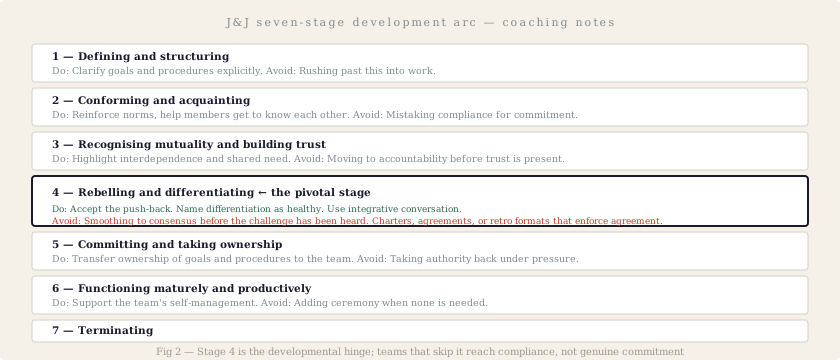
The coach's task at stage four is to accept rather than smooth. That means naming the differentiation as legitimate: "It sounds like you want this to work differently than we've set it up — say more about that." It means using integrative conversation (what can we negotiate here?) rather than consensus pressure (can we find something everyone agrees with?).
Three things to avoid at this stage: retro formats that structure the conversation toward agreement before the disagreement has been heard; team charters written in the forming stage and presented as settled when they haven't been tested; norms imposed by the coach or process rather than negotiated by the members themselves.
The rebellion stage is not a problem the coach needs to solve. It is the developmental act through which the team moves from following the process to owning it. Suppressing it doesn't prevent conflict — it stores it.
Continue Exploring
Go deeper into the work
The Book
The Art of Creating Self-Organizing Teams
The full framework behind this article — contracting, team dynamics, and practical coaching tools for every stage of the journey.
Companion Toolkit
Resistance Radar & Resilience Scorecard
Practical tools for mapping resistance patterns and measuring whether interventions increased capacity — not just compliance.
TA for Agile
Co-creative TA in Agile Contexts
Ego states, psychological contracts, group imago, and the relational concepts that underpin this article — applied to real teams.