The team that kept failing in the same way
Third retrospective in six months. The working agreements are on the wall — drafted carefully in session two, revised once after a frank conversation about decision rights, visible in every session since. The retrospective format has rotated through three variations: sailboat, 4Ls, start-stop-continue. Sprint planning runs noticeably tighter now, with clearer ownership and less time lost to the ambient ambiguity about who handles what at the boundary between front-end and back-end work. The action items from today's session are well-formed: better communication when a technical risk is spotted early, more explicit ownership on trade-offs, a shared agreement to raise deadline concerns before they become deadline failures rather than after.
The coach drives home and does something coaches rarely admit to: she counts. Three retrospectives in six months, each producing variations on the same four action items. Not identical — the wording shifts, the priority order changes, the format changes. But the underlying pattern holds. The same topics never surface unless she surfaces them. The same person's read on technical risk functions as final, regardless of what the working agreements say. The same sideways glance when a deadline looks tight, followed by the same collective decision to absorb the problem quietly rather than name it in the room.
She is a good coach. The interventions are correct at the level she's applying them. That turns out to be the problem.
When a team absorbs a sound intervention without changing, the first instinct is to examine the intervention: was it poorly timed, badly facilitated, wrong for the team's developmental stage? Sometimes the answer is yes, and adjusting the approach is enough. But sometimes the team genuinely receives an intervention well — the retrospective generates real energy, the working agreement is sincere, the SM facilitates differently for three sessions — and then, quietly, without any visible decision, the team returns to where it was. The new habit loosens. The old pattern reasserts. Six months later: the same room, the same exchange, slightly different wording.
Behavioral change operates on what the team does. Something else is determining what the team believes it has to do. Something running below the level at which the coaching is working.
This is the fifth article in a series examining the structural layers a coach must learn to read. Article 4 looked at the power the coach carries — often invisibly, often at the team's expense. This article goes one layer deeper, into the story the team carries. Not a metaphor for team culture, not a synonym for norms or group identity — something more specific. What if a team, as a collective, holds a foundational belief about what it is for, what threatens it, and what it must do to remain intact? And what if that belief — formed at the team's origin or under its first major crisis — runs beneath every retrospective, every ceremony, every coaching conversation, determining which of the coach's interventions will be absorbed and which will be quietly discarded?
That is the question this article works with.
Script theory and the theoretical extension
Eric Berne, writing in the early 1960s, described the individual life script as a plan formed in childhood under parental influence and later reinforced by experience. Fanita English sharpened the concept considerably. In "Whither Scripts?" (1988), she focused on what she called the survival conclusion — the decision a person makes under early existential pressure about what they must do and who they must be in order to continue existing.
The word "survival" is load-bearing here. This is not a preference, not an attitude developed through socialization, not a learned pattern that mild feedback can adjust. It is a conclusion reached when existence itself felt at stake — and an organizing principle adopted because it seemed, in that moment, to be what survival required.
"The script is not a preference or a style. It is a survival conclusion — a decision made under pressure about what one must do, and who one must be, in order to go on existing. Once formed, it resists revision because revision carries the felt sense of the original threat returning."— Fanita English, "Whither Scripts?" (1988)
The clinical literature built on this concept describes individual psychology. A person under early existential pressure reaches a conclusion about survival. That conclusion becomes the template through which subsequent experience is interpreted. Behaviors that contradict it feel dangerous; behaviors that confirm it feel necessary, even when the original pressure lifted long ago.
What follows here is a practitioner's extension of that framework to the level of the team as a collective subject. This is not established in the literature. Script theory, as developed by Berne and English, describes individual human beings — their life plans, their survival decisions, their defensive structures. The extension to teams is a practitioner's argument, not a theoretical claim with literature support. I am making the argument, not reporting a consensus.
The argument is this: teams — particularly at their formation or under early existential crisis — produce something functionally analogous to an individual survival conclusion. A collective decision about what the team is, what it must do, and what threatens it. Formed under pressure, adopted as the organizing logic of collective behavior, and resistant to revision precisely because revision carries the felt sense of the original threat returning.
One careful distinction before going further. A team-level script is not an aggregate of individual scripts, and it is not a shared individual experience. A team can contain people with entirely different personal life positions — the risk-taker and the conflict-avoider, the optimist and the catastrophist — and still operate as a collective with a coherent, consistent survival conclusion. The script belongs to the system, not to its members. Individual members exit and new ones join; the script persists.
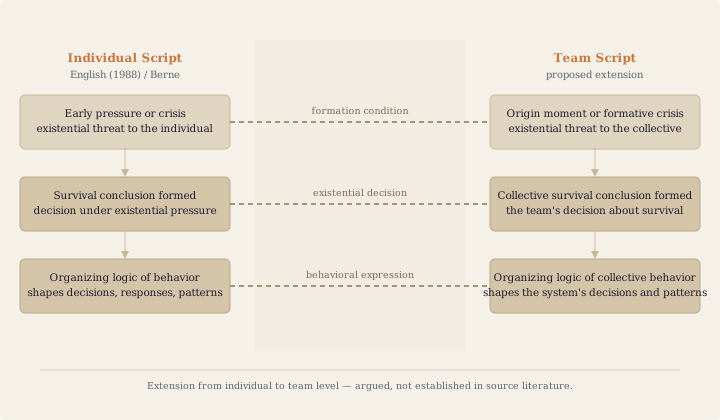
Two questions follow from this. First: how does a team-level script form? Second: once a coach has identified one, what does working with it actually look like? The rest of this article addresses both.
How a team script forms
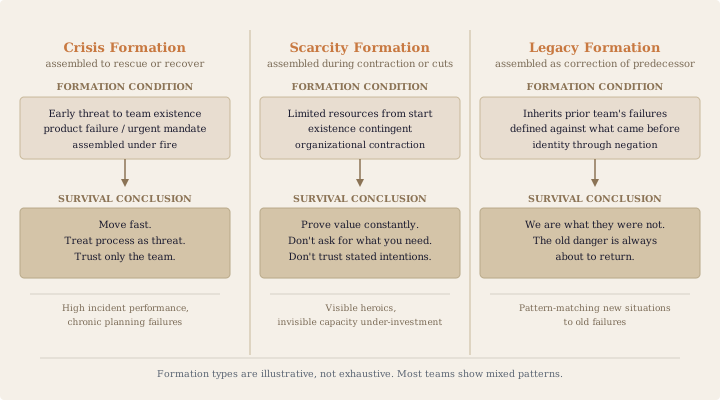
Scripts form at origin. The circumstances under which a team is assembled carry information that becomes encoded in the team's operating assumptions before any retrospective has been run, any working agreement produced, any coaching relationship established. A team formed to solve a stable problem operates differently from a team formed to save a failing one — not because their members have different skills, but because the founding conditions wrote different survival conclusions.
A team assembled because something is failing and must be rescued carries a particular kind of initial pressure. The problem is already in the room when the team shows up. Every early decision the team makes — about how to communicate, about what process to use, about who to trust and who to escalate to — is made under this pressure. The survival conclusion that forms here typically runs: move fast, trust each other and no one outside the team, treat any process that slows delivery as a threat to the mission. This team will often perform at a high level in the short term. It will become difficult to work with in the medium term. The conclusion that made it effective in the crisis makes it resistant to the systematic, considered investment that sustained delivery requires.
A team assembled during a period of organizational contraction — a restructuring, a round of cuts, a program defunded down to a skeleton — forms under a different kind of pressure. Resources are limited from day one. The team's existence may itself be contingent on demonstrating value quickly. The survival conclusion here typically runs: prove your value constantly, do not ask for what you need because that signals weakness, do not trust the organization's stated intentions because they have already changed once. This team will often do visible, impressive work. The investment it cannot make is in its own capacity — in training, in process improvement, in slowing down to get better. That investment carries the felt sense of the original threat: scarcity, exposure, vulnerability.
A team assembled as the correction of a predecessor has its identity shaped, from the first day, by what the previous team was. The failure of the predecessor is the founding narrative — the reason this team exists. The survival conclusion: we are what they were not, and the danger they failed to see is always about to return. This team will often be alert and conscientious. The thing it cannot easily do is treat novelty as genuinely novel. New leadership initiatives, new methodologies, new organizational structures will be assessed against the predecessor's experience before they are assessed on their own terms. The predecessor becomes a permanent template for threat.
None of these teams chose their survival conclusion. The conclusion formed because the conditions required a response, and the earliest collective responses became the template. By the time a coach arrives — often a year or more into the team's life — the template is invisible. The team does not experience it as a decision. It experiences it as the obvious way things are done here.
The temporal problem is what makes script-level work difficult. The product gets rescued. The restructuring ends. The predecessor team recedes into institutional memory. The survival conclusion stays. A team can be operating in a genuinely stable, well-resourced, forward-looking context while running a survival logic formed in an emergency that ended eighteen months ago. The behavioral expressions — the resistance to process, the inability to ask for support, the hypervigilance about organizational change — look like character flaws or cultural problems. They are neither. They are present-tense behavior driven by past-tense conclusions. The team is operating in present tense with a script written in past tense.
Reading the script
There is a difference between the content of a survival conclusion and its expression in the room. The content is the underlying decision: we survive by moving fast, or by proving our value, or by holding to what has failed before and naming every new thing as its potential repetition. The expression is what the coach sees in a given session: a team that treats sprint planning like a triage exercise, or that chronically over-delivers on visible metrics while under-investing in its own capacity, or that approaches every new framework with a mixture of procedural compliance and covert skepticism. Reading one from the other is possible, but it requires a different quality of attention than behavioral observation — not what the team does, but what the team keeps doing, under what conditions, with what emotional register.
The pattern that reasserts after intervention
The clearest diagnostic is the one the coach encounters most often without naming it: genuine improvement after a sound intervention, followed by gradual return of the pattern. Not because the team rejected the intervention. Not because anyone actively decided to go back. The new working agreement simply stops being used. The SM, noticeably more confident, defers in the fourth session. The improved retrospective format produces safe, surface-true content three weeks running. What returned is not a behavior the team chose. It is the survival conclusion routing itself through new behaviors, the same way a river that is temporarily diverted eventually finds its level again.
This is the moment the coach described driving home from the third retrospective. The intervention was absorbed. The pattern reasserted. That reassertion is the survival conclusion maintaining itself against change — not actively, not deliberately, but structurally.
The team's emotional response to process
Crisis-formation teams don't respond to process neutrally. They experience it as drag — something that stands between them and survival. This shows up as mild contempt for structured planning, as a collective pivot toward "what do we actually need to ship" when the planning session is most needed, as a subtle restlessness when the retrospective is going carefully rather than quickly. The process isn't wrong and the team knows it. The survival logic says process is what you do when you're not in a crisis, and this team never fully stops being in a crisis.
Scarcity-formation teams experience process differently: as luxury. The emotional signature is patient compliance that doesn't go anywhere. They will run the retrospective. They will produce the action items. What they will not do is invest real capacity in the improvement, because investing capacity when resources are scarce was the thing the survival conclusion was formed to prevent. Legacy-formation teams bring watchfulness to process — alertness for the ways the new thing could turn into the old thing — that shows up as a particular quality of deliberateness, a careful comparison of what is being proposed against what was tried before and failed.
Collective narrative about the outside
Ask a crisis-formation team about their stakeholders and you will hear a version of the same story: stakeholders don't understand what delivery actually requires, or they change requirements too frequently, or they're not available when real decisions need to be made. Ask a scarcity-formation team and you will hear that leadership says the right things but the resources never actually arrive, the priorities shift without warning, the stated commitment is not matched by what's funded. Ask a legacy-formation team and you will hear about the decisions made above the team's level that caused the predecessor's failure.
The consistency of this narrative across different individuals, different meetings, and different contexts is more diagnostic than its content. Every team has legitimate grievances about the organization it sits inside — that's just accurate observation. What marks a survival-conclusion-driven team is the remarkable uniformity of the grievance: the way it returns in the same form regardless of the specific situation, as if it is being generated by something more durable than the current facts.
Who gets to speak for the team
The people who most fluently express the survival conclusion carry the highest informal authority in a survival-conclusion-driven team. Not formal authority, not technical seniority, but the authority that comes from naming the team's experience more accurately than anyone else does. In a crisis-formation team, this is typically the person who was present during the original crisis — or who most accurately reads the room's anxiety and names it in the urgency register. In a scarcity-formation team, it is often the person most attuned to what leadership is actually doing rather than saying. The coach can partly identify the team's survival conclusion by identifying whose framing the team reaches for when situations are unclear, and what survival logic that framing carries.
A platform engineering team at a financial technology company. Eight people, assembled eighteen months earlier when the previous platform collapsed under load during a major product launch. Three of the current members had been on the old team and were still in the room when the CTO gave the mandate: fix it, fast, and make sure it never happens again. The team had performed well by every incident response metric since. It consistently missed its planning-dependent milestones.
A coach was brought in after the third consecutive quarter of OKR slippage in the delivery dimensions. The retrospectives were genuine — the team engaged, the action items were specific, the SM ran the sessions well. Action items were generated around estimation quality and backlog refinement. Ninety days later, the same pattern. The coach noticed something consistent across three planning sessions: at a particular point in every session, the conversation changed register. The careful collaborative consideration of trade-offs gave way to a collective pivot toward what the team was certain it could ship, conducted at a different pace, with a different texture. The session didn't fail — it produced outputs. But the outputs were what urgency produced wearing planning's format.
The coach stopped the next planning session at the moment of pivot. Not to diagnose the team or deliver an observation about their process. She asked: "When does this team feel most alive?" There was a beat of silence before the answer came — immediate and unanimous: when something is breaking. When there's a real problem that needs solving right now. She held that answer without judgment and asked a second question: "What would it mean for the team if nothing were breaking?" The room went quiet in a different way. Not the silence of a team that doesn't have an answer. The silence of a team that has just glimpsed, for the first time, something it has been carrying without knowing it was carrying it.
The coach did not name the survival conclusion in that session. It didn't need a name yet. It needed to be felt as a question.
Reading the survival conclusion is not diagnosing pathology. Most teams carry one — it is the ordinary result of forming under pressure in organizational conditions that are rarely neutral. The question is not whether a team has a survival conclusion but whether the conclusion it formed is still useful in the context it currently occupies.
Three levels of intervention
Working with a team-level script requires operating at three distinct levels. The levels are drawn from English's framework for individual survival conclusions and adapted here for the team context — in keeping with the extension argument this article is making. Each level addresses something different and requires different things from the coach. They tend to be sequential in logic, though not always in practice: access to the deeper levels typically requires some work at the more accessible ones first.
The triggering scene
A survival conclusion is not running continuously. It is activated by specific kinds of situations, and the triggers vary by formation type. Crisis-formation teams activate under constraints: a deadline moved forward, a resource removed, a new process requirement added. The constraint doesn't have to be large. The survival logic responds to the category, not the magnitude — anything that reads as slowing delivery triggers the response. Scarcity-formation teams activate under visibility: a request for a report to senior leadership, a reorganization announcement, a review of the team's value to the program. Legacy-formation teams activate under novelty: a new methodology introduced, a new leader assigned, a significant change to the team's scope or mandate.
Working at this level means helping the team see the trigger as a trigger — not as the reality it appears to be. The constraint is real. The reorganization is real. The question is whether the team's response is calibrated to the present situation or to the existential position formed in the founding conditions.
The coach's tool at this level is naming as question: "I notice this conversation shifted register when the new reporting requirement came up. What is the team reading that situation as?" The question is not interpretive — the coach is not telling the team what the trigger means. She is inviting the team to observe its own response. That observation, offered as a question rather than a diagnosis, is often the first moment the survival logic becomes visible to the team as something other than obvious reality. This is the most accessible level of work. It doesn't require a long relationship or high accumulated trust. It requires attentiveness to the moment the room's temperature changes, and the willingness to name it without loading the naming with clinical content.
The script decision
This is the deeper work. It requires more accumulated trust, more time, and a different quality of patience. Working at the level of the script decision means making the invisible decision visible — not as a pathology the team suffers from, but as a historical response to a real situation that the team is no longer in.
The key move is temporal. The coach helps the team hold both the context in which the survival conclusion was formed and the context the team currently occupies. "When this team was assembled — when the platform had failed and there was a mandate to fix it in ninety days — what did the team conclude it needed in order to survive that? Is that conclusion still accurate?" The question is genuine, not rhetorical. The coach is not trying to demonstrate that the old conclusion is wrong. She is inviting the team to test whether the old conclusion fits the current situation.
This is not a single conversation. A team that has been running a survival conclusion for eighteen months will not resolve it in one retrospective. The thread of the question lives across multiple sessions. The team will move toward the answer — recognizing the pattern, naming the founding pressure, acknowledging that the original conditions have changed — and then, in the next session, will be somewhere else entirely, back in the operational urgency of the current sprint. The coach holds the thread. She returns to it without pushing. One thing she is not doing: delivering a framework to the team or asking them to think in terms of survival conclusions. The language belongs in the coach's conceptual toolkit, not in the room. The team needs the questions the theory generates, not the theory itself.
The permission
In English's clinical framework, permission is specific: the therapist offers an explicit statement that the client is allowed to exist, to succeed, to act in ways the script has prohibited. The client's script says "I am not allowed to take up space." The therapist says, directly, that they are. The permission names the prohibition and overrides it with the therapist's authority.
Adapted for the team context, permission is the coach's offer of a different existential possibility. But it almost never takes the form of an explicit statement. What a team needs to hear — that it is allowed to invest in its own capacity, that it is allowed to trust stated intentions, that it is allowed to treat this new framework as genuinely new rather than as the last one in different clothes — cannot be said once and expected to land. Permission at the team level is demonstrated, not declared.
What that looks like in practice: the coach who works with a scarcity-formation team consistently treats capacity investment as legitimate, not as a luxury to be earned once everything else is stable. When the team says it doesn't have time to improve its practices, the coach doesn't accept that framing — not confrontationally, not by arguing with the team's read of the situation, but by not confirming it. She keeps treating the question of capacity as real and answerable. The coach who works with a crisis-formation team models process as safety rather than drag. The coach who works with a legacy-formation team responds to new initiatives without mapping them to the predecessor's failure. Permission accumulates through the coach's consistent orientation toward the team's actual possibilities, against the grain of the survival logic's limitations.
This is the slowest of the three levels. It cannot be installed in a session or delivered in a conversation. It is built through the coach's behavior across months — and it is also the most durable. When it takes, it changes the team's sense of what is permitted here in ways that survive the coach's eventual departure.
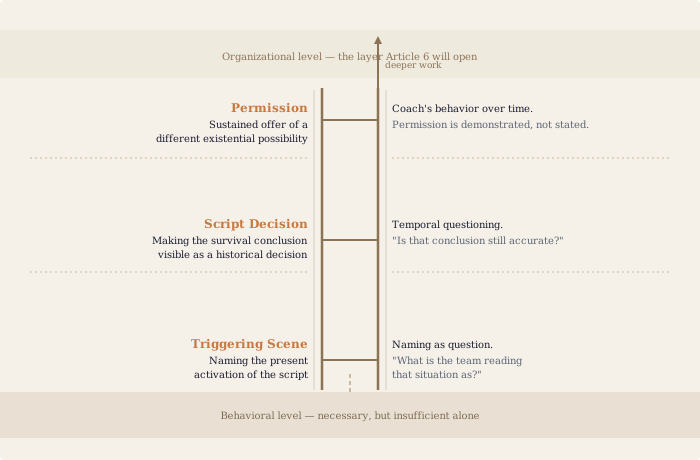
Working only at the behavioral level — introducing better retrospective formats, coaching the SM on facilitation, improving the quality of sprint planning — addresses the expression of the survival conclusion but not the conclusion itself. The team learns new behaviors. The survival logic eventually finds new behaviors to route through. Behavioral change is necessary. It is not sufficient when the conclusion driving the behavior has not been addressed.
Why behavioral coaching fails here
Behavioral coaching is correct at the level it operates on. Well-facilitated retrospectives, thoughtfully produced working agreements, coaching conversations that help an SM develop genuine facilitation skill — these are real improvements. Most of what coaches encounter is behavioral, and most behavioral coaching is good practice. The problem that script-level dysfunction creates is not that the tools are wrong. It is that they are aimed at the wrong level of the system.
The survival conclusion is not a behavior. It is the organizing principle from which behaviors are generated. Addressing the behavior while leaving the organizing principle intact produces the pattern the opening section described: genuine short-term improvement, gradual return of the original dynamic, the coach left with the unsettling sense that the work didn't hold.
Consider the crisis-formation team that keeps short-circuiting its own planning process. Every planning session escalates toward urgency; the careful consideration of trade-offs gets quietly abandoned in favor of what can definitely ship. A behavioral intervention addresses this as a facilitation problem: the coach works with the SM on holding the planning container, on redirecting when the conversation escalates, on producing cleaner outcomes at the close. The SM improves. The facilitation improves. Then, six weeks later, a stakeholder deadline moves by two days and the next planning session runs on urgency again. The survival conclusion — process is what you do when survival isn't at stake — simply waited for the next triggering event.
There is a clinical analogy worth naming, and worth qualifying immediately. In individual TA work, script change requires operating below the behavioral level — at the level of the script decision, the survival conclusion, the early existential position. The same logic applies here. But the coach is not a therapist and the team is not a patient. The team's survival conclusion is a structural feature of a system shaped by organizational conditions, not a mental health phenomenon. The analogy is structural, not clinical. The team does not need therapy. It needs a coach who recognizes that some patterns are not behavioral in origin.
A policy development team formed at a government agency from the merger of two separate departmental units. Officially a strategic alignment — combining complementary capabilities under a shared mandate. In practice, one unit had been targeted for defunding and was absorbed rather than closed. Four of its members joined the surviving team. The organizational narrative was forward-looking: new team, new mandate, new ways of working. The surviving members experienced the merger as a validation of their unit's value. The four absorbed members experienced it as a near-extinction event. The team had never acknowledged this difference.
An experienced coach was engaged to help the team develop clearer ways of working. She facilitated two workshops on communication norms, produced a team charter with the team's genuine participation, and agreed on a working agreement. The team engaged constructively throughout. Within six weeks, the absorbed members were quietly working around the charter and the surviving members were politely enforcing it. A process retrospective generated action items around consistency and accountability. Within a month, the pattern had returned.
The coach met informally with people from the two original units separately — not announced as sub-group meetings, just individual conversations about how things were going. In those conversations, she heard two entirely different accounts of what the team existed to do and what it was currently fighting for. The absorbed members were still in the experience of near-extinction: protecting what remained of their unit's perspective, not fully trusting that the merged team's leadership had their interests at heart. The surviving members were operating from a different story entirely — managing a successful integration, building something new. Two survival conclusions, two teams, one working agreement.
The coach brought this back to the full team — not as a diagnosis, not with a framework attached. "I've been hearing two different accounts of how this team came to exist, and what it's here for. I think we need to tell those stories in the same room."
The working agreement did not fail because it was poorly designed. It failed because it was written on top of a story that hadn't been told yet.
Before designing a behavioral intervention for a team that keeps producing the same dysfunction, the question worth sitting with is: what survival conclusion might this team have formed, and is the behavior I am seeing an expression of that conclusion rather than its own cause? If the answer is yes, the behavioral intervention is still worth doing. But it needs to accompany work at the level below.
The story is not the sentence
This article has argued that teams carry foundational survival conclusions formed at their origin or under early existential crisis, that these conclusions operate below the level of behavior, and that behavioral coaching alone cannot address them. It has not argued that survival conclusions are permanent, that coaches are powerless in the face of them, or that every dysfunctional pattern in every team is a script-level phenomenon. Not every recurring problem is a survival conclusion. Not every pattern that reasserts after intervention is existential in origin. The diagnostic skill is telling the difference — recognizing which of the team's patterns are behavioral in origin and addressable at that level, and which are being generated by something older and more durable.
Script-level work becomes possible under specific conditions. The coach has enough accumulated trust and time with the team to hold a thread across multiple sessions without losing the team's confidence. The team has encountered the limits of behavioral intervention enough times to be genuinely curious about what else might be operating — not just intellectually open to the idea, but experientially motivated to look. The organizational context is not actively reproducing the survival conclusion from above. That last condition matters more than it might appear. A team formed under crisis conditions will find it very hard to move off a crisis-formation script if the organization keeps generating crisis conditions. A scarcity-formation team will struggle to revise its survival conclusion if the organization's actual resource allocation confirms it every quarter.
That last point marks the edge of what this article can address. If a team's survival conclusion is often authored or reinforced by the way the organization assembled it, positioned it, and continues to treat it, then working with the team alone is a partial intervention. The managers the Agile structure has left without a clear role, the organizational dynamics that sit between the team and senior leadership and shape both: these are the next level of the same question. Article 6 in this series will open that territory.
The story the team was born into is not the story the team has to keep telling. But the coach cannot change that story by improving the team's retrospectives. The work starts a level lower.