The Task and the Tribe: Why Every Agile Team Is Simultaneously Two Different Things
Every Agile team is, at the same moment, two distinct systems with incompatible requirements. The task system demands openness, adaptation, and engagement with the external environment. The sentient system — the team as a tribe — protects belonging, guards identity, and resists exactly the disruption the task requires. Coaches who see only the task level misread resistance. Coaches who see only the relational level enable avoidance. The diagnostic question is always: is this behaviour protecting the work, or protecting the tribe?
The component that nobody could move
The team had been trying to reassign ownership of a legacy payment service for three sprints. Technically, the decision was straightforward: the service had grown beyond the scope of the team member who originally built it, and distributing the work made delivery sense. No one disputed this. And yet, every sprint planning session produced the same result — a brief discussion, a vague agreement, and no actual change. The component stayed where it was. The team moved on.
The coach spent two sessions trying to understand the technical concerns being raised. They were real but minor. In the third session, something shifted: the coach stopped asking about the component and started asking about the person. What did it mean to hand over work you had built from scratch? What happened to your standing in the team when the thing you were known for no longer lived in your queue? The room changed. The team member said, very quietly, that they weren't sure what they would be for if they didn't own that service. The decision was made within twenty minutes and held.
Two systems, one team
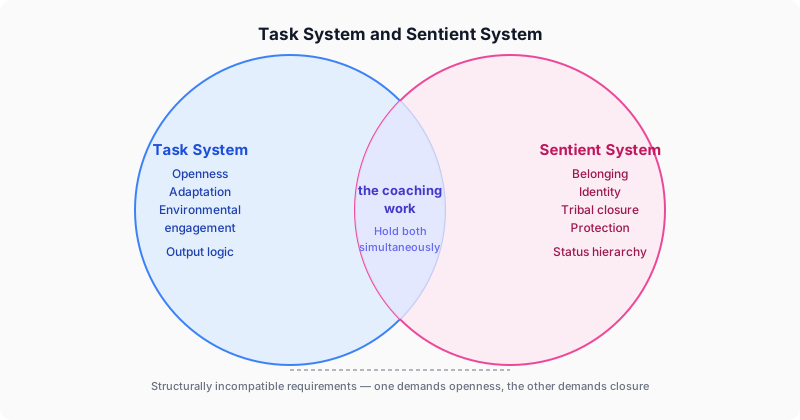
Eric Miller and Ken Rice, working at the Tavistock Institute in the 1960s, proposed a distinction that remains one of the most practically useful frameworks in organisational consulting. Every group that does work together is simultaneously two different systems: a task system and a sentient system.
The task system is the team as it appears in the org chart, the sprint board, and the team charter. It exists to produce outputs. Its logic is instrumental: what needs to happen, who is responsible, what counts as done. It has boundaries defined by accountability and function, and its relationship with its environment is necessarily open — it must engage with customers, stakeholders, and changing requirements to survive.
The sentient system is the team as a tribe. It exists to generate belonging, shared identity, and emotional safety. Its logic is relational: who are we, who is one of us, what do we protect. Its relationship with its environment is necessarily more closed — the tribe maintains itself by distinguishing members from non-members, insiders from outsiders. The sentient system is not a pathology. It is a functional property of any group that has existed long enough to develop a shared sense of itself.
These two systems coexist in every Agile team, all the time. The daily standup is simultaneously a task-system coordination event and a sentient-system ritual confirming membership and hierarchy. The retrospective is simultaneously a structured improvement process and a tribal ceremony that reinforces who is trusted, who is silenced, and what the group's taboos are. Sprint planning is simultaneously workload allocation and negotiation of status.
The incompatibility at the centre
The problem is that the two systems have structurally incompatible requirements. The task system demands openness: it must be permeable to feedback, adapt to changing requirements, incorporate new members quickly, and distribute work to where capability exists regardless of history or ownership. Left to its own logic, the task system would be in a constant state of reconfiguration.
The sentient system demands closure: it must protect membership identity, resist disruption to established patterns, maintain the status hierarchy that has developed over time, and keep the tribe coherent in the face of the environment's demands. Left to its own logic, the sentient system would resist every significant change.
Every significant team decision activates both systems simultaneously. Assigning a new feature to a different team member is a task-system decision. It is also a sentient-system event that threatens established status, disrupts the tribal understanding of who owns what, and requires the group to renegotiate identity. The component ownership dispute described above was never primarily about the component. It was about what owning the component meant to the person who built it, and what it meant to the team that they were one of the people who built things.
Five recognisable manifestations in Agile teams
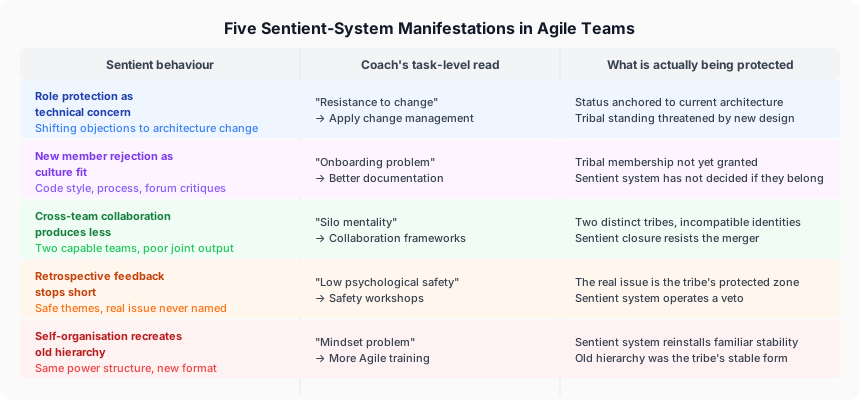
Once you can see the two-system dynamic, you start recognising it everywhere. These are the five patterns that coaches most frequently encounter and most frequently misread.
Role protection presented as technical concern. A team member raises persistent objections to a proposed architectural change — not on technical grounds that can be addressed, but on grounds that shift each time they are addressed. The technical concern is real but secondary. The primary driver is sentient: this person's standing in the team is anchored to their expertise in the current architecture. Changing the architecture changes their status. The tribe, which understands this even if it doesn't name it, repeatedly lets the objection succeed.
New member rejection presented as culture fit. A new team member is technically capable and professionally appropriate, but the team consistently finds reasons why their contributions are slightly off — the code style isn't quite right, they didn't follow the implicit process, they raised something in the wrong forum. No individual instance is significant. Collectively, they amount to a tribal rejection of someone who has not yet been incorporated into the sentient system. The task system needs them. The sentient system has not decided whether they belong.
Cross-team collaboration that produces less than individual work. Two teams that work well separately produce worse outcomes when they work together. The task systems are compatible. The sentient systems are not — each team is a distinct tribe, with its own identity, its own hierarchy, its own vocabulary, its own norms. Collaboration requires both sentient systems to partially suspend their self-protecting closure, and they typically cannot do this without help.
Retrospective feedback that stops just short of the real issue. The team raises themes in retrospectives — "communication could be better," "we need clearer priorities," "some stories are too big" — that are true but not the real issue. The real issue — a specific person's behaviour, a power dynamic, a historical decision that nobody wants to revisit — is the sentient system's protected zone. The tribe knows the rule: we don't say that here. Every retrospective format in the world will not surface it because the sentient system is operating a veto.
Self-organisation that recreates the old hierarchy. The team is given autonomy to self-organise. Within two sprints, the informal structure that has emerged is a near-replica of the formal hierarchy that was removed. The same people are directing, the same people are deferring. This is not resistance to Agile values. It is the sentient system reinstalling its familiar authority structure because the sentient system's primary concern is the stability of the tribe, and the old hierarchy was the stable form the tribe knew.
What coaches do wrong
Coaches trained primarily in process frameworks — and most Agile coaches are — attend primarily to the task system. They read team behaviour against task-system criteria: is the team delivering, are the ceremonies functioning, is the backlog healthy, is the velocity sustainable? This is legitimate and necessary. It is also insufficient.
When sentient-system dynamics appear, the process-oriented coach typically reads them as irrational. The component ownership dispute becomes "resistance to change." The new member difficulty becomes "culture problems." The cross-team friction becomes "silo mentality." Each of these labels is accurate from the task-system perspective and actively unhelpful, because the label immediately suggests an intervention — a change management approach, a culture workshop, a collaboration framework — that operates entirely at the task level and will not touch the sentient dynamic.
The opposite error is equally available, and equally common in coaches with more relational training. The relational coach sees the sentient dynamic and attends to it almost exclusively — the retrospective becomes a feelings conversation, the team development work becomes group therapy, and the task recedes into the background. This produces a different kind of failure: the team develops genuine warmth and insight while continuing to underdeliver, and the coach's authority erodes because they are no longer useful to the work.
Both errors share a common root: seeing only one system.
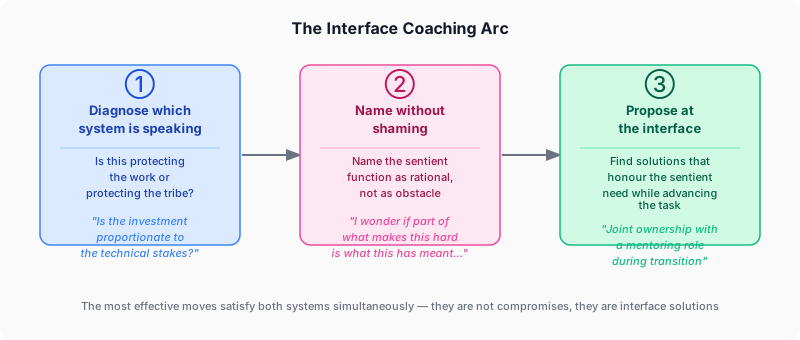
Three coaching moves
Diagnose which system is speaking before intervening. Before choosing a response, ask: is this behaviour primarily protecting the work, or primarily protecting the tribe? This is not always easy to determine, but the attempt to ask the question shifts the coach's attention from the surface content of what is happening to the systemic function it is serving. Role protection dressed as technical concern sounds like a technical conversation. It feels like something else — there is a quality of emotional investment that is disproportionate to the technical stakes. That disproportionality is the diagnostic signal.
Name the tribal function without shaming it. Once you have identified a sentient-system dynamic, the worst intervention is to confront it as irrational or resistant. The sentient system is not irrational — it is doing exactly what it is supposed to do, which is protect the tribe. The team member who cannot let go of the component is not being obstructive. They are doing what any person does when their standing in their community is threatened. Naming this — gently, tentatively, as a question rather than a diagnosis — invites the team into a more honest conversation than any process technique can open. "I'm wondering whether part of what makes this hard is what owning this has meant for you here" is a different kind of intervention from "it looks like we're having trouble with the handover process."
Work the interface — find proposals that honour the sentient need while advancing the task. The most elegant coaching moves in two-system situations are proposals that satisfy both systems simultaneously. The component can be jointly owned for a transition period, with the original builder in an explicit mentoring role — a proposal that creates a task-system solution while giving the sentient system a face-saving, status-preserving bridge. The new team member can be given a small project to own fully before being incorporated into existing work — a proposal that gives the sentient system time to incorporate them before requiring full integration. These are not compromises. They are proposals that are grounded in understanding what both systems actually need.
The tribe is the substrate, not the obstacle
The sentient system is easy to pathologise. Coaches trained in rational process improvement encounter it as the thing that resists good ideas, blocks obvious decisions, and frustrates straightforward interventions. It is tempting to frame it as the problem — the tribal dynamics that stand in the way of high performance.
This framing is both accurate and completely wrong. The sentient system is the social substrate that makes the task system possible. The team's willingness to take risks with each other, to raise difficult things, to do the unglamorous work, to stay in difficulty together rather than escalate or leave — all of this depends on the sentient system functioning. A team with no sentient cohesion is a group of individuals with a shared backlog. It is not a team.
The coach who cannot see the sentient system will keep trying to fix behaviour that is, from the system's perspective, entirely rational. The coach who can see both systems will find that the most difficult team situations contain, within the sentient resistance itself, the information needed to resolve them.
Continue Exploring
Go deeper into the work
The Book
The Art of Creating Self-Organizing Teams
The full framework behind this article — contracting, team dynamics, and practical coaching tools for every stage of the journey.
Companion Toolkit
Resistance Radar & Resilience Scorecard
Practical tools for mapping resistance patterns and measuring whether interventions increased capacity — not just compliance.
TA for Agile
Co-creative TA in Agile Contexts
Ego states, psychological contracts, group imago, and the relational concepts that underpin this article — applied to real teams.