The Time That Agile Cannot Measure
Agile operates entirely in chronos — sequential, measurable time. Transformation happens in kairos — the opportune moment when something becomes possible that was not possible before, and that will not remain possible if the moment passes. These moments cannot be scheduled, cannot be repeated, and will not wait for the next retrospective. The coach who is occupied with the agenda when one arrives will not notice it until it has gone.
The sprint that wasn't ready
Three weeks into the engagement, the coach could see that something important was forming. The conflict between the two senior developers — present from the beginning, acknowledged in the first retrospective and immediately de-escalated, since then managed carefully on the surface — was approaching the moment when it could actually be addressed. The signals were consistent: a particular quality of tension in the standup, the way certain decisions were being deferred rather than made, the conversation after the last retro that had gone somewhere new and then abruptly stopped.
The next coaching session was scheduled for the following week. Sprint planning was in two days. The moment that was forming would not wait for the schedule.
The coach rescheduled the session. The conversation that happened was not what she had planned. It was more important. The two developers said things to each other that had not been sayable in any of the previous sessions. Something shifted — not resolved, not closed, but genuinely shifted — that the planned session two days later could not have produced. The planned session could have happened on schedule. It would have been a competent session with the wrong conversation.
What the coach had read, and acted on, was a kairos moment: the moment when something becomes possible that was not possible before, and that will not remain possible if the moment passes. Understanding the difference between this kind of time and the clock time of the sprint calendar is one of the most important and least-taught competencies in Agile coaching.
Chronos and kairos — two kinds of time that Agile conflates
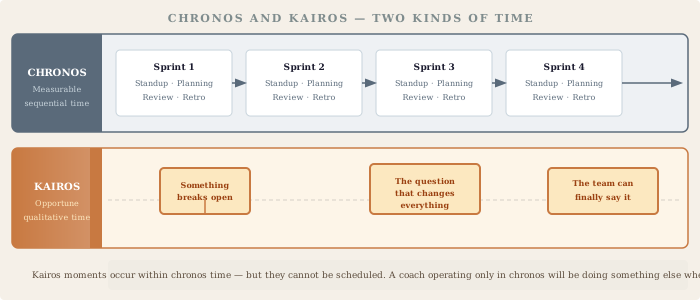
The ancient Greeks distinguished two kinds of time with two different words. Chronosis sequential, quantitative, measurable time — the kind that clocks track and calendars organise. One moment follows another in uniform succession. All moments are equivalent. Chronos is the time of schedules, sprints, and velocity.
Kairos is qualitative time — the right moment, the opportune moment, the moment that is different in kind from the moments surrounding it. Kairos is the time of ripeness: the moment when a fruit is ready to be picked, when a decision becomes possible that was not possible before, when something opens in a conversation that has been closed for weeks. Kairos moments cannot be scheduled. They cannot be repeated. They occur within chronos time, but they are not governed by it.
Paul Tillich gave kairos its most expansive philosophical treatment: the moment when eternity intersects history, when the unconditional breaks through the conditioned, when what is structurally true becomes momentarily accessible. This is the language of theology, but the structural observation it makes is applicable to the coaching context: there are moments in which what could not be said becomes sayable, what could not be seen becomes visible, what could not be changed becomes available for change. These moments are not distributed uniformly across time. They cluster unpredictably, they pass, and if missed they do not simply recur.
Agile operates almost entirely in chronos. The sprint is a fixed unit of time. Ceremonies are scheduled at regular intervals. Velocity is measured per sprint. Even retrospectives — designed for reflection — are timed events with defined outputs within defined windows. The system assumes that the work of the team — including the developmental work — is available for scheduling and that the right moment for it is the scheduled moment.
This assumption is wrong in a specific and important way. The developmental work of a team — the conversations that change something, the moments of recognition that make a different kind of work possible, the threshold crossings that cannot be planned — does not occur on schedule. It occurs when conditions are right: when enough trust has accumulated, when the pressure has reached a sufficient level, when the avoidance finally costs more than the confrontation. These conditions are not synchronised with the sprint calendar.
What kairos looks like in a team — and how to miss it
Kairos moments in team coaching do not announce themselves. They arrive in the middle of ordinary sessions, through the texture of a conversation that has been running on the surface and suddenly goes deeper. They arrive in what someone says in passing — a sentence delivered as an aside that carries more than its grammatical content. They arrive in silences that feel different from the silences that preceded them.
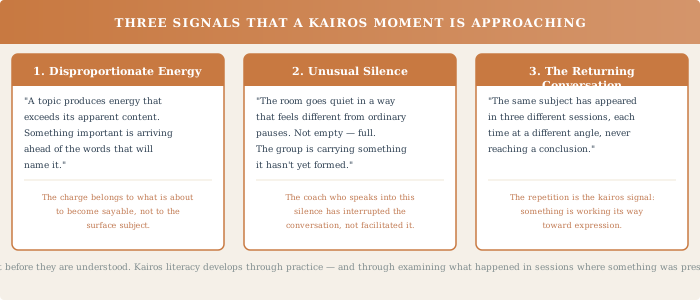
The first signal is disproportionate energy: a topic that generates charge beyond its apparent content. When a conversation about sprint planning suddenly becomes animated in a way that doesn't quite fit the planning question, something else is arriving through the available topic. The energy belongs to the thing that is about to become sayable, not to the surface subject.
The second signal is unusual silence — a quality of quiet that is full rather than empty. The silence that follows a session of difficult truth-telling is different from the silence that follows a planning discussion. The full silence signals that the group is carrying something it hasn't formed yet — that it is, in Bion's language, in contact with O: the unmetabolised experience that is not yet available as thought. The coach who speaks into this silence has interrupted a process rather than facilitated one.
The third signal is the returning conversation: the same subject that has appeared in three different sessions, each time at a different angle, never reaching a conclusion. The repetition is not a failure to progress. It is the kairos signal: the team is circling something that has not yet found the right moment for its expression. Each appearance is a partial approach. The accumulation builds the conditions under which the full expression becomes possible.
Missing a kairos moment is easy, and the costs are not immediately visible. The session proceeds according to plan. The planned conversation happens. Outputs are produced. Only later — in the next session, or the one after — does it become apparent that something that could have shifted has returned to the same position it was in before. The window was open and the coach was looking elsewhere.
The intervention that waited — and the one that didn't
The distinction between kairos responsiveness and simply abandoning structure is important. Not every moment of tension is a kairos moment. Not every energised conversation is pointing toward something the coach should pursue at the expense of the planned agenda. The coach who is chronically responsive to the room's energy without grounding in the team's developmental arc may be chasing stimulation rather than reading kairos.
What distinguishes a genuine kairos reading from reactive facilitation is the coach's contact with the team's developmental trajectory: the accumulated understanding of where this team has been, what it has been approaching, and what conditions are now in place that were not there before. The coach who has been paying attention to the pattern of avoidance — to what the team keeps almost addressing and then redirecting — recognises the moment when the pattern breaks because they have been tracking the pattern.
The intervention that waited — the rescheduled session in the opening story — was not reactive improvisation. It was the product of weeks of attention to a specific pattern in a specific team. The kairos reading was possible because the chronos observation had been consistent. Without the accumulated attention, there is nothing to distinguish a genuine moment of opening from ordinary session-to-session variation.
How coaches learn to read kairos moments
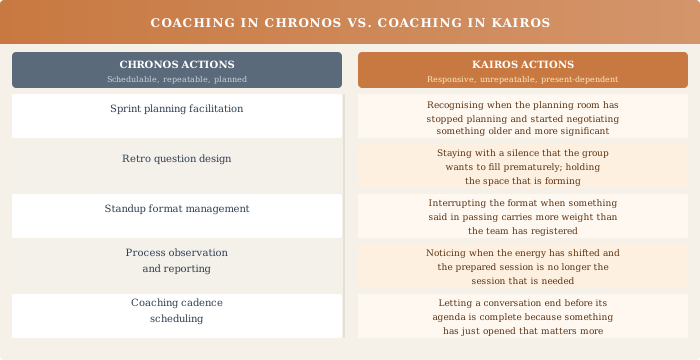
Kairos literacy is not taught in Agile coaching certification programmes. It is developed through practice and supervision, through the retrospective examination of sessions in which something was present and the coach responded to it or failed to. It is, in part, the ability to read one's own somatic response as information: the physical sense of something shifting in the room, the quality of alertness that arrives when a conversation goes below the surface.
Bion's concept of the present moment — the absolute O that supervision is designed to access — points toward the quality of attention that kairos reading requires. The coach who is monitoring the agenda, tracking time, managing the group's emotional temperature, and attending to process simultaneously may be too cognitively occupied to notice the texture of what is actually happening. Kairos reading requires a quality of receptive attention that is different from task-focused facilitation — a capacity to hold the structure lightly enough that what is not in the structure can be heard.
This is also why the coach's own developmental work matters for kairos literacy. The coach who carries unexamined anxiety about conflict will tend to miss kairos moments involving conflict — to redirect conversations at the point when they are approaching something genuinely difficult. The coach whose own experience of certain emotions is limited will not recognise them when they appear in the room in the form of unusual energy or quality of silence. Kairos reading requires that the coach's range of attention encompasses the range of experience the team is having.
Designing for kairos without abandoning structure
The chronos structures of Agile — the sprint, the ceremony calendar, the coaching cadence — are not obstacles to kairos. They are the conditions that make kairos possible. The regularity of meetings creates the relational continuity within which trust accumulates. The consistency of the coaching relationship creates the accumulated context within which the coach can read when something is different. Structure and kairos are not opposites. Structure is what kairos operates within.
The coaching design principle is to hold structure with enough flexibility that the structure can be set aside when the moment calls for it — and to hold the moment with enough groundedness in the developmental arc that the moment can be distinguished from ordinary session variation. This is not a formula. It is a capacity that develops through practice, supervision, and the ongoing cultivation of the quality of attention that kairos reading requires.
Practically, this means building margin into coaching designs: sessions that have a clear shape but that are not tightly scheduled, so that what is not planned has space to arrive. It means holding the closing summary or the action-item review lightly enough to be set aside when something more important is present. It means being willing for a session to end before its agenda is complete because something opened at minute forty that deserved the remaining time.
The team does not always know when a kairos moment is present. The coach does not always know either. What the coach can develop — through practice, through supervision, through the honest retrospective examination of what happened in sessions where something was present and they missed it or caught it — is a finer attunement to the texture of how time moves in the room. Not every moment is the right moment. But some moments are — and the work of the coach includes learning to recognise the difference before the moment has passed.
Continue Exploring
Go deeper into the work
The Book
The Art of Creating Self-Organizing Teams
The full framework behind this article — contracting, team dynamics, and practical coaching tools for every stage of the journey.
Companion Toolkit
Resistance Radar & Resilience Scorecard
Practical tools for mapping resistance patterns and measuring whether interventions increased capacity — not just compliance.
TA for Agile
Co-creative TA in Agile Contexts
Ego states, psychological contracts, group imago, and the relational concepts that underpin this article — applied to real teams.