The Discomfort That Transforms
Coaching practice routinely short-circuits the transcendent function — the psyche's capacity to generate a genuine third position from the tension between two incompatible ones. Reframing, consensus-seeking, problem-solving, and premature interpretation all interrupt the process at the moment when sitting with the tension is the actual work. The team that is helped past its discomfort has been deprived of the transformation that discomfort was producing.
The team that keeps finding the wrong answer
The conflict has been in the room for three sessions. On one side: the team lead who believes the problem is insufficient technical rigour — too many shortcuts, not enough attention to quality. On the other: the delivery manager who believes the problem is insufficient pace — too much time spent on perfection at the expense of shipping. Both are right. The evidence supports both positions. The team can see this.
In each of the three sessions, the conversation has arrived at the same impasse and resolved it the same way: the coach has invited the group to "find common ground," someone has offered a formulation that both parties can accept, and the meeting has ended with a solution that satisfies neither position and addresses neither problem. Three sessions, three identical movements through the same loop.
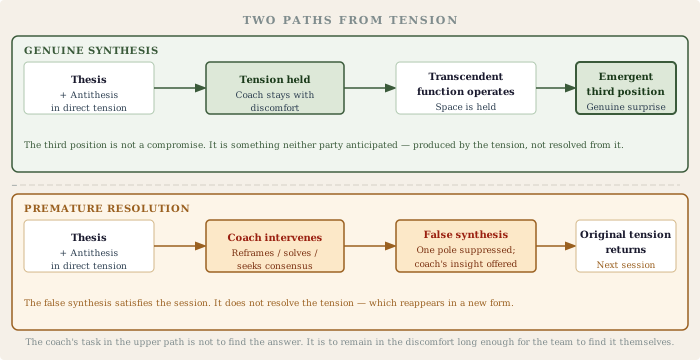
What the coach has been doing, in good faith and with real skill, is preventing the transcendent function from operating. The resolution the group keeps reaching is not a synthesis. It is an escape from the tension that synthesis requires. Understanding the difference — and understanding why coaches so reliably interrupt the process at the moment it matters most — is the subject of this article.
What the transcendent function actually is
Jung introduced the transcendent function in a 1916 paper that was not published until 1957. The concept is easily misread: "transcendent" does not mean elevated or spiritual. It refers to the function's capacity to transcend — to cross — the opposition between two incompatible positions. The transcendent function is the psyche's capacity to generate a third position that is not a compromise between the two but something genuinely new: something that could not have been produced by either position alone, and that carries elements of both without being reducible to either.
The mechanism requires a specific condition: the two positions must be held simultaneously, in genuine tension, without premature resolution. The third position does not emerge from debate, from finding the halfway point, from rational synthesis. It emerges from the tension itself — from what becomes possible when neither pole is abandoned and neither dominates. This is what Keats called negative capability: the capacity to remain in uncertainty and doubt without any irritable reaching after fact and reason.
In Bion's language, what is being held in this tension is "O" — the formless ground of experience that has not yet been metabolised into thought, interpretation, or action. The transcendent function operates in the space where O is allowed to remain O long enough that something new can form within it. The coach who moves too quickly from O toward understanding has closed the space before the function could work.
Applied to team coaching, the transcendent function is the capacity of a team — held in genuine tension between two incompatible positions — to generate an insight, a reframing, a new way of seeing the problem that neither position could have produced independently. This emergent third is typically marked by a quality of surprise: neither party recognises it as their position, yet both recognise it as more adequate than either. The team experiences it as discovery rather than decision.
How coaching practice systematically prevents it
Coaching training produces reliable interventions for reducing discomfort. Reframing, facilitated consensus-building, normalising difficulty, problem-solving — all of these are genuine skills, and all of them are applied, reflexively, at the moment when they are most counterproductive.
The moment in question is the moment of genuine tension — when two positions are in direct contact, neither yielding, and the group is holding something that has not yet resolved. This moment feels, to the coach trained in conflict facilitation, like the moment to intervene. The silence is uncomfortable. The energy is charged. The group appears stuck. The coach's training says: this is when I help them find the way through.
But the "way through" that coaching interventions typically produce is not a passage to the third position. It is a premature exit from the tension that would have generated it. The coach who reframes the conflict — "what if this is less about quality versus pace and more about how we communicate trade-offs?" — has offered a new frame that reduces the tension without the team having done the work of sitting with the original incompatibility. The new frame is the coach's synthesis, not the team's. And the team's capacity to generate its own synthesis — which is what the transcendent function produces — has been bypassed.
The coaching field's bias toward action compounds this. A session that ends with insights is rated as productive. A session that ends with the team sitting with an unresolved incompatibility feels unsuccessful — and the coach who allowed it to end that way may feel they have failed at their job. This pressure is not incidental. It shapes, systematically, the point at which coaches intervene, and that point is typically too early.
Five premature resolutions — and what each forecloses
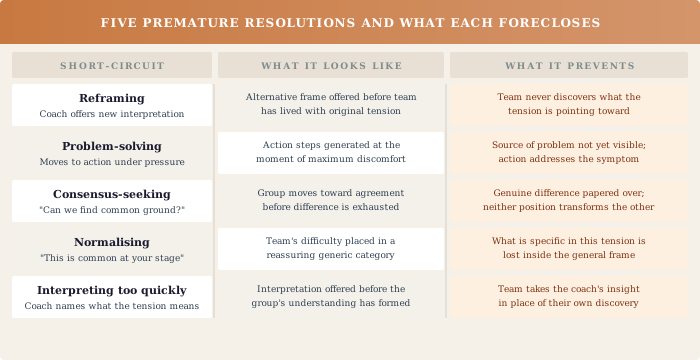
Each of the standard coaching interventions for managing tension has a specific way of short-circuiting the transcendent function. Understanding the mechanism helps distinguish between interventions that hold the tension and those that prematurely resolve it.
Reframing offers an alternative interpretation before the team has lived with the tension long enough to discover what it is pointing toward. The reframe is intellectually coherent and often genuinely helpful — but it is the coach's insight, not the team's, and it arrives before the team has done the work that would make the insight discoverable from inside their own experience.
Problem-solving moves to action at the moment of maximum discomfort. The problem-solving move is: here is something concrete we can try. It produces forward motion and a sense of agency, which is exactly what the group wants. What it prevents is the attention to what the tension itself is revealing — the source of the problem that the action will not address, because it has not yet been seen.
Consensus-seeking asks whether the group can find common ground — and in doing so, signals that the goal is the reduction of difference rather than the working-through of it. Genuine difference that could have transformed both positions is papered over. Each party retains their position privately while performing agreement publicly, and the tension re-emerges in the next session in a slightly different form.
Normalising tells the group that what they are experiencing is common at their stage of development. This is often true, and the normalisation is kindly intended. It prevents the group from attending to what is specific in their difficulty — the particular form this tension has taken, which contains information about this team's specific history and condition. The generic frame absorbs the specific signal.
Interpreting too quickly names what the tension means before it has had time to work on the group. The interpretation may be accurate. Offered prematurely, it becomes an object the group can engage with instead of sitting with the experience that would have produced their own understanding. They take the coach's insight in place of the insight the tension was developing.
What holding the tension requires of the coach
The coach who wants to support the transcendent function rather than interrupt it needs to develop a specific tolerance for sitting with a group in unresolved tension — without the impulse to help by resolving it. This is a developmental requirement, not a skill that can be learned through technique. The coach who is activated by group discomfort will intervene reflexively regardless of what their training says about holding space. Their own anxiety about the group's state will drive the move.
Practically, this means learning to distinguish between different qualities of silence and tension: the unproductive silence that signals the group has given up or shut down, and the full silence that signals something is forming. The first calls for facilitation. The second calls for the coach to stay out of the way. The distinction is felt, not derived — it is part of the somatic literacy that experienced coaches develop and cannot fully articulate as rules.
It also means that when the coach does intervene, the intervention is designed to deepen the tension rather than resolve it. Questions that place both positions more sharply in contact with each other: what happens when you take both of these as equally true? What are you each protecting, and what is that protection costing? What would it mean to give up neither? These are not rhetorical moves toward a predetermined synthesis. They are genuine questions that make the incompatibility more visible and therefore more available to work with.
The coach also needs to be willing for sessions to end unresolved. Some of the most important work happens in the hours and days after the group has held a genuine tension without resolution — when the transcendent function operates not in the session but in the space the session opened. The coach who insists on a takeaway from every session will close this space consistently and reliably.
When something new emerges — and how to recognise it
The emergence of a genuine third position has a particular quality that distinguishes it from the false syntheses that premature resolution produces. It arrives with a quality of surprise — often followed immediately by a sense of obviousness, as if the group had known this all along but had not had the language for it. Neither party recognises it as a victory. Both recognise it as adequate in a way that their original positions were not.
The energy in the room changes. The quality of attention shifts from defensive alertness — each party tracking the other's moves — to something more open and forward-looking. The conversation that follows is qualitatively different from the conversation that preceded the tension: it is generated from the new position rather than negotiated between the old ones. People speak faster, more fluidly, without the careful qualification that characterised the earlier exchanges.
The coach's role at this moment is minimal. The temptation is to explain what happened — to offer the frame of the transcendent function, to help the group understand the mechanism that produced the insight. This is rarely useful and sometimes harmful. The insight is fresh and fragile. Explanation can turn it into an intellectual object before the group has had time to inhabit it. The coach who can stay quiet — who can let the new thing be new without immediately installing it in a framework — protects the space the transcendent function has just opened.
What the coach can do, and what is genuinely useful, is notice aloud that something has shifted — without explaining the mechanism. Not "this is the transcendent function at work" but "something just changed here." The observation holds the moment without collapsing it. It allows the group to register what happened without reducing it to a technique or a concept. The team that has genuinely discovered something — rather than been shown it — has a different relationship to what it found. That relationship is the point.
Continue Exploring
Go deeper into the work
The Book
The Art of Creating Self-Organizing Teams
The full framework behind this article — contracting, team dynamics, and practical coaching tools for every stage of the journey.
Companion Toolkit
Resistance Radar & Resilience Scorecard
Practical tools for mapping resistance patterns and measuring whether interventions increased capacity — not just compliance.
TA for Agile
Co-creative TA in Agile Contexts
Ego states, psychological contracts, group imago, and the relational concepts that underpin this article — applied to real teams.