The Turbulent Field: Why Teams Cannot Save Themselves from Their Environment
Fred Emery and Eric Trist identified a category of environment they called the turbulent field: a context in which the sources of disturbance cannot be traced to specific causes, solutions become outdated before they can be implemented, and the interactions between organisations in the field produce unpredictable consequences for all of them. Agile teams live in exactly this kind of field. And Emery and Trist's conclusion was stark: individual organisations cannot adapt to turbulent fields alone. The team that is coached in isolation while its environment remains unaddressed is being asked to stabilise something the environment is continuously destabilising.
The team that kept reverting between sessions
The coaching sessions were producing something. The coach could see it: clearer conversations, more direct feedback, a retrospective that was actually surfacing real issues. And then, between sessions, the environment would move. A budget cycle decision would reorder priorities mid-sprint. A leadership change would redefine who the team reported to. A platform migration announcement would make two months of architecture decisions obsolete. A re-organisation in a neighbouring department would alter the team's stakeholder landscape overnight.
The coach increased frequency. The team improved in sessions and reverted between them. The coach increased structure, adding check-ins and follow-up. The reversion accelerated. The coach began to wonder what she was missing about the team — what psychological or relational dynamic was making the change so difficult to hold. She was missing the right question. The question was not about the team. It was about the environment the team was embedded in, and whether the environment was compatible with the kind of stability that coaching was trying to build.
Emery and Trist's four causal textures
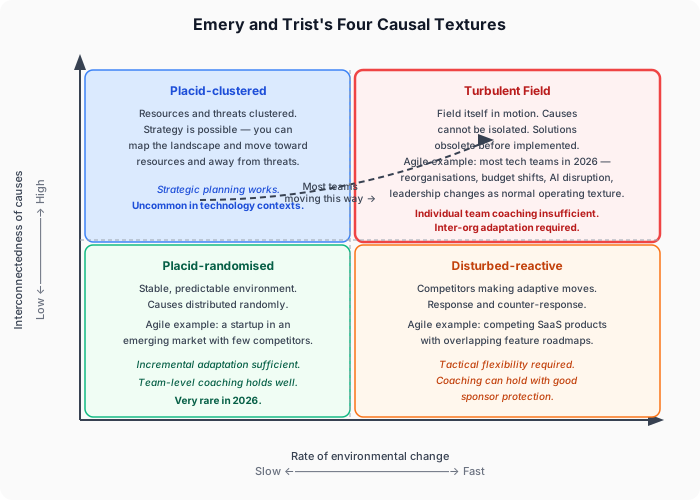
Fred Emery and Eric Trist published a paper in 1965 that introduced a typology of organisational environments they called causal textures. The term is unfamiliar but the concept is precise: causal texture describes the pattern of causes operating in the environment — how predictable, how interconnected, how fast-moving, and how amenable to the organisation's adaptive strategies.
They identified four types. The placid-randomised environment is stable and predictable — causes are distributed randomly and do not cluster. The organisation can learn from prior experience and adapt incrementally. The placid-clustered environment has resources and threats clustered in predictable locations — strategy is possible. The disturbed-reactive environment has competitors: other organisations are making adaptive moves that the focal organisation must respond to. The fourth type — the turbulent field — is categorically different from the other three.
In a turbulent field, the sources of disturbance cannot be traced to specific causes. The field itself is in motion — the interactions between organisations and their environments produce unpredictable consequences that cascade through the whole. Solutions that work in one cycle become obsolete before they can be implemented in the next. The rate of environmental change exceeds the organisation's capacity to adapt to it. The organisation is not dealing with a difficult problem in a stable environment. It is dealing with an environment that is continuously generating new problems faster than existing ones can be resolved.
The turbulent field in 2026
Emery and Trist were writing about the world in 1965. Their description of the turbulent field was a warning about a kind of environment that was just beginning to emerge in large multinational organisations. They were, sixty years later, describing the normal operational context of Agile teams in technology companies.
Reorganisations every six to eighteen months, not as exceptional events but as normal management cadence. Budget cycles that override team plans regardless of sprint commitments. Leadership changes that redefine team purpose before the previous definition has been implemented. AI capability shifts that make last quarter's architecture decisions obsolete. Platform migrations announced before the current migration is complete. These are not turbulent conditions — they are the texture of the field. The team did not encounter an unusually difficult period. It operates in an environment whose causal texture is permanently turbulent.
Why individual team coaching is insufficient
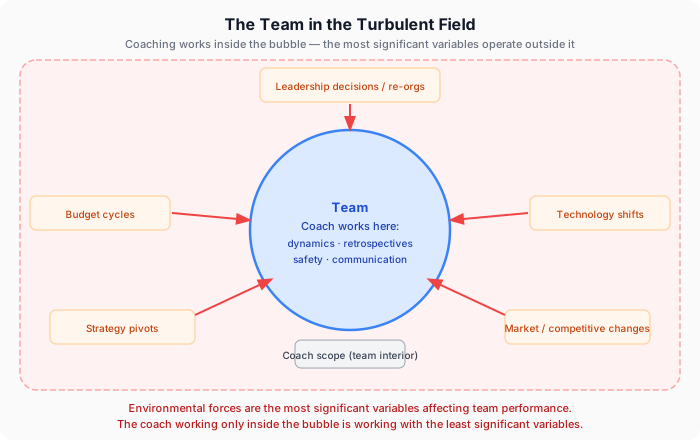
In a turbulent field, the environment produces disturbances faster than any team can adapt to them. The team's improved internal functioning — better retrospectives, clearer communication, more honest conflict resolution — is a real improvement. It is also continuously being overridden by environmental inputs the team cannot control. The coach who works with the team in isolation is building capacity in a container that the environment is continuously destabilising.
This is not a team resilience problem that more coaching can solve. A team cannot be coached to the level of internal stability that would absorb an organisational re-structure, a budget cut, a leadership change, and a strategy pivot in the same quarter — because no level of internal stability can absorb those inputs while maintaining continuity of purpose. The inputs are not challenges to the team's resilience. They are challenges to the team's existence as a coherent unit.
Emery and Trist's conclusion from the turbulent field research was stark: individual organisations cannot adapt to turbulent fields alone. Adaptation requires inter-organisational collaboration — the development of shared domain-level adaptive strategies that reduce the environmental turbulence for all participants. Applied to Agile coaching: the team coach who works only with the team is working at the wrong scale.
What coaches can do in a turbulent field
Map the team's field, not just the team. The diagnostic for turbulent field conditions is environmental, not team-internal. What is the reorganisation history of this team over the past three years? What is the rate of leadership change? What is the budget cycle impact on team continuity? How much of the team's planning horizon is affected by external decisions they cannot control? These questions reveal whether the coach is working in a turbulent field condition before investing team-level interventions that the field will neutralise.
Work with the sponsor on environmental conditions, not just team dynamics. The sponsor conversation that matters in a turbulent field is not about team health. It is about what environmental stability the sponsor can provide or protect for the team — a commitment to not reorganising the team mid-quarter, a decision to shield the team from a particular class of external disruption, a clarity about the team's purpose that will not change regardless of the surrounding turbulence. These are the sponsor interventions that create the conditions in which team-level coaching can actually hold.
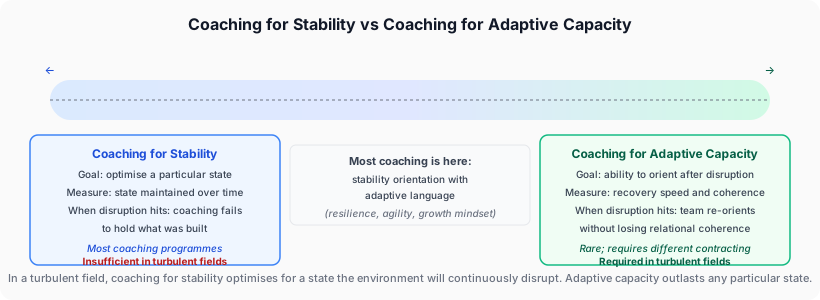
Develop adaptive capacity rather than stabilising a particular state. In a turbulent field, coaching for a particular state — a specific level of psychological safety, a specific team dynamic, a specific way of running retrospectives — is coaching for a state the environment will inevitably disrupt. The more durable coaching goal is adaptive capacity: the team's ability to orient quickly to environmental changes, to maintain enough relational coherence to function through disruption, to not lose themselves entirely when the ground shifts. This is a different coaching agenda from stabilising a particular state.
Contracting implications
The coach who has identified turbulent field conditions needs to be honest with the sponsor about what team-level coaching can and cannot do. A coaching engagement contracted to "improve team performance" in a turbulent field condition will produce measurable improvement in sessions and visible reversion between them — and the coach will be evaluated against performance metrics that the environment is continuously disrupting.
The more honest contract names what the coach's scope actually includes: the team's internal dynamics, the quality of its relational functioning, its capacity to manage what it can manage. And what it explicitly does not include: the reorganisation decisions, the budget cycles, the leadership changes, and the strategy pivots that are the most significant variables affecting team performance. The sponsor who contracts for team performance improvement needs to understand that they are one of the most significant variables the coach cannot work with.
Coaching in denial
Emery and Trist wrote that individual organisations could not adapt to turbulent fields through internal optimisation alone. The team cannot save itself from its environment by developing better internal functioning. The coaching that pretends otherwise — that frames environmental turbulence as a team resilience challenge, that responds to field-generated disruption with more team development, that measures itself against outcomes the field is continuously disrupting — is coaching in denial.
This is not an argument against team coaching. It is an argument for team coaching that is honest about the field it is operating in, contracted appropriately for what it can influence, and working at the right scale for the problem it is trying to address.
The turbulent field is not a temporary condition to be managed while coaching returns the team to stability. It is the environment in which Agile teams now operate. Coaching that does not account for it will keep producing insights that dissolve between sessions, measuring outcomes that the environment determines, and puzzling over why the team keeps reverting despite apparently excellent coaching work.
Continue Exploring
Go deeper into the work
The Book
The Art of Creating Self-Organizing Teams
The full framework behind this article — contracting, team dynamics, and practical coaching tools for every stage of the journey.
Companion Toolkit
Resistance Radar & Resilience Scorecard
Practical tools for mapping resistance patterns and measuring whether interventions increased capacity — not just compliance.
TA for Agile
Co-creative TA in Agile Contexts
Ego states, psychological contracts, group imago, and the relational concepts that underpin this article — applied to real teams.