The Type the Framework Forgot
Agile ceremonies were designed by and for extroverted thinking types. The standup, the planning session, the retrospective — each carries a cognitive bias that structurally favours rapid public verbal exchange, logical categorisation, and concrete task-orientation. Introversion, feeling, sensing, and intuition encounter hostile conditions in every standard ceremony. The result is not resistance or low engagement. It is a systematic loss of cognitive diversity that no amount of psychological safety can address.
The planning session that three people experienced differently
The sprint planning session ran for two hours. The product owner walked through the backlog. The team estimated, debated, and committed. The facilitator was competent. The format was standard. At the end, the team lead — quick to speak, energised by the discussion, clear on what had been decided — said it had been productive.
The senior developer who had said almost nothing across the two hours did not think it had been productive. She had formed her assessments privately during the session, could see two significant estimation errors in what the team had committed to, and had not been able to surface them in the rapid back-and-forth of the public discussion. She left the room with the sense that the commitments were wrong and that she had not been heard, even though nobody had prevented her from speaking.
The UX designer experienced something different again: the abstract story descriptions had felt disconnected from anything he could concretely test or validate. He had found the acceptance criteria premature. He had left with a vague sense of unease about what was being built and a more specific sense that he hadn't been equipped to contribute in a way that mattered.
Three people, one session, three genuinely different experiences — not because of interpersonal conflict or different levels of engagement, but because the session was designed for one cognitive type and had inadvertently treated the others as slower or less capable versions of the same thing. Jung's typological theory explains what was happening and what the coach can do about it.
Jung's type theory — what the original framework actually says
Jung's Psychological Types, published in 1921, was not a personality categorisation system in the sense that subsequent popularisations made it. It was an investigation into the irreducible differences in how human beings orient to the world — differences that Jung observed were not deficits or failures of development but genuine structural variations in how the psyche engages with experience.
The framework identifies two orientations — extraversion and introversion — and four functions: thinking, feeling, sensing, and intuition. Extraversion is characterised by orientation toward the object — the external world of people, events, and action. Introversion is characterised by orientation toward the subject — the inner world of reflection, image, and processing. These are not sociability preferences. They are descriptions of where psychic energy naturally flows: outward or inward.
The four functions describe how the psyche engages with the world once oriented. Thinking evaluates through logic and principle. Feeling evaluates through value and relational significance. Sensing perceives through concrete, immediate, factual experience. Intuition perceives through pattern, possibility, and meaning that exceeds the immediate data. Each function is present in each person, but one is typically dominant, one auxiliary, and the others less developed — including one that is significantly inferior and therefore prone to archaic, undeveloped expression when activated.
The Myers-Briggs Type Indicator made this framework widely known, but in doing so simplified it significantly: the four-letter categories became personality labels, the dynamic tension between functions was lost, and the inferior function — the most interesting and most clinically significant element of Jung's theory — largely disappeared. What follows stays with Jung's original framework, not the popularised version.
The extroverted thinking bias of Agile ceremonies
Agile ceremonies were designed by a community of people who built software for a living in the late 1990s and early 2000s. Without speculating about individual types, the practices they developed show a consistent structural preference: rapid verbal exchange, public expression of work state, immediate feedback loops, concrete outputs within short timeframes. This is a cognitively specific environment.
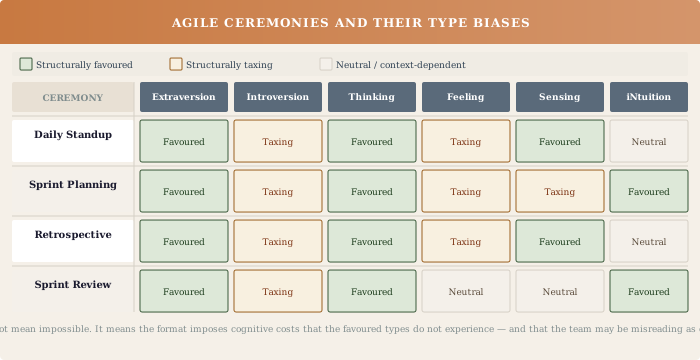
The daily standup structurally favours extraversion: it asks people to formulate and deliver their update in public, in real-time, in a fast-moving group setting. The thinking-function is preferred: the expected format is logical status reporting (yesterday/today/impediments), not evaluation of relational or emotional significance. Sensing is preferred over intuition: the good standup answer is concrete and grounded in verifiable fact, not possibility or pattern.
Sprint planning similarly privileges extroverted thinking: public estimation in a group discussion, rapid convergence on numbers, acceptance criteria as logical conditions. The format is hostile to the introverted type's natural processing tempo, to the feeling type's relational evaluation of story significance, and to the sensing type who finds abstract user stories disconnected from the concrete reality of implementation.
Retrospectives, ostensibly designed for psychological openness, carry their own biases: the sticky-note and clustering format is concrete and categorising (sensing-thinking), the expectation of public ownership of issues is extrovert-friendly, and the emphasis on actionable outputs privileges thinking over feeling in evaluating what matters and what should be addressed. The feeling type whose primary concern is relational — how did the sprint affect our relationships, what are we doing to each other — consistently finds their input treated as peripheral to the "real" conversation about process and metrics.
None of this is deliberate. It is the structural consequence of ceremonies designed by and for a particular cognitive profile becoming universal requirements for teams whose members span the full type range.
What introversion costs in a standup culture
Introversion is not shyness. It is a genuine structural difference in how cognition processes information: the introverted type produces its best thinking after processing internally, not during public exchange. The standup format — brief, public, real-time — asks the introverted type to do the opposite of what their cognition naturally does.
The observable consequence is familiar: the introverted team member whose standup update is thin, vague, or generic, not because they have nothing to say but because they have not had the conditions in which their actual thinking becomes accessible. The senior developer in the opening scenario had formed her estimates during the planning session — but internally, and more thoroughly than her extroverted colleagues. The format prevented those estimates from entering the room.
Over time, the cost compounds. The introverted team member learns to produce an adequate performance of participation — enough to satisfy the ceremony's requirements — while the actual quality of their thinking remains inaccessible to the team. The team loses access to a thinking resource it formally includes but structurally excludes.
The coach who diagnoses this as "low engagement" or "lack of psychological safety" has correctly observed the symptom and misread the cause. Increasing safety interventions will not help the introverted type contribute in a format that structurally conflicts with how they think. The intervention that helps is structural: changing the conditions under which input is generated and shared.
Sensing, intuition, and the story-pointing problem
Story points are abstract units of effort or complexity. The intuitive type finds this natural — abstraction is their preferred mode of engagement, and the question of relative complexity can be answered without needing to specify every concrete step. The sensing type finds it alienating. For the sensing function, knowledge is concrete and present-based: what does this actually require, in specific, observable terms? Until that question can be answered, estimation feels false.
The typical planning session moves at the intuitive type's pace. Stories are presented at an abstract level, comparisons are made to previous work at a similarly abstract level, and estimation proceeds through a kind of gestalt assessment that the intuitive type manages comfortably. The sensing type either produces very different numbers — because they are doing something different when they estimate — or learns to follow the group consensus rather than trusting their own assessment.
The feeling type encounters a different problem in the planning ceremony: the evaluation of work significance is conducted through logical criteria (complexity, effort, value). The feeling function evaluates through relational and human significance — does this matter to the people it serves, does it align with what we are actually for? These evaluations are not illogical. They are differently grounded, and the planning session's format provides no channel for them.
Designing ceremonies that work for the full type range
The design principle is not to create separate ceremonies for different types. It is to modify existing ceremonies so that they create genuine participation conditions for the full range of cognitive preferences without compromising the ceremony's purpose. Most of the adaptations are small and inexpensive. The cost is in the facilitator's willingness to design beyond their own type preference.
For the introvert in the standup: written asynchronous input before the verbal exchange. Even a short shared document where people post their status before the standup begins means the introverted type has already processed and formulated before the verbal ceremony starts. The spoken standup becomes a reference to something already formed rather than a demand for real-time thinking-out-loud.
For the feeling type in the retrospective: an explicit opening that asks not "what went wrong" but "how was this sprint for you?" before moving to the process-level analysis. The feeling type's evaluation of relational significance — what this work has cost us, what it has given us, how we have treated each other — becomes legitimate input into the retrospective rather than material that has to be translated into process-language before it can be heard.
For the sensing type in planning: concrete examples, prototypes, or specific acceptance criteria before abstract estimation. The sensing function can engage with "here is what this would look like in the interface" or "here is the specific error condition we are handling" in a way that "a user story about preference management" does not allow.
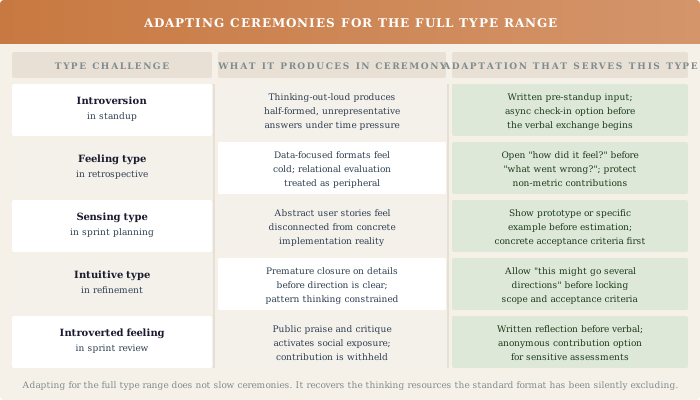
What the coach can offer here is twofold: a diagnosis that distinguishes type-based exclusion from engagement failure or psychological safety deficit, and a set of facilitation adaptations that are grounded in structural understanding rather than generic advice.
The team that includes people across the full type range has more cognitive diversity than it knows how to access. The ceremonies, designed for one type, have been losing most of that diversity in every session. Redesigning for the full range does not produce more comfortable meetings. It produces meetings in which the team thinks better — because the thinking resources it formally includes are finally allowed to operate.
Continue Exploring
Go deeper into the work
The Book
The Art of Creating Self-Organizing Teams
The full framework behind this article — contracting, team dynamics, and practical coaching tools for every stage of the journey.
Companion Toolkit
Resistance Radar & Resilience Scorecard
Practical tools for mapping resistance patterns and measuring whether interventions increased capacity — not just compliance.
TA for Agile
Co-creative TA in Agile Contexts
Ego states, psychological contracts, group imago, and the relational concepts that underpin this article — applied to real teams.