The Under-Bounded Team: What Organisational Transition Actually Does to a Group
When organisations impose significant change — restructuring, transformation, leadership replacement, strategy shifts — the affected teams become under-bounded: their role definitions blur, decision rights dissolve, relationships to authority become unclear, and identity becomes unstable. This is not resistance in the ordinary sense. It is what happens to any system when its boundaries are threatened. The symptom set of an under-bounded team is specific and recognisable, and it has a distinct intervention logic that is different from resistance coaching, basic assumption work, or psychological safety repair.
The team that started escalating everything
Six weeks into an announced Agile transformation, the team was running its ceremonies. The sprint board was populated. Stories were being groomed. The Scrum Master was facilitating standups. On the surface, the process was working.
But something had changed in the texture of the team's behaviour. Decisions that used to resolve in a ten-minute conversation between two engineers were now taking a week and going to the department head. Conflict that used to settle between the people involved was now involving three or four people and generating email threads. The retrospective was producing unusual amounts of honest feedback — more than usual, far less qualified — about management decisions that had not previously been the retrospective's subject. The coach's first read was: low psychological safety. But that didn't fit. The team was speaking quite openly. The coach's second read was: resistance to the transformation. But the team wasn't resistant to Agile. The coach's third read was closer: the team's role boundaries had dissolved and nobody had told them who had authority to decide what.
Bounded and under-bounded systems
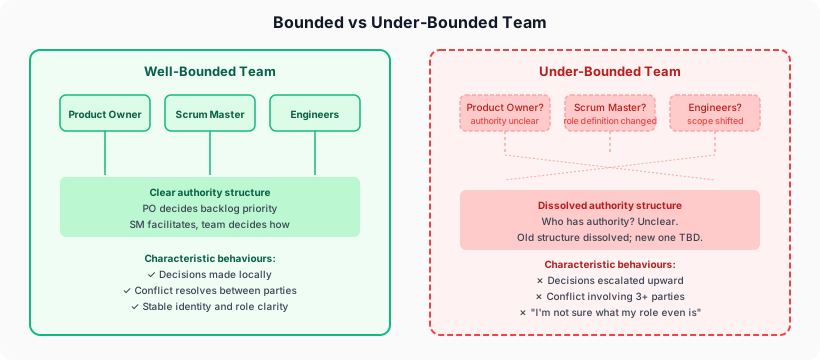
Systems psychodynamics uses the concept of boundary with precision: the boundary of a system is what distinguishes it from its environment, defines what belongs inside and what belongs outside, and provides the structural conditions for members to act within defined roles with defined authority.
A well-bounded system provides predictability. Team members know their roles, understand who has authority to decide what, can orient their actions relative to a stable definition of what the team is for. This predictability is not bureaucratic — it is the structural precondition for confident action. You cannot self-organise effectively if you don't know the boundary of what you are authorised to organise.
An under-bounded system is one in which the boundary structures have become permeable or have dissolved. Role definitions are unclear. Decision rights are ambiguous. The relationship between team members and authority is uncertain. Identity is unstable — "what kind of team are we?" no longer has a clear answer. This state is distinct from a team that lacks psychological safety or a team that is in conflict or a team that is resisting change. It is a structural condition produced by boundary dissolution.
How transition creates under-bounded conditions
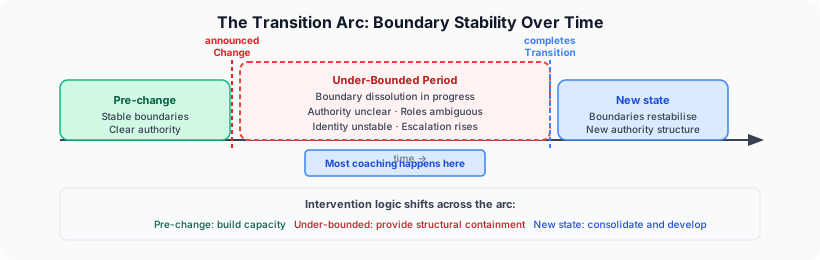
Organisational transitions — Agile transformations, restructuring, leadership replacement, strategy shifts — create under-bounded conditions through a specific mechanism: they dissolve existing authority structures before new ones are established. The announcement of change is the moment of dissolution. The completion of the transition is the moment of restabilisation. The interval between them is the period of maximum under-bounded condition — and it is precisely the period during which coaching most often operates.
An Agile transformation announcement does several things simultaneously. It tells the team that the existing hierarchy is no longer the primary authority structure — Agile is. It tells the team that the Scrum Master has new authority — but does not specify what the boundaries of that authority are relative to the engineering manager. It tells the team that they should self-organise — but does not specify what they are authorised to organise and what remains in management's domain. It tells the team that the product owner has authority over the backlog — but does not specify what happens when that authority conflicts with technical decisions that were previously the engineering manager's.
The team is left with the old authority structure dissolved and the new one not yet established. This is the under-bounded condition. It is not a failure of Agile implementation. It is what happens to any system when its boundaries are deliberately changed.
The under-bounded symptom set
The symptom set of an under-bounded team is specific and recognisable, once you know what you are looking for. Each symptom is a rational response to boundary dissolution — which is why treating these symptoms with the wrong intervention produces confusion and sometimes makes them worse.
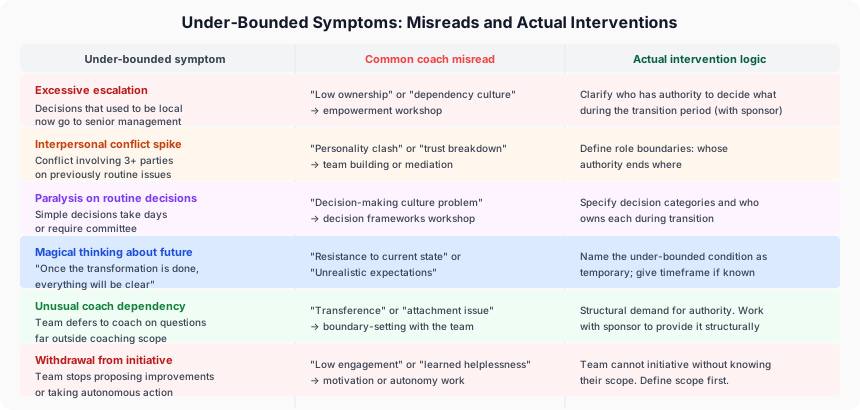
Excessive escalation. When role boundaries are unclear, nobody is certain whether they have the authority to make a decision. The rational response to this uncertainty is to escalate — to seek the authorisation that the boundary structure no longer provides. A team that is escalating decisions that used to resolve locally is not failing to self-organise. It is responding correctly to the absence of the boundary conditions that self-organisation requires.
Increased interpersonal conflict. When roles are ambiguous, the same action can be legitimate (within my role) or a boundary violation (outside my authority). Conflict that appears interpersonal — two people disagreeing about who should make a decision — is often structural: both parties are operating at the edge of an authority boundary that has not been defined. They are not the problem. The undefined boundary is the problem.
Paralysis on routine decisions. The previously routine decision has become fraught because the rule that made it routine — the role-based authority that previously resolved it — no longer operates. The team is not slow or avoidant. It is operating without the structural conditions that make fast, confident decision-making possible.
Magical thinking about the future state. The under-bounded condition is psychologically intolerable as a permanent state. When it cannot be resolved structurally, it is often resolved cognitively through idealisation of the future: "once the transformation is complete, everything will be clear." This magical thinking is not delusion — it is a coping mechanism for the present uncertainty, and it can be functional as long as it does not prevent necessary interim action.
Unusual dependency on the coach. In the absence of clear structural authority, the team seeks authority wherever it can find it. The coach who is present and confident and who appears to know what the new way of working looks like may receive more authority than they expected or than is appropriate to their role. This is not transference in the psychoanalytic sense — it is a structural demand for containment that the boundary dissolution has created.
What coaches typically do wrong
The coach who reads under-bounded behaviour as low psychological safety responds with psychological safety work — facilitated workshops, safety surveys, working agreements. These do not address the structural condition and may temporarily worsen it by adding more relational material to a system that is already overwhelmed by structural uncertainty.
The coach who reads under-bounded behaviour as resistance responds with change management approaches — stakeholder engagement, communication strategies, vision alignment. These also miss the structural condition. The team is not resistant. It is structurally disoriented.
The coach who reads under-bounded behaviour as team dysfunction responds with team development work — retrospectives, working agreements, relationship-building. This is not harmful but it is inefficient. The most sophisticated relational development work will not restore the structural conditions the team is missing.
The intervention logic for under-bounded teams
The intervention logic for under-bounded teams is structural rather than relational. The team needs provisional boundary restoration — not the permanent new structure (which may not yet be designed), but a clear enough temporary structure to function during the transition. Specifically: who has authority to decide what, for the duration of this transition; what the team's purpose is in the interim; and what is guaranteed to remain stable while everything else changes.
These provisions are structural and sponsor-dependent. The coach cannot provide them alone — they require authority decisions from the people who have the authority to make them. The coach's role is to diagnose the under-bounded condition, name it to the sponsor in terms that make the structural nature of the problem clear, and work with the sponsor to establish the provisional structure that will allow the team to function during the transition.
Three moves
Diagnose under-bounded versus other dynamics. The diagnostic question is: has the team's boundary structure recently changed or been threatened? If yes, and if the symptom set matches — escalation, paralysis, conflict, magical thinking, unusual dependency — the working hypothesis is under-bounded condition. This is a different hypothesis from low safety, resistance, or conflict, and it points to a different intervention.
Work with the sponsor to establish provisional structure. The sponsor conversation is the primary intervention. Who has authority to decide X, Y, Z during the transition? What is the team's purpose for the next three months? What will not change regardless of how the transformation unfands? Getting provisional answers to these questions — even imperfect ones — gives the team enough structural orientation to function.
Provide explicit containment until the boundaries restabilise. In the interim, the coach can provide a limited form of the structural clarity the system is missing: explicit naming of the transition period as a temporary state, an orientation to what is known and what is not, a regular space (not a ceremony) in which the team can bring uncertainty and receive acknowledgement that the uncertainty is structural rather than their failure. This is containment work — different from psychological safety work in that it is explicitly temporary and explicitly structural.
The system is not dysfunctional
Under-bounded behaviour is rational. The team that is escalating everything, that is paralysed on routine decisions, that is producing unusual amounts of conflict and unusual amounts of openness and unusual dependency on the coach — this team is not dysfunctional. It is responding exactly as any system responds when its boundary structures dissolve. Every symptom in the under-bounded symptom set is the rational behaviour of a system that is trying to function without the structural conditions that functioning requires.
The coach who names this — who can say to the team "you're not resistant and you're not dysfunctional, you are operating in a transition without clear structural conditions, and here is what that looks like and here is what we need to do about it" — does more in one conversation than six months of psychological safety work on a team that is under-bounded.
Continue Exploring
Go deeper into the work
The Book
The Art of Creating Self-Organizing Teams
The full framework behind this article — contracting, team dynamics, and practical coaching tools for every stage of the journey.
Companion Toolkit
Resistance Radar & Resilience Scorecard
Practical tools for mapping resistance patterns and measuring whether interventions increased capacity — not just compliance.
TA for Agile
Co-creative TA in Agile Contexts
Ego states, psychological contracts, group imago, and the relational concepts that underpin this article — applied to real teams.