The Wound That Works: Why the Coach's History Is Always in the Room
Coaches do not arrive at the team system as blank instruments. They arrive carrying their own developmental history — their own experiences of authority, belonging, failure, and transition. These are actively recruited by the team's dynamics. The Jungian wounded healer concept offers something more useful than 'know your triggers': the coach's wound is also the source of their developmental authority. But only if it is examined. Supervision is not professional development — it is the technical mechanism that keeps the coach's history from running the session.
The myth of the blank instrument
There is an assumption that runs through most Agile coaching training, sometimes explicitly stated and more often implicit: that the competent coach arrives at the team system as a neutral presence. They have their frameworks. They have their toolkit. They apply these to the team's situation with professional detachment. Their personal history is irrelevant to the work. What matters is their skill.
This is not what happens. A coach who spent their early career under punishing management will not be neutral in the presence of a sponsor who exercises authority abrasively. Their history will be activated. They will experience something — protective anger, a pull toward advocacy for the team, a reluctance to challenge the sponsor that they may attribute to professional caution. A coach who learned early that uncertainty is dangerous will not be neutral in the presence of a team that sits with ambiguity too long. They will experience a pull toward resolution, a slight anxiety that manifests as encouragement to decide.
These are not failures of professionalism. They are the evidence of a functioning human being in a relational field. The question is not whether the coach's history is in the room. It is whether the coach knows it is there.
Jung's concept of the wounded healer — the archetypal pattern of the healer whose authority derives from their own wounds and the work of integrating them — offers something considerably more useful than the blank instrument myth. It does not ask coaches to be neutral. It asks them to know what they are carrying.
The wounded healer: what it actually means
The wounded healer archetype originates in Greek mythology — in the story of Chiron, the centaur who was the teacher of heroes and who could heal others but could not heal his own wound. Jung identified this as a fundamental pattern in the healer's relationship to their work: the healer's own wounds are not merely incidental to their capacity to help others. They are constitutive of it.
The logic is not sentimental. It is structural. A coach who has crossed difficult thresholds — who has experienced failure, worked through their own defensiveness, confronted the places where their early conditioning creates blind spots, and done the work of integrating rather than suppressing what they found — carries an authority that cannot be produced by skill development alone. They understand from the inside what it costs to change. They have been in the territory that the team is approaching.
This is why the most effective coaches in the most difficult situations are not always the most technically skilled ones. They are often the ones who have been through something analogous to what the team is experiencing — and who can hold the space of that experience with equanimity because they have already survived it. Their presence communicates something that no framework can: that it is survivable.
The crucial qualifier is "examined." The wound must be worked with, not simply carried. A coach who is unaware of their own wounds does not become the wounded healer. They become the wounded coach: someone who is running their own history in the room without knowing it, reproducing their own unresolved patterns in the teams they are supposed to be helping.
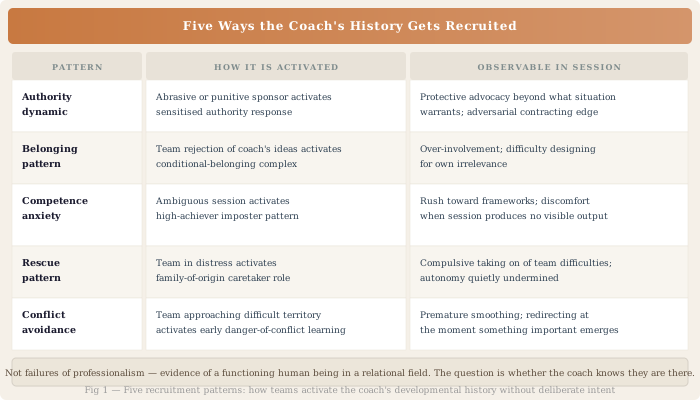
Five ways the coach's history gets recruited by teams
Teams do not recruit the coach's history deliberately. They do it through the natural operation of the relational field — through projective identification, transference, and the unconscious activation of patterns that resonate with the team's own dynamics. The coach whose history maps onto the team's current situation is particularly susceptible.
1. The authority dynamic
A coach who grew up in an environment of unpredictable or punitive authority will have a sensitised response to authority dynamics in the coaching context. In the presence of a sponsor who is even mildly abrasive, they may experience a protective impulse toward the team that goes beyond what the situation warrants — that is not a professional assessment of the team's needs but a personal response to the felt threat. Their contracting conversations with sponsors may have a slightly adversarial edge that they cannot fully explain. Their advocacy for team autonomy may be more vigorous than the team's own.
2. The belonging pattern
A coach who has a complex around belonging — whose early experience taught them that belonging is conditional or insecure — may be pulled toward over-involvement with teams in ways they experience as caring but that serve their own need. They may find it difficult to design for their own irrelevance because ending the engagement activates the belonging complex. They may experience team rejection of their ideas as personal rejection in a way that shapes their responses without their knowing it.
3. The competence anxiety
A coach who carries significant anxiety about their own competence — often a feature of high-achieving practitioners who attribute their success to luck rather than capability — may rush toward certainty in situations that warrant more sitting with ambiguity. They will reach for the framework before the team has had time to find its own formulation. They will feel an urgent need to demonstrate value in every session. They will be uncomfortable with the sessions where nothing concrete is produced and something important shifts.
4. The rescue pattern
The coach whose early history included caring for others — whose role in their family of origin was the one who managed others' distress — may compulsively take on the team's difficulties in ways that prevent the team from developing its own capacity to manage them. The rescue pattern is particularly dangerous in Agile coaching because it is so easily confused with helpfulness. The team experiences it as caring. The coach experiences it as fulfilling their role. The team's autonomy is quietly undermined throughout.
5. The conflict avoidance pattern
A coach for whom conflict was dangerous in early experience will have a systematic tendency to smooth over tensions that require holding rather than resolving. They will redirect conversations at the moment when the team is approaching something important and uncomfortable. They will produce a quality of ease in retrospectives that feels like safety but is actually the suppression of the material the retrospective needs to access.
The difference between self-awareness and examined history
Most coaching training addresses "self-awareness" — the capacity to notice one's own reactions, to name one's triggers, to manage one's emotional responses. This is useful but insufficient. Self-awareness in the moment is a skill. Examined history is a developmental condition.
Examined history means having worked, over time and with external support, on the patterns that one's developmental experience has produced. It means having developed a clear account of where one's sensitivities come from, how they are activated, and what they produce in practice. This is not the same as being able to name a trigger when it fires. It is the difference between recognising a symptom and understanding the condition.
A coach with examined history who enters a difficult authority dynamic does not simply notice their protective impulse. They can trace it to its source, assess how much of it belongs to the current situation and how much belongs to their own history, and make a more calibrated response. Their history is available to them as information rather than operating as an invisible driver.
Why supervision is a technical requirement of this work
Supervision in the Agile coaching field is typically positioned as continuing professional development — a useful practice for maintaining standards and developing capability. This framing misses the primary function of supervision in depth-oriented coaching work: it is the mechanism that keeps the coach's history from running the session.
The coach working with the transference matrix — using their own reactions as diagnostic data about the team system — cannot assess their own reactions without an external perspective. The countertransference that is most informative is also the most invisible from inside the experience. The coach who feels inexplicably irritated with a team member is in the worst possible position to determine whether that irritation belongs to the team's dynamics or to their own history. They need someone outside the field to help them make that distinction.
Supervision structured around countertransference analysis is different from case review. Case review asks: what happened, what did you do, was it effective? Countertransference supervision asks: what did you feel, where did that feeling come from, what does it tell you about the system, and what does it tell you about yourself? These are different questions. They require different skills in the supervisor and different willingness in the coach.
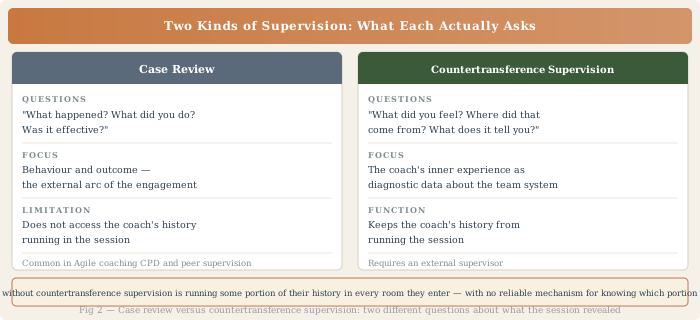
A coach who does not have regular countertransference supervision is working without one of the primary instruments of depth coaching practice. They may produce good results — they have their frameworks, their skills, and their genuine care for the teams they work with. But they are also systematically running some portion of their own history in the rooms they enter, and they have no reliable mechanism for knowing which portion or when.
The wound, examined, becomes the source of authority. The wound, unexamined, becomes the source of systematic error. The difference is not talent or commitment. It is whether the coach has found the external support that allows them to see what they cannot see from inside their own experience. This is not a luxury for particularly reflective practitioners. It is the technical infrastructure of the work.
Continue Exploring
Go deeper into the work
The Book
The Art of Creating Self-Organizing Teams
The full framework behind this article — contracting, team dynamics, and practical coaching tools for every stage of the journey.
Companion Toolkit
Resistance Radar & Resilience Scorecard
Practical tools for mapping resistance patterns and measuring whether interventions increased capacity — not just compliance.
TA for Agile
Co-creative TA in Agile Contexts
Ego states, psychological contracts, group imago, and the relational concepts that underpin this article — applied to real teams.