A Theory of Change for Coaching: Making Your Impact Visible Before Anyone Demands Proof
The field's inability to demonstrate coaching effectiveness is not primarily a measurement problem — it is a theory problem. Coaches who cannot articulate what mechanism they think will produce what outcome for which teams under which conditions cannot design evaluation, cannot recognise when they are succeeding, and cannot explain their work to sponsors asking for evidence. A theory of change for coaching is not an academic exercise. It is a practical specification that makes coaching work more intentional, more assessable, and significantly easier to defend when budgets tighten.
The question the coach could not answer
The sponsor's question was not hostile. It was not a challenge to the coaching's value. It was a genuine request for understanding: "Can you help me see how the coaching is connected to what's improving?" The coach had data. Team health scores were slightly up. Retrospective action item completion had improved. Velocity was stable. The coach presented these.
The sponsor looked at them carefully and said: "What does that tell us about the value of the coaching?" And the coach had no answer — not because the coaching had had no impact, but because they had never specified what mechanism they believed was operating. They had collected data about outputs without first articulating the causal chain that the outputs were supposed to reflect. The measurement had failed not because the metrics were wrong but because the theory was missing.
Why measurement fails without theory
The standard objection to coaching measurement is that you cannot isolate variables — there are too many confounding factors, too many things changing simultaneously, to demonstrate that the coaching caused any particular outcome. This objection is correct for randomised controlled trials. It is irrelevant to theory-based evaluation, which asks a different question entirely: did the mechanism we thought would produce change actually operate?
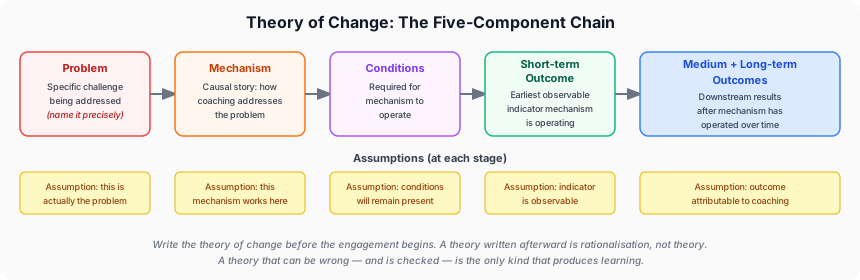
A theory of change is a specification of the causal story: this is the problem, this is the mechanism through which coaching will address it, these are the conditions required for the mechanism to operate, these are the short-, medium-, and long-term outcomes we expect if the mechanism is working, and these are the assumptions we are making. You can evaluate a mechanism without a control group. You cannot evaluate an absence of theory.
The field's credibility problem is not primarily a measurement problem. It is a theory problem. Coaches who cannot articulate what mechanism they think will produce what outcome for which teams under which conditions cannot design meaningful evaluation, cannot recognise when they are succeeding by the logic of their own work, and cannot explain their practice to people who need to understand it to fund it.
Three evaluation approaches from practice
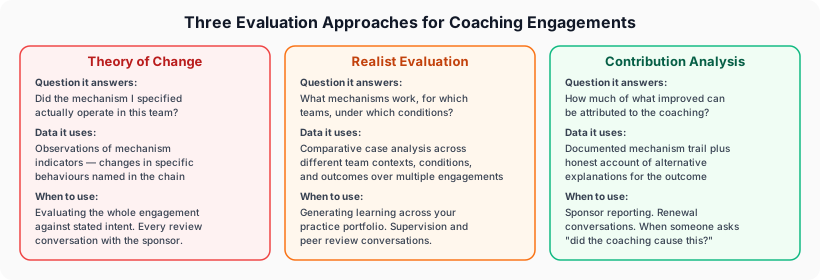
Theory of change. The causal chain approach: specifying the mechanism and the sequence of outcomes it should produce. Suitable for evaluation of the coaching engagement as a whole. The question it answers: "Is the mechanism I specified actually operating in this team?" The data it uses: observations of mechanism indicators (changes in interaction quality, changes in specific behaviours specified as early outcomes in the chain).
Realist evaluation. Developed by Ray Pawson and Nick Tilley; applied to coaching by asking: what mechanisms work, for which teams, under which conditions? Suitable for generating learning across multiple engagements. The question it answers: "Under what conditions does my coaching approach produce the outcomes it's designed for?" The data it uses: comparative case analysis across different team contexts, conditions, and outcomes.
Contribution analysis. Making the case for the coaching's contribution to observed changes without claiming exclusive causation. Suitable for sponsor reporting. The question it answers: "How much of what improved can be reasonably attributed to the coaching, given everything else that was operating?" The data it uses: a documented trail of mechanism operation and outcome observation, combined with an honest account of alternative explanations.
Building a theory of change for a coaching engagement
A theory of change for a coaching engagement has five components. The first is the problem or challenge being addressed — specifically, not generically. Not "the team has psychological safety issues" but "the team produces accurate signals about technical risk in private and inaccurate signals in ceremonies, which means decisions are being made on incomplete information." The specificity matters because it defines what the mechanism needs to address and what early indicators of success will look like.
The second is the mechanism — the causal story about how coaching will address the problem. Not "we will do retrospectives and working agreements" (that is a method list, not a mechanism) but "by providing a consistent relational container in which the team can approach difficult signals without the usual defensive structures, and by making the pattern of signal suppression visible to the team as a group dynamic rather than an individual behaviour, the team will develop the capacity to bring accurate information into ceremonies."
The third is the conditions required for the mechanism to operate. Most mechanisms have preconditions. The mechanism above requires that the sponsor does not punish accurate negative signals when they appear; it requires that the coaching have enough time in the sprint cycle to be present at the ceremonies where the suppression is happening; it requires that the team's workload not be so high that defensive structures are continuously activated. These conditions are either present or absent, and if absent, the mechanism cannot operate regardless of coaching quality.
The fourth is the sequence of outcomes: short-term (within two to four sprints), medium-term (within the engagement), and long-term (after coaching ends). Each outcome in the sequence should be a leading indicator for the next. The short-term outcome is not the same as the long-term goal; it is the earliest observable signal that the mechanism is operating.
The fifth is the assumptions being made. Every theory of change relies on assumptions that may not hold. Making them explicit converts them from hidden risks into assessed risks. The assumption that the sponsor will not punish accurate negative signals is an assumption worth naming. So is the assumption that the team's core membership will remain stable long enough for the mechanism to produce outcomes.
What to measure: leading indicators from the causal chain
Once the theory of change is specified, the measurement question becomes much more tractable. The question is not "has team health improved?" — that is an output at the end of the chain, and by the time it changes, the engagement may already be over. The question is: what is the earliest observable indicator that the mechanism is operating?
In the example above, the earliest indicator is whether accurate negative signals appear in ceremonies that previously suppressed them. This can be observed directly in the first two or three sprints, without waiting for downstream outcomes. If accurate signals are appearing, the mechanism is operating. If they are not, the theory needs revision — either the mechanism is wrong, or one of the required conditions is absent.
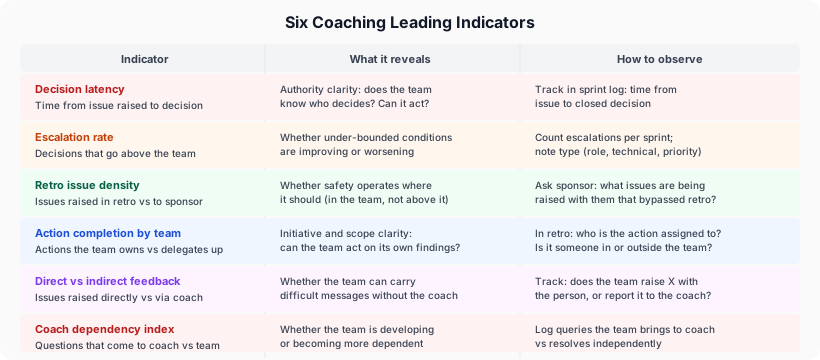
Other useful leading indicators, depending on the mechanism specified: decision latency (how long it takes the team to reach a decision, as an indicator of authority clarity); escalation rate (proportion of decisions that go above the team, as an indicator of under-bounded conditions improving or worsening); issues raised in retros versus issues raised to the sponsor outside retros (as an indicator of psychological safety operating where it should); time between a problem being identified and the team taking action on it (as an indicator of initiative and scope clarity).
Three moves
Write a one-page theory of change before the engagement begins. The discipline of writing it before beginning is the point. It forces the coach to commit to a mechanism rather than improvising one after the fact. A theory of change written after the engagement is a rationalisation, not a theory. It will naturally describe a mechanism that produced the outcomes that occurred. The pre-engagement version can be wrong, which is how it becomes useful.
Share it with the sponsor as part of contracting. The sponsor who understands the mechanism the coaching is trying to activate is a different sponsor than one who has signed off on a vague mandate to "improve team performance." The theory of change creates a shared language for evaluation: "We said the mechanism required the team to be shielded from stakeholder conflicts. That condition hasn't held. Let's talk about whether the engagement should continue on the current terms."
Use it in every review conversation. The theory of change is not a document produced at the start of the engagement and then filed. It is a reference point for every review. "Is the mechanism we specified actually operating? Are the leading indicators moving? Are the assumptions holding? If not — which assumption has failed, and what does that tell us about the theory?"
The difference between being wrong and not knowing
A coach without a theory of change is a practitioner who cannot say what they are doing or why. When the engagement produces good outcomes, they cannot explain what produced them. When it produces poor outcomes, they cannot learn from it, because they have no specified expectation against which to compare what happened.
A coach with a theory of change is a practitioner who can be wrong, learn from being wrong, revise the theory, and explain what they learned. The theory that correctly specified the mechanism in this engagement produces learning that can inform the next one. The theory that was wrong in this engagement reveals something about the conditions under which the mechanism operates. Both outcomes are useful. The field's credibility depends on more coaches being willing to be usefully wrong.
Continue Exploring
Go deeper into the work
The Book
The Art of Creating Self-Organizing Teams
The full framework behind this article — contracting, team dynamics, and practical coaching tools for every stage of the journey.
Companion Toolkit
Resistance Radar & Resilience Scorecard
Practical tools for mapping resistance patterns and measuring whether interventions increased capacity — not just compliance.
TA for Agile
Co-creative TA in Agile Contexts
Ego states, psychological contracts, group imago, and the relational concepts that underpin this article — applied to real teams.